

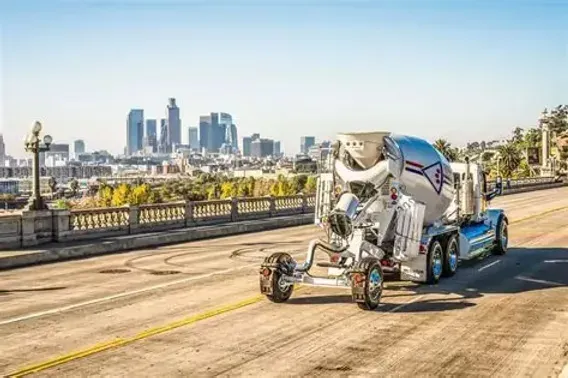
A ready-mix operation is a trucking business before it is anything else, and commercial auto is its dominant line. A fleet of loaded mixers moving concrete on public roads is a regulated motor carrier, which means it carries a USDOT number, answers to the Federal Motor Carrier Safety Administration and the U.S. Department of Transportation, and typically runs an auto liability policy carrying the MCS-90 federal endorsement. Understanding those pieces — and where the ISO covered-auto symbols pick up your owned, hired, and non-owned trucks — is how you read whether the policy actually fits the fleet.
This post walks through why a ready-mix fleet is treated as a motor carrier, what the USDOT number and the FMCSA framework mean, how interstate and intrastate operation differ, what the MCS-90 endorsement actually does, and how the covered-auto symbols match the policy to the trucks. The short version: the fleet is the business, commercial auto is where the federal rulebook lands, and the work your crews perform sits on a separate line.
Why a ready-mix fleet is a motor carrier first
A ready-mix operation does not own a few trucks as a convenience — the trucks are the operation. Concrete is mixed, loaded, and driven to the pour on a clock, and everything about the business runs on the fleet moving. That is what makes a ready-mix hauler a trucking company in the eyes of the federal system, and it is why the commercial-auto policy is not a supporting line here; it is the center of the program.
Loaded mixers are also among the heaviest vehicles on the road, carrying a liquid, high load whose center of gravity shifts as the drum turns. That combination makes the fleet’s severity real — a rollover or load-shift involving a fully loaded mixer is a serious auto loss, with the potential to be catastrophic for the people and property around it. We describe that severity in words rather than statistics, because the point stands without a fabricated number. The regulatory weight the fleet carries follows directly from what it is: heavy trucks moving on public roads for a living.
DOT, FMCSA, and the USDOT number
The Federal Motor Carrier Safety Administration (FMCSA), part of the U.S. Department of Transportation (DOT), is the federal body that regulates motor carriers. When a ready-mix fleet falls under that regime, it is built around a USDOT number — the federal identifier assigned to the carrier — and the federal safety rules that apply to its trucks and its drivers. These are real federal bodies and a real identifier, not insurance jargon.
The USDOT number is how the carrier is identified in the federal system, and the safety framework is what sits on top of it. Whether and how the framework reaches your fleet depends on how and where you run, which is part of what we determine before placing the program. We name the bodies and the number precisely and do not attach a penalty figure or a regulation citation we cannot verify — the framework is real, and the specifics are confirmed against the rules that apply to your operation.
Interstate vs intrastate: which rules reach your fleet
Not every ready-mix fleet sits under the federal framework the same way, and the line that matters most is interstate versus intrastate. A fleet that crosses state lines is operating in interstate commerce and generally falls under the federal motor-carrier framework directly. A fleet that runs only within one state is intrastate — but many states have adopted the federal safety rules for intrastate carriers, which can pull an in-state fleet under a version of the same framework.
This distinction matters for ready-mix in a specific way. Because concrete is perishable and begins to set if it is not placed in time, most ready-mix runs are short and local, so many fleets operate primarily intrastate. That does not put them outside regulation — it changes which rules apply, whether an MCS-90 is expected, and how the program is structured. The honest answer for any given fleet depends on its routes and its state’s adopted rules, which is a distinction worth walking through deliberately rather than discovering after a loss.
The MCS-90 endorsement: a safety net for the public
The MCS-90 is the real federal financial-responsibility endorsement tied to the Motor Carrier Act of 1980, and it typically attaches to a for-hire or interstate motor carrier’s auto liability policy. The most important thing to understand about it is what it is for: it is best read as a safety net for the public rather than coverage that broadens your own protection.
Mechanically, it generally guarantees that an injured member of the public can be paid for bodily injury or property damage up to the applicable federal minimum, even where a coverage dispute might otherwise apply — after which the carrier can seek reimbursement from the insured. In other words, it is a surety mechanism that backstops the public and then looks to the insured, not primary coverage that adds to your own limits. We name the endorsement precisely and describe the federal minimum qualitatively, because the verified figure is something to confirm against the rules that apply to your fleet rather than guess at. Whether your operation needs one depends on how and where it runs, and forms and editions vary by carrier — so this is a piece to read on your actual policy, not assume.
The covered-auto symbols: matching the policy to the fleet
In the standard ISO business auto form, coverage is assigned through covered-auto symbols — numbers that designate which autos a given coverage applies to. As the standard examples, Symbol 1 means any auto, Symbol 7 means specifically described autos (the mixers listed on your policy), Symbol 8 means hired autos, and Symbol 9 means non-owned autos.
For a ready-mix fleet the symbols are how the policy is matched to the real operation, coverage by coverage. The mixers you own are picked up as specifically described autos; a unit you rent to cover a busy stretch is a hired auto; a vehicle an employee drives on company business is a non-owned auto. Getting the symbols right is the difference between a policy that reflects how you actually run and one that quietly leaves a unit or a use uncovered. It is a check worth making deliberately, because the gap does not show until a claim tests it. For the borrowed-and-employee side of this in depth, see hired and non-owned auto for concrete businesses.
The high-value unit alongside the fleet
Not every truck in a concrete operation is a mixer. Many businesses that run a ready-mix fleet also operate a boom pump truck, and that single high-value unit is a different problem from fleet economics — one very expensive asset rather than many working trucks. The physical-damage decision on that unit deserves its own attention, which is why we treat it separately in insuring the boom pump truck. The fleet and the boom truck both live on commercial auto, but they are underwritten as the different animals they are.
Real-World Scenario: A ready-mix hauler runs a fleet of loaded mixers on short, in-state routes, and on a wet morning one of them shifts its load on a curve and rolls, injuring a person in a passing vehicle. The claim runs to the fleet’s commercial auto — the auto liability answering the third-party harm the truck caused, the physical damage answering the mixer itself. Because the fleet was placed as the motor carrier it is, with the covered-auto symbols set to the owned trucks and the federal endorsements in place where the rules called for them, the program responds where it should. The owner who built the auto program around how the fleet actually runs is in a very different position than the one who treated a trucking operation like an ordinary vehicle schedule.
Where commercial auto stops: the general-liability seam
The cleanest way to keep the program straight is to see where commercial auto ends. It covers the trucks — the auto liability when a mixer causes an accident on the road or maneuvering on site, and the physical damage when a truck is wrecked, stolen, or burned. It does not cover the work your crews perform, or the third-party harm the work itself causes. That harm — a slab or foundation you placed that fails downstream — is general liability, specifically its completed-operations exposure, never an auto loss.
The two lines are written together and read together, but they answer separate exposures: commercial auto for the fleet, general liability for the work you leave behind. Where a large account or a fleet loss could test the primary auto layer, an umbrella sits excess of the policy and adds height over it. Holding that seam clearly is part of building the program, because a claim involving a truck runs to auto and a claim involving your work runs to general liability.
Building the program around how the fleet runs
The takeaway is direct: a ready-mix operation is a motor carrier, so its commercial-auto program has to be built like one. Confirm the USDOT number and the FMCSA and DOT framework as they actually apply to your routes, read whether the MCS-90 is expected for how and where you run, and set the covered-auto symbols to the owned, hired, and non-owned trucks the way you really operate. When you are ready, start a quote and tell us how your fleet runs, read the full commercial auto page to see how the whole line fits together, or browse the coverage overview to see where each line sits. For what actually drives the cost of the coverage, see ready-mix insurance cost in Texas. Naming the federal pieces is the point — a program built to how the fleet runs is worth far more than one you assumed would fit.