Coverage line
Workers Compensation Insurance for Concrete Contractors
The coverage for your own crew — the install and finishing hands, the pump crew, and the ready-mix drivers — when a worker is hurt on the job. It answers for medical care, lost wages, and the employer-liability piece, with honest handling of the monopolistic states and a clear-eyed look at the experience mod as a cost you can control.
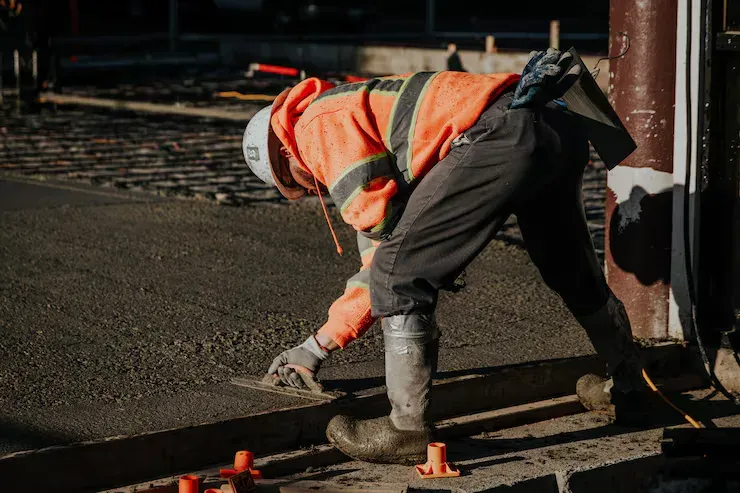

Workers compensation is the coverage for your own crew. Where general liability answers for the people and property around your work, workers comp answers for the workers doing it — the install and finishing hands, the pump crew, and the ready-mix drivers who carry the physical load of a concrete business. When one of them is hurt on the job, it is the policy that pays for medical care, replaces a portion of lost wages, and stands between a workplace injury and the cost of one. In most states it is also legally required once you have employees, which makes it not optional but foundational.
Concrete is a labor-heavy, physically demanding trade, and that shapes everything about this line. This page covers what workers compensation pays for, describes the injury exposure on a concrete crew honestly and without inventing statistics, explains the four monopolistic states where coverage runs through a state fund rather than a private carrier, and treats the experience mod as what it really is — a long-term cost you can actually influence. Throughout, the distinction that matters most holds: workers comp is for your crew, general liability is for third parties.
What workers compensation covers for a concrete crew
Workers compensation responds when one of your employees is injured in the course of the work. For a concrete contractor it breaks into a few clear parts:
- Medical care. The treatment a hurt worker needs, from the initial injury through recovery, is what the coverage is built to pay for.
- Lost wages. When an injury keeps a worker off the job, workers comp replaces a portion of the wages they lose while they recover.
- Disability benefits. Where an injury leads to a lasting disability, the coverage provides the benefits the system sets for it.
- Employers liability. The employers liability part — sometimes called Part B — responds to the employer’s liability that can arise out of a workplace injury, alongside the benefits themselves.
The defining line is who it covers: your own crew. Injuries to third parties — the public, another contractor’s workers, a property owner around your pour — are general liability, a separate line. A concrete business needs both, and we write them together so neither is left assumed.
The injury exposure on a concrete crew
Concrete is among the more physically demanding trades, and the injury exposure runs across every crew. The install and finishing hands carry the heaviest of it — lifting and placing material, pouring and finishing, setting and stripping forms, working bent and kneeling for hours, around heavy material and equipment. Strains and overexertion, struck-by hazards, slips and falls, and dust exposure including silica are part of the physical reality of the work. The pump crew and the ready-mix drivers carry their own exposure too, from the equipment they run to the demands of the job.
We describe this exposure in plain, qualitative terms on purpose — the point is that concrete work is genuinely hard on the people who do it, and that is exactly why the coverage matters. Workers compensation is the line that responds when the physical demands of the trade turn into an injury, and it is built to take care of the worker and protect the business at the same time.
The monopolistic states: North Dakota, Ohio, Washington, and Wyoming
There is a piece of honesty this page owes every concrete contractor, because it changes how coverage works depending on where your crews are. In four states — North Dakota, Ohio, Washington, and Wyoming — workers compensation is provided through a state fund rather than private carriers. North Dakota runs Workforce Safety & Insurance (WSI); Ohio runs the Bureau of Workers’ Compensation (BWC); Washington runs the Department of Labor & Industries (L&I); and Wyoming runs a state fund as well.
In those four states, the workers compensation coverage runs through the state fund — not through a private policy we place. We will be straight about that: we do not write private workers comp in a monopolistic state, and we will not imply otherwise. What we do is help you understand where your crews work and how that maps to the coverage you carry, so a contractor running jobs across state lines knows exactly how their workers comp is handled in each place rather than assuming one policy answers everywhere.
The experience mod: a cost you can control
One of the most important things to understand about workers compensation is that part of its cost is in your hands. The experience modification factor — the experience mod, or EMR — reflects your claims history and adjusts your premium up or down relative to others doing the same work. A record of fewer and less severe claims pulls the mod in your favor; a worse record pushes it the other way.
That is what makes it a controllable cost: it is driven by safety and claims management over time, not fixed by the trade you are in. We do not promise a number, because honest advice does not work that way — we explain how the mod works and focus on the levers that move it. For a labor-heavy concrete crew, the experience mod is one of the most meaningful long-term costs you can actually affect, which is why it is worth managing deliberately rather than treating as a line item you cannot change.
What drives your workers comp premium
Workers compensation premium is built primarily on your payroll and how that payroll is classified by the kind of work your employees do, then adjusted by your experience mod and other rating factors. The physical, labor-heavy nature of concrete work is reflected in how the work is classified, and getting that classification right — so your payroll is rated to the work your crews actually do — matters more than any single figure. We treat this qualitatively on purpose and read your operation accurately before quoting, so the premium reflects the real work rather than getting corrected at audit.
Why concrete contractors need it
What makes this line foundational for a concrete business is simple: the work is physical, the crew carries real injury exposure, and in most states the coverage is legally required once you have employees. Workers compensation is the line that takes care of a hurt worker and protects the business at the same time, and the employers liability piece stands behind the employer when a workplace injury turns into a liability. For a trade built on the hands that pour, finish, pump, and haul, there is no version of the program that leaves it out.
Why Concrete Guard Insurance
We are an independent agency that writes one class — concrete contractors — and we place coverage with carriers that want the work. That focus is the point. We know how a concrete crew is classified and how the install, pump, and ready-mix sides differ; we handle the monopolistic states honestly rather than pretending we write private coverage where the state fund does; and we treat the experience mod as the controllable cost it is, focusing on the levers that move it over time. When workers comp is both a legal requirement and one of your largest controllable costs, that is exactly the conversation we have. Start with a quote, or talk it through with us first.
Learn more
Coverage for a concrete business works as a system. Workers compensation pairs most often with general liability for the people and property around the work, commercial auto for the pump and mixer trucks, commercial property for the building, yard, and equipment, and umbrella liability, which can sit excess over the employers-liability piece. How it is written also differs by operating model across the three service pillars — Concrete Construction Insurance, Concrete Pumping Insurance, and Ready Mix Insurance.
Coverage for concrete contractors
- General Liability Insurance
- Commercial Auto Insurance
- Commercial Property Insurance
- Umbrella Liability Insurance
Insurance by operating model
Get covered
Primary sources
Frequently asked questions about Workers Compensation Insurance
What does workers compensation cover for a concrete crew?
Workers compensation covers your own employees when they are hurt on the job. It is built to pay for medical care, replace a portion of lost wages while a worker recovers, provide disability benefits, and — through the employers liability part, sometimes called Part B — respond to the employer’s liability that can arise from a workplace injury. For a labor-heavy concrete crew — the install and finishing hands, the pump crew, and the ready-mix drivers — it is foundational coverage, because the physical demands of the trade carry real injury exposure. It covers your crew, not third parties, which is the line that separates it from general liability.
Is workers compensation different from general liability?
Yes, and the difference is who gets hurt. Workers compensation covers injuries to your own employees — your crew. General liability covers bodily injury and property damage to third parties — the public, another contractor’s workers, a property owner. They are separate lines built for separate exposures, and a concrete business needs both: workers comp for the crew doing the physical work, general liability for the people and property around it. We write them together so neither exposure is left assumed.
How do the monopolistic states — North Dakota, Ohio, Washington, and Wyoming — work?
In four states — North Dakota, Ohio, Washington, and Wyoming — workers compensation is provided through a state fund rather than private carriers. North Dakota uses Workforce Safety & Insurance (WSI), Ohio uses the Bureau of Workers’ Compensation (BWC), Washington uses the Department of Labor & Industries (L&I), and Wyoming runs a state fund as well. If your crews work in one of those states, the workers compensation coverage there runs through the state fund — we do not write private workers comp in a monopolistic state, and we will be honest about that. What we do is help you understand where your crews work and how that maps to the coverage you carry, so there are no surprises.
What is an experience mod, and can I lower it?
The experience modification factor — the experience mod, or EMR — reflects your claims history and adjusts your workers compensation premium up or down relative to others doing the same work. A history of fewer and less severe claims pulls it one way; a worse record pulls it the other. That is what makes it a controllable cost: it is driven by safety and claims management over time, not set in stone. We do not promise a number — we describe how it works honestly and focus on the levers that influence it, because for a labor-heavy concrete crew the mod is one of the most meaningful long-term costs you can actually affect.
What drives my workers compensation premium?
Workers compensation premium is built primarily on your payroll and how that payroll is classified by the kind of work your employees do, then adjusted by your experience mod and other rating factors. The physical, labor-heavy nature of concrete work is reflected in how the work is classified. We describe this qualitatively on purpose — the right classification of your payroll and an accurate read of your operation matter more than any single figure, and getting the classification right is part of what we do before quoting rather than after an audit.
Get workers comp built around the crew that does the work
Tell us about your install, pump, and ready-mix crews and where they work, and we will market it to carriers that write the class — with the monopolistic states handled honestly and the experience mod managed as a cost you can control.