Coverage line
Commercial Auto Insurance for Concrete Contractors
The line that covers the trucks — where general liability covers the work and the harm. Two vehicle profiles define it: the boom pump truck as a high-value mobile asset, and the ready-mix mixer fleet as a motor-carrier operation running under DOT and FMCSA rules.

Commercial auto is the line that covers your trucks. Where general liability answers for the work you do and the harm it can cause to third parties, commercial auto answers for the vehicles — the road liability when one of them causes an accident, and the physical damage when one of them is wrecked, stolen, or burned. For a concrete contractor that distinction is not academic. The trucks are where much of the money is, where much of the daily risk is, and where the federal rulebook lands hardest — and an owner who assumes general liability covers the fleet finds the gap during a claim.
Two vehicle profiles define this coverage for a concrete business, and they carry different exposures, so this page gives each its own deep section. The first is the boom pump truck — often the single most expensive item the contractor owns, a high-value mobile asset whose liability and physical damage both run through here. The second is the ready-mix mixer fleet — a trucking operation regulated as a motor carrier, with auto liability as its dominant line and a layer of federal mechanics that come with running trucks. After both profiles, this page draws the honest seam where commercial auto stops and general liability begins.
The vehicle profile (1): the concrete-pumping boom truck
The boom pump truck is the asset that most defines a pumping contractor’s commercial-auto exposure, because it is usually the single most expensive item the business owns. It is a high-value, specialized, mobile asset — a truck chassis carrying an articulated placing boom and a pumping system — and protecting it means thinking about both sides of the auto policy at once: the liability it can create and the physical damage it can suffer.
On the liability side, auto liability responds to third-party bodily injury and property damage the truck causes — not only on the road between the yard and the pour, but also while the truck is positioned and maneuvering at the job site, because the vehicle is in use as a vehicle in both settings. Setting up on a tight site, swinging into position, and pulling out through traffic are all moments where the truck can create an auto claim against a third party.
On the asset side, physical damage — collision and comprehensive — protects the truck itself: collision for an accident, comprehensive for theft, fire, vandalism, and other non-collision perils. For a machine this valuable, physical damage is not an afterthought; it is the coverage that stands between a wrecked or stolen pump truck and a loss the business has to absorb on its own. The asset is the reason a pumping contractor’s auto program has to be built around the truck rather than treated as a generic vehicle schedule.
Now the seam that owners most often get wrong, and the reason this line and general liability have to be read together. When a pump boom contacts an overhead power line and injures a third party, that catastrophic bodily-injury loss is general liability, not commercial auto — it is the work causing third-party harm, the boom acting on the world around it. But the truck itself — the physical damage to it, its auto liability when it causes an accident — is commercial auto, right here. The split is honest and it is sharp: the power-line bodily injury the boom causes is general liability; the asset and the road liability of the vehicle that carries the boom are commercial auto. We name that line plainly because an owner who blurs it finds out which policy answers only after a loss.
One more piece belongs to this profile: hired and non-owned auto. A pumping contractor who rents or borrows a unit to cover a busy stretch, or whose employees run company errands in their own vehicles, has exposure that an owned-only policy does not answer. Hired-auto coverage addresses the rented or borrowed unit; non-owned-auto coverage addresses the employee’s vehicle used on company business. Both are worth confirming on the policy, because a borrowed truck or an employee errand can produce a liability claim that the owned schedule alone would leave open.
The vehicle profile (2): the ready-mix mixer fleet
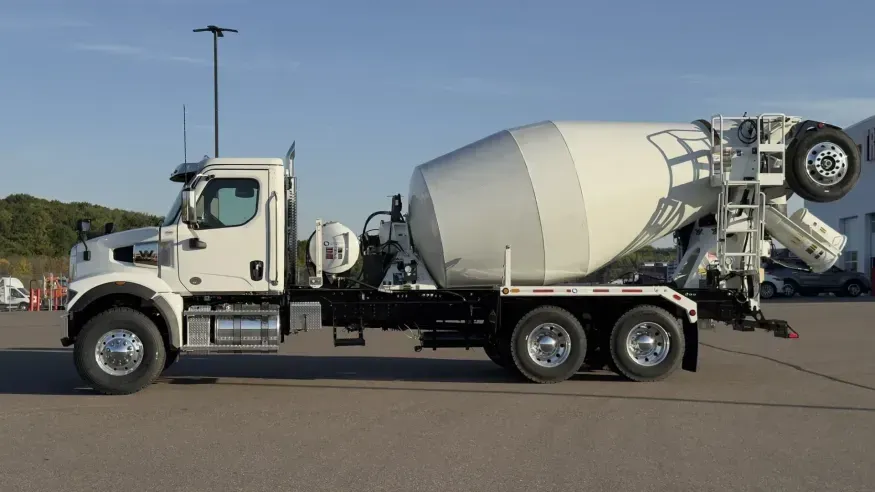
A fleet of mixer trucks is not a side detail of a concrete business — it is the business, and it is a trucking operation first. That reframing changes how the auto program has to be built, because a ready-mix fleet runs under the federal motor-carrier regime, and the commercial-auto policy is where that regime is answered. Auto liability is the dominant line, and a layer of real federal mechanics comes with running trucks. We name those mechanics precisely, hedged, and without inventing any figure.
DOT, FMCSA, and the USDOT number. The Federal Motor Carrier Safety Administration (FMCSA), part of the U.S. Department of Transportation (DOT), regulates motor carriers. A ready-mix fleet operating in interstate commerce — or in a state that has adopted the federal rules for intrastate carriers — generally falls under that regime, which is built around a USDOT number identifying the carrier and the federal motor-carrier safety rules that apply to its trucks and drivers. These are real federal bodies and a real identifier; whether and how they apply to your fleet depends on how and where you run, which is part of what we determine before placing the program. We do not attach a regulation citation or a penalty figure we cannot verify.
The MCS-90 endorsement. The MCS-90 is the real federal financial-responsibility endorsement tied to the Motor Carrier Act of 1980, and it typically attaches to a for-hire or interstate motor carrier’s auto liability policy. It is best understood as a safety net for the public rather than coverage that broadens your own protection: it generally guarantees that an injured member of the public can be paid for bodily injury or property damage up to the applicable federal minimum, even where a coverage dispute might otherwise apply — after which the carrier can seek reimbursement from the insured. In other words, it is a surety mechanism that backstops the public and then looks to the insured, not primary coverage. We name it precisely and describe the federal minimum qualitatively, because the verified figure is something to confirm against the rules that apply to your fleet rather than guess at.
The covered-auto symbols. In the standard ISO business auto form, coverage is assigned through covered-auto symbols — numbers that designate which autos a given coverage applies to. As the standard examples, Symbol 1 means any auto, Symbol 7 means specifically described autos (the units listed on the policy), Symbol 8 means hired autos, and Symbol 9 means non-owned autos. For a ready-mix fleet that owns its mixers, sometimes hires a unit, and has employees who occasionally drive their own vehicles on company business, the symbols are how the policy is matched to the real owned, hired, and non-owned exposure — coverage by coverage. Getting them right is the difference between a policy that picks up how you actually operate and one that leaves a unit or a use uncovered.
Load-shift, rollover, and perishability. A loaded mixer is among the heaviest vehicles on the road, and the load it carries is liquid and high — a center of gravity that shifts as the drum turns and the load moves. That combination makes rollover a severe risk, and a rollover or load-shift involving a fully loaded mixer is a serious commercial-auto loss, with the potential to be catastrophic for the people and property around it. The load also carries its own pressure: ready-mix concrete is perishable, beginning to set up if it is not placed in time, so a fleet runs against the clock in a way that compounds the driving exposure. We describe these risks in words rather than statistics, because the severity is the point and the trade does not need a fabricated number to make it.
Why concrete contractors need it
What separates a concrete operation from ordinary commercial-auto risk is the kind of trucks it runs. A boom pump truck is a high-value, specialized asset that creates liability the moment it leaves the yard and sustains a major loss the moment it is wrecked or stolen. A ready-mix fleet is a full motor-carrier operation, with the heaviest vehicles on the road, a liquid load that wants to shift, a clock that does not stop, and a federal rulebook layered on top. General liability does not answer for any of that — it answers for the work — so commercial auto is the line that stands behind the trucks, the drivers, and the assets that move the concrete.
Because the exposure differs by operating model, the auto program has to fit the model. A Concrete Construction contractor runs work trucks and the occasional rented unit, with general liability carrying the signature exposure and auto supporting it. A Concrete Pumping contractor builds the program around the boom truck as a high-value asset — physical damage and liability both. A Ready Mix operation is a trucking business first, where the motor-carrier mechanics, the symbols, and the fleet’s severity drive the file. Writing all three off one generic auto form misprices the trucks and leaves the real exposure exposed. We rate each to the real operation.
What commercial auto responds to
These are the categories underwriters expect on a concrete commercial-auto file. They are described qualitatively and with generic carrier language — every claim is handled by the carrier, never named here — with no fabricated cost, frequency, or penalty figures.
- Auto liability. Third-party bodily injury and property damage your trucks cause — on the road between yard and pour, and while positioning or maneuvering on a job site.
- Physical damage on the asset. Collision and comprehensive protecting the trucks themselves, above all the high-value boom pump truck — against an accident, theft, fire, or other covered peril.
- The motor-carrier layer. The federal mechanics a ready-mix fleet runs under — the MCS-90 financial-responsibility endorsement, and the DOT and FMCSA framework that comes with a USDOT-numbered fleet.
- Hired and non-owned auto. Rented or borrowed units and employees’ vehicles used on company business — the exposure an owned-only schedule leaves open, picked up through the covered-auto symbols.
- Load-shift and rollover severity. The serious — potentially catastrophic — auto loss when a fully loaded mixer, among the heaviest vehicles on the road, shifts or rolls.
Limits and structure
Commercial auto is usually written with a combined or split liability limit and physical-damage coverage on the scheduled units, and for a concrete operation the structure is driven by the trucks themselves — what they are worth, how they run, and the rules they run under. A pumping contractor’s program turns on the boom pump truck as a high-value asset, where physical damage on that single unit is a central decision. A ready-mix fleet’s program turns on the motor-carrier layer — the symbols that pick up owned, hired, and non-owned autos, and the federal endorsements a USDOT-numbered fleet carries. General-contractor, developer, and project accounts also drive the limits, often demanding auto liability at specified amounts before they let your trucks on site. Rather than quote a number, we read what your operation and your contracts actually require and build the limit and endorsement structure to satisfy them. Where an account or a contract calls for limits above your primary auto layer, that is what umbrella liability is for, sitting excess of this policy.
Where commercial auto stops: the general-liability seam
One exposure looks like it should be covered here and is not, and naming it honestly is the whole point — because a concrete contractor who assumes commercial auto answers for everything the trucks touch finds the gap during a claim. Commercial auto covers the vehicles: the road liability, the maneuvering on site, and the physical damage to the asset. It does not cover the work, or the third-party harm the work itself causes.
The clearest case is the pump boom. When the boom contacts an overhead power line and injures a spotter, a finisher, or a bystander, that catastrophic third-party bodily injury is general liability — the work acting on the world, not the vehicle causing an accident. The truck that carries the boom is commercial auto; the harm the boom causes is general liability. The same logic runs the other way for installed work: a slab or foundation that fails downstream is general liability’s completed-operations exposure, never an auto loss. The two lines are written together and read together, and the seam between them is part of building the program. This is the honest division for concrete: commercial auto for the trucks, general liability for the work and the harm — not a single form that pretends to do both.
Why Concrete Guard Insurance
We are an independent agency that writes one class — concrete contractors — and we place coverage with carriers that actually want the work. That focus is the point. We know to ask whether you run work trucks and a rented unit, build the program around a high-value boom pump truck, or operate a ready-mix fleet under federal motor-carrier rules before we quote; to set physical damage on the asset that warrants it; to match the covered-auto symbols to your owned, hired, and non-owned exposure; to name the MCS-90 and the DOT and FMCSA framework precisely for a USDOT-numbered fleet; and to read the seam where the power-line exposure becomes general liability rather than auto. When a project owner lands an auto-liability requirement on your desk that you do not recognize, that is a call we take. Start with a quote, or talk it through with us first.
Learn more
Coverage for a concrete business works as a system. Commercial auto pairs most often with general liability for the work your crews do and the power-line exposure on the pour, commercial property for the building, yard, and equipment, workers compensation for your crew and drivers, and umbrella liability when an account demands limits above your primary auto layer. How it is written also differs by operating model across the three service pillars — Concrete Construction Insurance, Concrete Pumping Insurance, and Ready Mix Insurance.
Coverage for concrete contractors
- General Liability Insurance
- Commercial Property Insurance
- Workers Compensation Insurance
- Umbrella Liability Insurance
Insurance by operating model
Get covered
Primary sources
Frequently asked questions about Commercial Auto Insurance
What does commercial auto cover for a concrete contractor?
Commercial auto is the line that covers your trucks. For a concrete business that means two things above all: auto liability, which responds to third-party bodily injury and property damage your vehicles cause on the road or maneuvering on a job site, and physical damage — collision and comprehensive — which protects the trucks themselves, including the high-value boom pump truck that is often the single most expensive asset you own. A policy can also extend to hired and non-owned autos — rented or borrowed units and employees’ vehicles used on company business. What it does not cover is the work your crews perform or the third-party harm the work itself causes; that is general liability, a separate line. The vehicles are auto; the work is general liability.
Is my concrete pump truck covered on the road and at the job site?
Yes — auto liability and physical damage on a boom pump truck generally apply both while the truck is driven on the road and while it is positioned and maneuvering at the placement site, because the vehicle is in use as a vehicle in both settings. Physical damage — collision and comprehensive — is what protects the asset itself against an accident, theft, fire, or other covered peril, which matters because the pump truck is typically the most expensive item a pumping contractor owns. The exact line between an auto loss and a general-liability loss depends on what actually happened — damage to the truck is commercial auto, while third-party harm caused by the work, including a boom contacting a power line, is general liability — which is exactly the seam we read against your operation before binding.
What is an MCS-90 and does my ready-mix fleet need one?
The MCS-90 is a real federal endorsement — the financial-responsibility endorsement tied to the Motor Carrier Act of 1980 — that typically attaches to a for-hire or interstate motor carrier’s auto liability policy. It works as a safety net for the public: it generally guarantees that an injured member of the public can be paid for bodily injury or property damage up to the applicable federal minimum, even if a coverage dispute would otherwise apply, after which the carrier can seek reimbursement from the insured. It is a surety mechanism backstopping the public, not primary coverage that broadens your own protection. Whether your ready-mix operation needs one depends on how and where the fleet runs and the federal motor-carrier rules that apply — which is part of what we determine before placing the program. We name the form precisely and do not guess at the figures.
Does commercial auto cover a power-line strike from my pump boom?
No — and this is the seam every pumping contractor should understand. When a pump boom contacts an overhead power line and causes third-party bodily injury or property damage, that harm is a general-liability loss, not a commercial-auto loss, because it is the work causing the injury rather than the vehicle causing an accident. Commercial auto covers the truck itself — its physical damage and its auto liability on the road and maneuvering on site. General liability answers the third-party power-line bodily injury caused by the boom. The two lines are written together and read together; the power-line exposure is covered on our general liability page, and the truck is covered here.
What are covered-auto symbols on a business auto policy?
In the standard ISO business auto form, coverage is assigned through covered-auto symbols — numbers that designate which autos a given coverage applies to. As the standard examples, Symbol 1 means any auto, Symbol 7 means specifically described autos (the units listed on your policy), Symbol 8 means hired autos, and Symbol 9 means non-owned autos. The symbols matter because they decide, coverage by coverage, whether your owned trucks, the units you rent or borrow, and the vehicles your employees drive on company business are actually picked up. For a concrete fleet that owns trucks, occasionally hires units, and has employees running errands in their own vehicles, getting the symbols right is how the policy is matched to how you really operate — which is what we check rather than assume.
Does commercial auto cover hired or non-owned vehicles?
It can, when the policy is set up for it. Hired auto coverage addresses vehicles you rent, lease, or borrow — an extra unit brought on for a busy stretch — and non-owned auto coverage addresses vehicles you do not own but that are used on your behalf, most often an employee’s own vehicle driven on company business. In the standard ISO business auto form these are picked up through the covered-auto symbols, typically the hired-auto and non-owned-auto symbols. For a concrete contractor this fills a real gap, because a borrowed unit or an employee errand can create a liability claim that an owned-only policy would not answer. Whether your policy includes hired and non-owned auto, and at what limits, depends on how it is written — which is part of what we read before binding.
Get commercial auto built around your trucks
Tell us whether you run work trucks, a boom pump truck, or a ready-mix fleet, and we will market it to carriers that write the class — with the asset, the liability, and the motor-carrier layer covered, not assumed.