

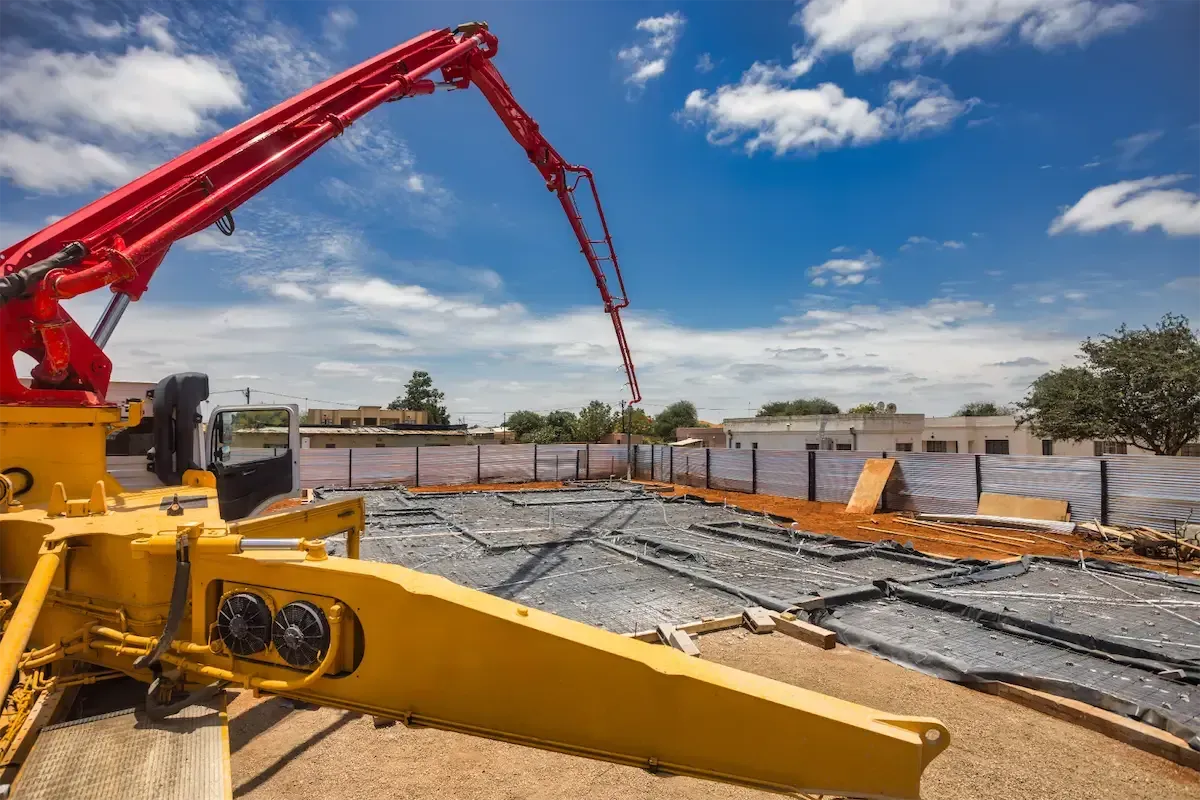
Concrete pump truck insurance is a set of policies, not one. Commercial auto covers the truck on the road, physical damage covers the truck and boom, general liability covers the placing work, and workers’ compensation covers the crew. The boom is what makes pumping different.
This post is for owners of boom pumps and line pumps, and for contractors who hire them.
The truck is the business
A pumper’s main asset is a truck-mounted boom or trailer-mounted line pump. If the truck is out of service, so is the business. That is why the commercial auto policy and its physical damage terms come first. The pumping coverage stack post maps all the lines; this post focuses on the placing operation.
Physical damage terms matter more here than on a plain truck. Ask how the policy values the truck and boom, whether the boom is covered as part of the vehicle or scheduled separately and what it says about outrigger and setup damage. The boom truck physical damage post covers the details.
Boom work near overhead lines
Contact between a boom and an energized line is the most serious placing exposure, and the rules differ by state. A few examples drawn from verified records:
- Texas bars working, or bringing tools and equipment, within six feet of a high voltage overhead line unless the danger of contact is effectively guarded against, and requires the party responsible for temporary work closer than allowed to notify the line operator at least 48 hours before it begins (Texas Health and Safety Code ch. 752).
- Alabama bars using or placing equipment within 10 feet of a high voltage overhead conductor unless the person has arranged effective safeguards (Code of Alabama 37-8-52).
- Federal OSHA requires an employer, before work begins, to find out whether any energized power circuit is located where the work could bring a person or machine into contact with it (29 CFR 1926.416).
These are not the same rule. Confirm the clearance and notice requirement for the state where you are pouring, and do not rely on a general number. The power line coverage post explains which policy responds if contact happens.
Next step. Start a quote with your unit list, operator list and the states where you work. We bring it to carriers before a policy binds.
Clearance rules set the minimum; a planning habit keeps the crew above it. Walk the site before setup, locate every overhead line, note where the boom will swing as the pour moves and decide in advance who watches the line. Document the plan. A written plan helps with the contractor, with the line operator and with an underwriter who asks how the company manages the exposure.
Real-World Scenario: A boom pump sets up beside a building with a distribution line running along the property. The operator sees the line, but the placing plan moves the boom toward it as the pour shifts. Nobody called the line operator beforehand. The operator has to stop the pour, reposition the truck and sort out the delay with the contractor. A planning step before setup would have caught it.
Federal and state truck rules, in scope
A pump truck is a commercial motor vehicle for federal safety purposes when it has a gross vehicle weight rating of 10,001 pounds or more and operates in interstate commerce, among other tests (49 CFR 390.5). The financial-responsibility rules in Part 387 apply to for-hire carriers of property in interstate or foreign commerce, and the MCS-90 is the prescribed form.
State rules apply to in-state carriers. Texas DPS, for example, applies the federal regulations to vehicles above 26,000 pounds operating intrastate. Confirm how your trucks run, and in which states, before a filing is chosen.
Crane rules and the pump exclusion
The federal cranes and derricks standard, Subpart CC, states that it does not cover machinery converted or adapted for non-hoisting use, and gives concrete pumps as an example. That is a statement about the federal construction standard. State crane operator rules differ and are not covered here.
General liability and the placing work
General liability answers for injury and property damage from the placing operation: hose whip, a line burst, damage to a form or a neighboring structure. Contractors who hire pumpers often ask for additional-insured wording, which the additional insured post explains.
Pump hands and operators are covered through workers’ compensation; see the workers’ compensation page. For a mixed fleet that also runs mixers, the cement truck insurance post covers that side. Ready to review your program? Use the quote form.