
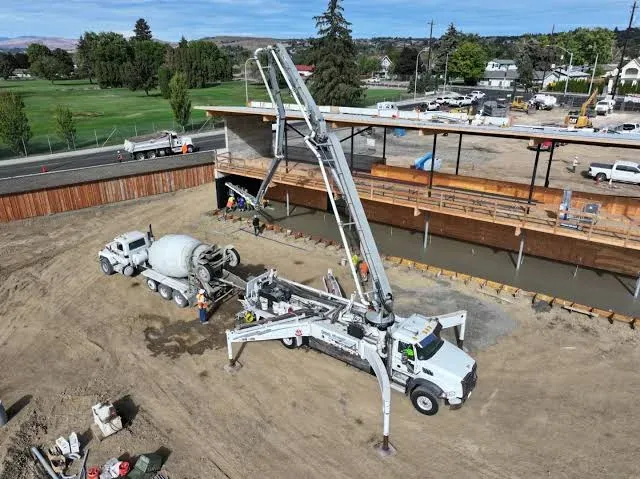
A concrete pumping business needs a coverage stack, not a single policy, and two lines carry most of the weight. General liability answers for the work and the harm it can cause to other people and their property — including the catastrophic power-line exposure when a boom contacts an overhead line — and commercial auto answers for the boom pump truck, usually the single most expensive asset the business owns. Those two are the co-signature lines of a pumper’s program. Above them sits an umbrella that adds excess limit for the severity a power-line loss can reach, workers compensation covers the operator and spotter crew on the pour, and commercial property covers the shop and yard behind it all.
This post is a walk through that stack — which coverages a pumper carries, which forms sit inside them, and how the lines layer and where the seams are. It is not a quote, and it is not a risk profile of your operation. When you want the pumping risk picture read against the way you actually run and a price built around it, the concrete pumping insurance page is the conversion step. Here, the goal is to understand the mechanics: what each line does, which real forms name the coverage, and the one seam owners most often get wrong.
The two co-signature lines: general liability and commercial auto
Most businesses have one signature coverage. A pumping contractor has two, and they carry equal weight. That is because the pump-truck model concentrates its exposure in exactly two places at once: the boom, which creates the most serious third-party loss in the trade, and the truck that carries it, which is the most valuable single thing the business owns.
The boom exposure runs through general liability — the line for the work you do and the harm it causes to others. The truck runs through commercial auto — the line for the vehicles. Neither of those exposures belongs to an install crew pouring flatwork or a delivery fleet hauling ready-mix; both belong to pumping. So the stack does not have a single lead line with everything else supporting it. It has two co-signature lines, and the rest of the program is built around them.
General liability: the work, the harm, and the power-line exposure
General liability responds to third-party bodily injury and property damage that arise from your operation — the member of the public, another crew’s worker, or a bystander hurt around your work, and physical damage to property that is not yours. For a pumping contractor the everyday version of that is real, but the exposure that defines the class is the power-line contact.
A boom is a long, conductive steel arm swung into position over a pour. When placement happens near an overhead line, boom contact can energize the boom, the truck, and the ground around it, causing severe and frequently fatal third-party bodily injury to spotters, finishers, and bystanders. We describe that severity plainly and without inventing statistics, because it does not need them. General liability is built to respond to that third-party harm.
The same line also answers for the work you leave behind. Most general liability policies start from the standard ISO commercial general liability coverage form — typically the occurrence-based version known as CG 00 01 — and inside it the coverage for finished work is the products-completed operations hazard, which responds to bodily injury and property damage arising out of “your work” after the work is complete. For a contractor, the finished placement is “your work” in the policy’s language. Naming the form is worth doing because it hands you a check: confirm the hazard is in your policy and the trigger fits. Coverage always depends on the specific policy and its endorsements, so read the form rather than assume.
Commercial auto: the boom pump truck as a high-value asset
The boom pump truck is the asset that most defines a pumper’s commercial-auto exposure, because it is usually the single most expensive item the business owns — a truck chassis carrying an articulated placing boom and a pumping system. Protecting it means thinking about both sides of the auto policy at once.
On the liability side, auto liability responds to third-party bodily injury and property damage the truck causes, both on the road between the yard and the pour and while the truck is positioned and maneuvering at the placement site, because it is in use as a vehicle in both settings. On the asset side, physical damage — collision and comprehensive — protects the truck itself against an accident, theft, fire, or other covered peril. For a machine this valuable, physical damage is not an afterthought; it is what stands between a wrecked or stolen pump truck and a loss the business absorbs on its own.
The standard ISO business auto form assigns coverage through covered-auto symbols — the numbers that designate which autos a coverage applies to, with the familiar examples being any-auto, specifically-described-auto, hired-auto, and non-owned-auto symbols. For a pumper that owns a truck, occasionally rents a unit, and has employees who sometimes drive their own vehicles on company business, getting the symbols right is how the policy is matched to how you really operate. Whether your policy picks up each of those uses depends on how it is written.
The seam: where general liability stops and commercial auto begins
This is the piece owners most often get wrong, and the reason the two co-signature lines have to be read together. The cleanest way to hold it: general liability covers the work and the harm it causes; commercial auto covers the vehicle.
So when a pump boom contacts an overhead power line and injures a spotter or a bystander, that catastrophic third-party bodily injury is general liability — it is the work acting on the world, the boom causing harm, not the vehicle causing an accident. But the truck itself — the physical damage to it, its auto liability when it causes a collision — is commercial auto. The boom’s harm is general liability; the asset that carries the boom is commercial auto. A contractor who blurs that line finds out which policy answers only after a loss.
Umbrella: why the power-line exposure demands excess above both
Because the signature exposure is catastrophic, the stack does not stop at the primary lines. An umbrella sits above general liability and commercial auto and adds excess limit over both — it does not replace them or broaden what they cover; it extends the height of coverage for a loss large enough to exhaust a primary layer.
A power-line contact is exactly that kind of loss. It can run straight past the primary limits on general liability, and a severe at-fault accident involving the boom truck can do the same on the auto side. For a boom operation carrying the power-line exposure, real excess limit is usually part of building the stack honestly rather than an optional add-on.
Workers compensation: the operator and spotter crew
General liability answers for third parties; it does not answer for your own employees. The people who guide the boom, watch the lines, and place and finish at the discharge are your crew, and an injury to one of them on the pour runs through workers compensation — medical and lost-wage coverage, with employers liability alongside it.
For a pumper the crew is smaller than an install contractor’s labor-heavy roster, but it is exposed to the same energized environment the power-line risk describes, which is why the workers-compensation line sits deliberately in the stack rather than as an afterthought. Rules vary by state, including the monopolistic states where coverage comes only through the state fund, so how it is placed depends on where your crew works.
Commercial property: the shop and yard
The lightest line in the pumping stack is commercial property: the shop, the yard, and the stored equipment against fire, theft, and other perils. It is lighter here for a reason — the highest-value asset a pumper owns is the boom truck, and that rides on commercial auto as a mobile asset rather than as fixed property. Property still belongs in the program, but it does not carry the weight the two co-signature lines do.
Real-World Scenario: A pumping contractor sets up on a tight site and swings the boom into position for a pour. The boom comes too close to an overhead line, contact energizes the truck, and a spotter standing nearby is seriously injured. In the same season, on a different job, the pump truck is struck backing out through traffic and needs major repair. The two losses land on two different lines: the spotter’s injury is the power-line bodily-injury claim on general liability, with the umbrella behind it for the severity; the damaged truck is a physical-damage claim on commercial auto. The contractor who understood the stack knew which line answered each one, and had the excess limit sized to the power-line exposure before the loss — not after.
How the stack fits together
The takeaway is that a pumping program is a system, not a policy. General liability and commercial auto lead it together — the work and the harm on one, the truck on the other — with the seam between them read deliberately. The umbrella sits above both because the power-line loss can outrun a primary limit. Workers compensation covers the crew that general liability cannot, and property covers the facility behind it.
When you want that stack read against your own operation and priced, start a quote or see the risk profile on the concrete pumping insurance page. To understand the completed-work side of general liability in depth, read what completed operations means for concrete contractors; for the ready-mix version of this stack, see what insurance a ready-mix business needs; and for what moves the price, see what concrete pumping insurance costs. You can also browse the full coverage overview to see where each line sits.