

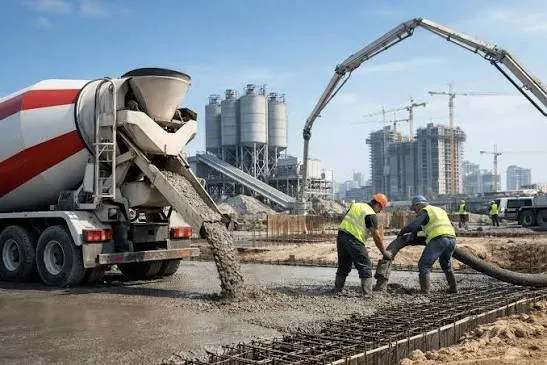
A ready-mix business is a trucking operation first, and its coverage stack reflects that: it is auto-led. Commercial auto is the dominant line — auto liability and physical damage on the mixer fleet, run as a regulated motor carrier under the federal rulebook. Above the auto tower sits an umbrella for the severity a fully loaded mixer can create; workers compensation covers the fleet drivers; general liability covers the delivery and site work; and commercial property covers the batch plant and yard. Unlike a stack with two co-equal signature lines, a ready-mix program has one clear center of gravity, and everything else is built around it.
This post is a walk through that stack — which coverages a hauler carries, which real forms ride on the auto line, and how the lines layer under the fleet. It is not a quote, and it is not a risk profile of your operation. When you want the ready-mix risk picture read against the way you actually run and a price built around it, the ready mix insurance page is the conversion step. Here, the goal is to understand the mechanics: why auto leads, what the MCS-90 and the covered-auto symbols do, and how the supporting lines fit around the fleet.
Why commercial auto is the dominant line
Most concrete operations lead with the work. A ready-mix producer leads with the trucks, because the fleet is the business. A producer batches concrete and delivers it with a fleet of mixer trucks, and that fleet is a trucking operation — so commercial auto, the line that covers the trucks, carries the heaviest exposure by a wide margin.
The severity is built into the equipment. A loaded mixer is among the heaviest vehicles on the road, carrying a liquid load that sits high and shifts as the drum turns — a center of gravity that makes rollover a severe risk and any at-fault accident a potentially catastrophic one. Commercial auto is the line that answers for all of it: auto liability for the third-party harm the trucks cause on the road and maneuvering at the pour, and physical damage — collision and comprehensive — for the trucks themselves. For ready-mix, that is the spine of the stack, not a supporting line.
The federal motor-carrier layer: the MCS-90
Layered on top of ordinary road liability is a federal regime, because a mixer fleet is regulated as motor-carrier equipment. The Federal Motor Carrier Safety Administration (FMCSA), part of the U.S. Department of Transportation (DOT), regulates motor carriers, and a fleet running in interstate commerce — or in a state that has adopted the federal rules for intrastate carriers — generally falls under that regime, built around a USDOT number identifying the carrier and the federal safety rules for its trucks and drivers.
The endorsement that rides on the auto policy is the MCS-90. It is the real federal financial-responsibility endorsement tied to the Motor Carrier Act of 1980, and it typically attaches to a for-hire or interstate motor carrier’s auto liability policy. It is best understood as a safety net for the public rather than coverage that broadens your own protection: it generally guarantees that an injured member of the public can be paid for bodily injury or property damage up to the applicable federal minimum, even where a coverage dispute might otherwise apply, after which the carrier can seek reimbursement from the insured. In other words, it is a surety mechanism that backstops the public and then looks to the insured. The federal minimum is described qualitatively here on purpose — the figure depends on the rules that apply to your fleet, and it is confirmed against those rules rather than guessed at.
The covered-auto symbols on the mixer fleet
The second piece of form craft on the auto line is the covered-auto symbols. In the standard ISO business auto form, coverage is assigned through covered-auto symbols — the numbers that designate which autos a given coverage applies to. As the standard examples, there is a symbol for any auto, one for specifically described autos (the units listed on the policy), one for hired autos, and one for non-owned autos.
The symbols matter because they decide, coverage by coverage, whether the policy actually picks up your owned mixers, the unit you occasionally rent, and the vehicles employees drive on company business. For a fleet that owns its trucks, sometimes hires a unit for a busy stretch, and has drivers running errands in their own vehicles, getting the symbols right is how the policy is matched to the real owned, hired, and non-owned exposure. Whether your policy picks up each of those uses depends on how it is written, which is a thing to read before a loss rather than during one.
Umbrella: excess above the auto tower
Because a loaded mixer can create a severe loss, the stack does not stop at the primary auto limit. An umbrella sits above commercial auto and the other primary lines and adds excess limit over them — it does not replace the auto policy or broaden what it covers; it extends the height of coverage for a loss large enough to exhaust the primary layer.
A rollover or an at-fault accident involving a fully loaded mixer is exactly that kind of loss. It can run past the primary auto limit and reach into the excess layer, which is why a ready-mix operation tends to carry real umbrella limit as part of building the stack honestly. How much depends on how the fleet runs and the limits contracts and the federal rules call for.
Workers compensation: the fleet drivers
General liability answers for third parties; it does not answer for your own people. The drivers who run the mixers and the crew who load them at the plant are your employees, and an on-the-job injury runs through workers compensation — medical and lost-wage coverage, with employers liability alongside it.
For a hauler the driver payroll is the center of the workers-compensation exposure, sitting right behind the fleet on the auto line. Rules vary by state, including the monopolistic states where coverage comes only through the state fund, which matters for a producer whose drivers cross a state line or whose ownership runs plants in more than one state.
General liability and property: the work and the fixed site
Two supporting lines round out the stack. General liability covers the third-party bodily injury and property damage around the delivery and the site — the work and the harm it causes off the truck. It is lighter for this model than for an install contractor, whose signature exposure is the completed work it leaves behind, but it is still part of the program; the standard ISO commercial general liability form and its “your work” mechanics apply the same way, just with less weight than the auto line carries.
Commercial property covers the fixed site the fleet runs from: the batch plant, the yard, stored materials, and the equipment against fire, theft, and other perils, often with business income for a covered shutdown. It is the line for what does not move, sitting behind the rolling exposure of the trucks.
Real-World Scenario: A mixer leaves the plant fully loaded and, taking a curve too fast on the way to a pour, shifts its load and rolls, injuring a driver in another vehicle and blocking the road. The third-party injury is a commercial-auto liability claim, with the MCS-90 backstopping the public where the federal rules apply and the umbrella behind the primary limit for the severity; the damaged mixer is a physical-damage claim on the same auto line; and the injured driver of the mixer, if hurt, is a workers-compensation claim. One event, several lines — and the operator who understood the stack knew the auto tower and the umbrella above it were built to carry exactly this, not left to assumption.
How the stack fits together
The takeaway is that a ready-mix program is auto-led, and the rest is built around the fleet. Commercial auto is the dominant line, carrying the trucks, the federal motor-carrier layer, and the load-shift and rollover severity. The umbrella sits above the auto tower because a loaded-mixer loss can outrun a primary limit. Workers compensation covers the drivers the auto line does not, general liability covers the delivery and site work off the truck, and property covers the batch plant and yard behind it all.
When you want that stack read against your own fleet and priced, start a quote or see the risk profile on the ready mix insurance page. To understand the completed-work side of general liability that matters more for install crews, read what completed operations means for concrete contractors; for the pumping version of this stack, see what insurance a concrete pumping business needs; and for what moves the price, see what ready-mix insurance costs. You can also browse the full coverage overview to see where each line sits.