

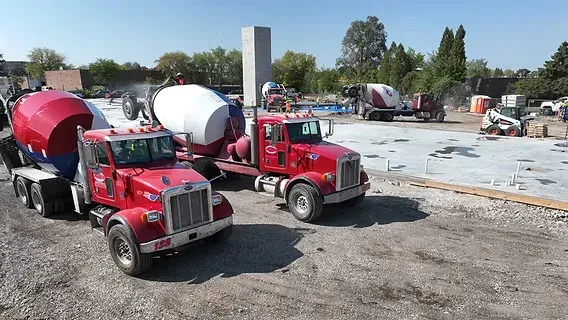
Cement truck insurance is commercial auto written for a mixer fleet. It pays for harm the trucks cause on public roads and for damage to the trucks themselves, and it is built around the drivers, the schedule of trucks and the plant they run from. General liability and workers’ comp sit beside it but do not cover the trucks.
This post is for owners of mixer and concrete truck fleets, and for ready-mix producers reviewing a renewal. It covers what the auto policy does, when federal motor-carrier rules reach a fleet, and what to bring to a quote.
What people mean by cement truck, cement mixer and concrete truck insurance
The searches differ, but the vehicle is the same: a truck-mounted drum that carries mixed concrete to a placement. Insurers write it as commercial auto. The policy ties to each truck, each driver and, for many fleets, a business-use classification that reflects hauling a loaded drum rather than a pickup running errands.
If the trucks belong to a ready-mix producer, the full program also includes plant, product and employee exposures. The ready-mix coverage stack walks through those lines. This post stays on the trucks.
What the commercial auto policy covers on a mixer
Auto liability answers for bodily injury and property damage you cause with a covered truck, including to other drivers and to what the truck hits. Physical damage is a separate choice: it pays to repair or replace the mixer, the chassis and sometimes the drum, subject to the deductible and how the truck is valued.
A loaded drum carries a heavy, shifting load high on the chassis, so it is worth asking how the policy values the truck, whether the drum is covered as part of the vehicle, and what the form says about use on soft or private ground. Those are policy questions, not assumptions. Read the form, and ask the carrier to explain anything that is unclear.
When federal motor-carrier rules reach a concrete truck fleet
The Federal Motor Carrier Safety Regulations apply to employers, employees and commercial motor vehicles that transport property in interstate commerce, and a commercial motor vehicle there is one with a gross vehicle weight rating of 10,001 pounds or more, among other tests (49 CFR 390.5).
The separate financial-responsibility rules in Part 387, Subpart A, apply to for-hire motor carriers transporting property in interstate or foreign commerce (49 CFR 387.3). Where they apply, the policy carries an endorsement in the form FMCSA prescribes, which is the MCS-90.
That is a narrower statement than it sounds. A mixer fleet is not automatically for-hire, and not automatically interstate. Many routes stay inside one state, and states set their own rules for in-state carriers. Texas, for example, requires a motor carrier to register with its Department of Motor Vehicles before operating a commercial motor vehicle on its roads (Texas Transportation Code ch. 643). So we ask how the hauling really runs before we choose the filing.
Real-World Scenario: A ready-mix producer sells concrete delivered to the customer’s site and also sends two mixers to haul a customer’s own material on slow weeks. The first use looks like delivery of its own product; the second looks like hauling for pay. The auto policy and any filings were written for the first only, so the second use sits in a gray area until the producer tells the agent how the trucks are really used.
Next step. If you want a second look at how your mixers are written, start a quote with your truck list, driver list and a note on where the trucks run. We start with the fleet schedule, authority and plant permits.
Drivers, licenses and hired trucks
The people behind the wheel matter as much as the trucks. Under federal CDL rules, a heavy straight vehicle with a gross vehicle weight rating of 26,001 pounds or more used in commerce to transport property is a commercial motor vehicle (49 CFR 383.5), so a mixer at or above that weight rating is a commercial motor vehicle for CDL purposes. Check your trucks’ ratings against the rule.
Underwriters usually ask for the driver list, license class, motor vehicle records and how new drivers are trained. Hired trucks and owner-operators on a busy day are a separate seam; the hired and non-owned auto post explains how that gap opens.
What to have ready for a quote
A useful submission is short and specific:
- A schedule of trucks with year, make, type and garaging location
- A driver list with license class and years of experience
- Where the trucks run, and whether any trip crosses a state line
- Whether you haul only your own concrete or also haul for others
- Existing USDOT number, state registration and any filings in force
- Loss runs, if you have them
The trucks live on commercial auto. Injuries to drivers go to workers’ comp. Plant and premises exposures sit on general liability. An umbrella can sit over the auto and liability limits; the umbrella post for concrete companies explains when a contract asks for it, and the pump truck guide covers the other truck in the same fleet.
A mixer fleet usually runs out of a batch plant, and the plant brings its own exposures: employees, visitors, stored material and the product itself once it leaves the yard. Those belong to general liability, property and workers’ compensation, not to the auto policy. Keeping the lines separate on paper makes it easier to see which policy answers when a loss happens at the plant gate or on the road.
Before you renew
Start with the schedule, the authority you actually need and how the trucks are used. Fix those and the rest of the program follows. Ready to look at it? Send your fleet details through the quote form; we bring it to carriers before a policy binds.