
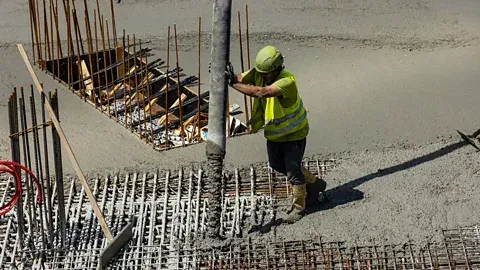
A Pennsylvania flatwork contractor needs general liability that keeps covering driveways, sidewalks and patios after they are finished, workers’ compensation from either the state fund or an authorized carrier, and a residential contractor registration for most residential work. The coverage itself is the same as anywhere else. The Pennsylvania rules around it are what change the paperwork.
This post is for contractors who place and finish driveways, sidewalks, curbs, aprons and patios in Pennsylvania, for house owners, builders and municipalities. For how general liability works on flatwork in any state, read general liability for flatwork concrete contractors. This post covers what Pennsylvania adds.
Registration for residential flatwork
Pennsylvania requires contractors doing covered residential work to register with the Attorney General, and it defines covered residential work to include the construction, replacement or improvement of driveways and patios (Pennsylvania Attorney General). The Attorney General’s guidance lists limited exceptions and asks applicants to show personal injury and property damage liability coverage. That makes the general liability certificate part of getting registered, not only part of winning jobs.
The same guidance says political subdivisions cannot separately license or register these contractors, with a limited exception for trade licensing tied to testing or training. Municipal sidewalk work is a different matter. Boroughs and townships commonly require a permit for work in the right-of-way, set their own sidewalk specifications, and ask the contractor for a certificate naming the municipality before the forms go in. Ask the municipal office what it wants before you bid.
Completed operations on driveways and sidewalks
Flatwork claims usually arrive after the job. A sidewalk panel heaves above its neighbor, an apron settles at the curb, or a driveway sheds water toward a garage. Someone trips, or something gets damaged, and the claim names the property owner and the contractor who poured it.
That is the products-completed operations part of general liability, explained in the completed operations post. It does not pay to tear out and re-pour your own work. It pays for injury and damage to others that the finished work causes.
Pennsylvania’s statute of repose for improvements to real property sets an outer limit for suits against those who performed the construction, measured from completion and covering injury to persons and property (42 Pa.C.S. 5536). Inside that window, a finished sidewalk is still on your record. Freeze-thaw cycles, de-icing salt and tree roots work on flatwork every winter, which is why the exposure tends to show up years after the pour.
Ground conditions add to it. Pennsylvania’s Department of Conservation and Natural Resources says karst is common to areas underlain by carbonate bedrock. Settlement is a common allegation in slab claims, so check whether your policy carries an earth movement or subsidence exclusion.
Workers’ comp in Pennsylvania
Pennsylvania requires employers under the Workers’ Compensation Act to insure the payment of compensation with the state fund or with an authorized insurance company or mutual association, unless the Department of Labor and Industry exempts the employer as a self-insurer (Pennsylvania Workers’ Compensation Act). The fund operates alongside private carriers, so a flatwork contractor has more than one place to ask. The workers’ comp options post compares the routes.
Failing to insure is a criminal matter in Pennsylvania: a misdemeanor on conviction, and a felony if the failure is intentional. The Act also makes a contractor who subcontracts work, and its insurer, liable for compensation to the subcontractor’s employees unless the subcontractor secured its own coverage. If you sub out finishing, sawcutting or stamping, collect a certificate before the crew shows up.
Next step. Send your current policies, a description of your residential and municipal work and your payroll through the quote form. We write concrete, so the questions will be the ones a concrete underwriter asks.
Real-World Scenario: A flatwork contractor replaces a stretch of sidewalk for a borough under a permit and pours several residential driveways the same season. Over the next winters a sidewalk panel heaves at a tree root and a pedestrian trips and is injured. The claim names the borough, the abutting owner and the contractor. The contractor’s completed operations coverage responds to the injury. The borough’s request to replace the panel is a separate cost the policy does not pay.
Contracts, snow and the certificate
General contractors and municipalities ask flatwork subs for additional insured status and an indemnity promise; the additional insured post explains the endorsements. Pennsylvania’s indemnification act voids certain indemnity agreements that protect architects, engineers and surveyors, and it also addresses snow removal and ice control contracts. Many flatwork crews plow in winter, so have counsel read any snow contract’s indemnity clause.
Winter plowing is a separate exposure from concrete work. Tell the underwriter about it, because a general liability policy written for concrete may not contemplate snow removal for hire.
Building the rest of the program
General liability and comp are the core. Add commercial auto for the dump trucks, pickups and trailers, and an umbrella if a municipal or commercial contract sets a higher limit. The Pennsylvania page covers the state picture, and the Pennsylvania concrete construction page shows how the lines fit together for flatwork crews. To have a Pennsylvania flatwork account reviewed, use the quote form.