

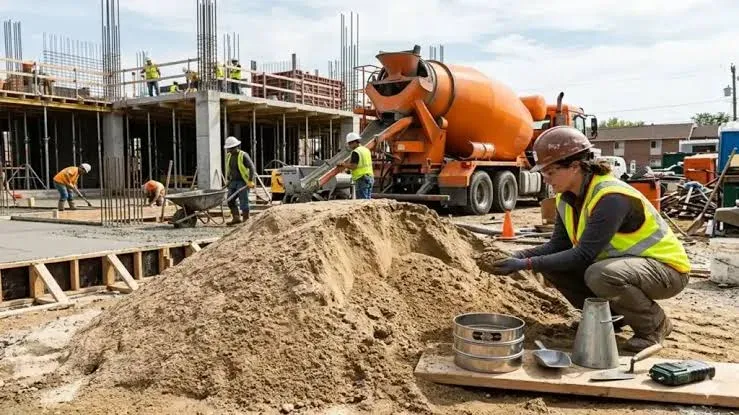
General liability for a flatwork contractor pays for injury and property damage the work causes to other people, during the pour and after the slab is finished. It does not pay to redo your own defective work. Most disputes on flatwork claims come from that second sentence.
This post is for contractors who place and finish driveways, sidewalks, curbs, patios and slabs on grade. The general liability page covers the policy for every kind of concrete operation; this post stays on flatwork.
While the job is open
The first part of the policy is premises and operations coverage. It answers for what happens while the crew is working:
- A pedestrian trips over forms, stakes or a hose left across a walkway.
- Concrete splatter or wash water damages a customer’s siding, garage door or landscaping.
- A wheelbarrow or power buggy damages an existing surface on the way to the pour.
- A truck backing to the forms cracks a neighbor’s apron. Whether that is a general liability or an auto claim depends on the facts, which the GL and auto post explains.
Flatwork is done in public view, often at an occupied property, so the people at risk are customers, neighbors and passers-by. Barricades and a clean site matter to an underwriter for that reason.
Fresh concrete also draws foot traffic. Repairing a marked-up surface is your own cost, but an injury to someone who walks into an unmarked pour is a liability claim.
After the slab is finished
The second part is products-completed operations coverage. It applies once the work is complete or put to its intended use, and for flatwork it is where the serious claims arise:
- A lip between sidewalk panels becomes a trip hazard and someone is injured.
- A slab pitched toward a building sends water into a finished space.
- A surface that scales or stays slick contributes to a fall.
The completed operations post explains the coverage, and the completed operations aggregate post explains how its limit works. The practical point is that completed work is still an exposure after the crew has left the site.
Where the policy stops
General liability is not a warranty. The standard form excludes the cost of repairing or replacing your own defective work, so a driveway that cracks, scales or settles is usually a business cost. The policy responds when that slab injures someone or damages other property.
Three parts of the form deserve a careful read on a flatwork account:
- The subcontractor exception. Many policies restore coverage for damage to completed work when a subcontractor performed it. Some carriers remove that exception by endorsement. If you sub out finishing or sawcutting, find out which version you have.
- Earth movement or subsidence. Some policies exclude damage tied to settling or movement of soil. Settlement is a common allegation in slab claims, so this exclusion can remove the claims a flatwork contractor is most likely to see.
- Residential work. Some policies limit or exclude work on new homes, tract developments or condominiums. A contractor who pours driveways for builders should confirm that the work is inside the policy.
Next step. Send the policy or the quote through the quote form with a short description of your work. We read the form before it binds.
Real-World Scenario: A flatwork contractor replaces a section of sidewalk in front of a retail building. Months later the new panels settle unevenly against the old ones, and a customer of the store trips at the joint and is injured. The claim names the store, the property owner and the contractor. The contractor’s completed operations coverage is the part of the policy that responds to the injury. The cost of re-pouring the panels is a separate matter that the policy does not pay.
Contracts, licenses and the certificate
Owners and general contractors ask flatwork subs for a certificate of insurance and usually for additional insured status. The additional insured post explains the endorsements. State law limits how far these clauses reach. New York voids a construction-contract promise to indemnify another party for that party’s own negligence (N.Y. General Obligations Law § 5-322.1), and Ohio treats the same kind of promise as void (Ohio Revised Code 2305.31).
Licensing can also name flatwork. South Carolina’s contractor licensing chapter lists Concrete as a subclassification that covers sidewalks, driveways, curbs, medians and barrier walls (S.C. Code Title 40, Chapter 11). Where a state licenses the work, the certificate request may ask for the license number as well.
Building the rest of the program
General liability is one line. A flatwork crew also needs workers’ compensation for employees, commercial auto for the trucks and trailers, and often an umbrella to meet a contract’s limit requirement. The concrete construction page shows how the lines fit together for install crews. To have a flatwork account reviewed, use the quote form.