

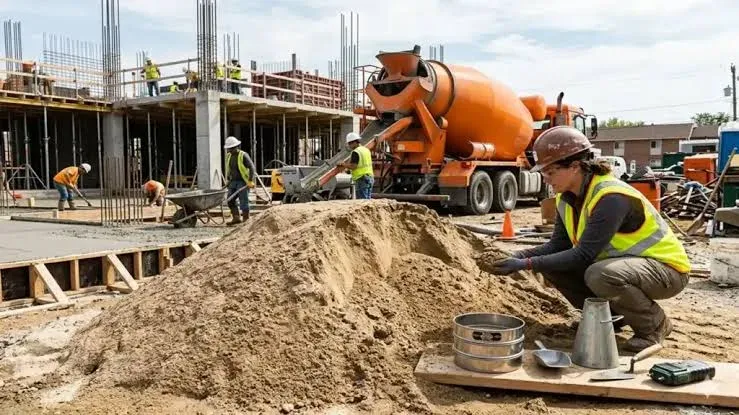
For a concrete contractor, one sentence sorts almost every coverage question: general liability covers the work and the harm it causes, and commercial auto covers the vehicles. General liability is the line for the completed installation you leave behind and the third-party harm your operation causes — including the pumping power-line exposure. Commercial auto is the line for the boom pump truck and the ready-mix mixer fleet. Where one stops, the other begins, and the trades that get burned are the ones that blur the two.
This post makes that distinction its own subject, because for this class it is the defining discipline. It walks through what general liability answers, what commercial auto answers, exactly where the seam falls, and the two other seams — workers compensation and commercial property — that round out the program. The goal is simple: so that every loss a concrete business can have already has a clear home before it happens.
The one-sentence rule
Hold onto this and most of the confusion disappears: general liability is the work and the harm; commercial auto is the vehicles. General liability answers for the people and property around your operation and for the work you leave behind. Commercial auto answers for the trucks — on the road and maneuvering on site — and for the physical damage to the trucks themselves.
The reason this needs saying at all is that a concrete operation loads serious risk on both sides at once. The trucks are among the heaviest and most valuable assets the business owns, and the work can cause catastrophic third-party harm. An owner who assumes a single policy covers “the business” finds, during a claim, that the two lines are separate — and that the separation is exactly what decides which one answers.
General liability: the work and the harm it causes
General liability is the foundation policy, and for a concrete contractor it carries two signature exposures. The first is completed operations — the coverage for the work you leave behind. After a crew pours and finishes a slab, footer, driveway, or foundation and leaves the site, that installed concrete keeps existing, and if it fails downstream and injures someone or damages property, general liability is built to respond. In the standard ISO commercial general liability form — typically the occurrence-based CG 00 01 — that coverage attaches to “your work,” the finished installation. It is the installer’s signature exposure, and it has its own completed-operations explainer.
The second is the power-line exposure on the pumping side: a boom pump truck whose boom contacts an overhead line during placement, causing severe third-party bodily injury and property damage. That harm, too, is general liability — the work acting on the world around it. Both exposures share the same logic: general liability answers the harm the work causes to third parties. The full line is laid out on the general liability page.
Commercial auto: the vehicles
Commercial auto is the line that covers the trucks. For a concrete business that means two vehicle profiles above all. The boom pump truck is often the single most expensive item the contractor owns — a high-value mobile asset whose auto liability on the road and at the job site, and whose physical damage if it is wrecked or stolen, both run through commercial auto. The ready-mix mixer fleet is a trucking operation first, a motor-carrier fleet whose auto liability is the dominant line.
On a business auto policy, coverage is assigned through the ISO covered-auto symbols — numbers that designate which autos a given coverage applies to, such as any auto, specifically described autos, hired autos, and non-owned autos. The symbols are how the policy is matched to your owned, hired, and non-owned trucks. What commercial auto does not answer is the work your crews perform or the third-party harm the work causes — that is general liability. The vehicles are auto; the work is general liability. The full line is on the commercial auto page.
Where one stops and the other begins
The clearest test case is the pump boom, because it is where the seam is easiest to misread. When a boom contacts an overhead power line and injures a spotter or a bystander, that catastrophic third-party bodily injury is general liability — the work acting on the world, not the vehicle causing an accident. But the truck that carries the boom — its physical damage, its road liability — is commercial auto. The same event can involve both, and the two lines split the pieces cleanly: the harm the boom causes is general liability; the vehicle is auto. That single example has its own power-line explainer.
The logic runs the other way too. A slab or foundation that fails downstream is general liability’s completed-operations exposure, never an auto loss — no vehicle caused it. A mixer that rolls on the highway is a commercial-auto loss, never a general-liability claim — the vehicle caused it. The question is always the same: did the work cause the harm, or did a vehicle? Answer that, and the loss has a home.
Real-World Scenario: A crew arrives on a pour and, while a boom pump truck is maneuvering into position on a tight site, it clips a parked third-party vehicle — and separately, during placement, the boom comes too close to an overhead line and a bystander is hurt. Two things happened in the same afternoon, and they run to two different lines. The truck striking the parked vehicle is a commercial-auto loss — a vehicle causing an accident. The boom contacting the line and injuring a third party is a general-liability loss — the work causing harm. The contractor who keeps the seam clean already knows which policy answers which piece, instead of arguing it out after the fact.
The other two seams: workers compensation and property
The work-versus-vehicles line is the main event, but two more seams complete the picture. Injuries to your own crew do not run through general liability, which answers third-party harm, or through commercial auto — they run through workers compensation, the line built for employee injury. So a serious pour can touch three liability-side lines at once: general liability for the third parties hurt, workers compensation for your own people, and commercial auto if a truck was involved.
The fourth seam is your own physical assets. Your building, the yard, and the equipment you own are not covered by any of the three liability lines — those answer harm to others, injury to your crew, and the vehicles. Your own property runs through commercial property. Four lines, four jobs: the harm to others, the vehicles, your crew, and your own assets. Keeping them apart is how a concrete contractor knows which policy answers a given loss.
Why the distinction is the discipline
The reason this brand treats the seam as its defining discipline is that concrete loads risk on every side of it at once — heavy high-value trucks, work that can cause serious third-party harm, a crew in a hazardous trade, and valuable owned assets. Write it all off one vague idea of “business insurance” and a claim can land in a gap between policies that both looked like they should respond. Keep the lines clean and every loss has a clear home.
That is what it means to build a program rather than buy a policy. When you are ready, start a quote and tell us how you operate, or read the two lines at the center of the seam — general liability for the work and commercial auto for the trucks — and see where an umbrella sits above both. Browse the full coverage overview to see how the whole system fits together. The seam is not a technicality; it is the thing that decides which policy answers when a loss arrives.