Concrete pumping insurance · Idaho
Concrete Pumping Contractor Business Insurance in Idaho
Insurance for the Idaho concrete pumping contractor — boom, line, and trailer pump operators placing concrete for other crews across Boise, Meridian, Nampa, Idaho Falls, Pocatello, and Coeur d’Alene. Two exposures define the pump-truck model at once: the power-line bodily-injury risk when a boom works under Idaho’s long rural overhead runs on open and mountain-access sites, and the high-value boom pump truck as the single most expensive asset you own — read against Idaho’s competitive private workers-comp market and its contractor-registration regime.

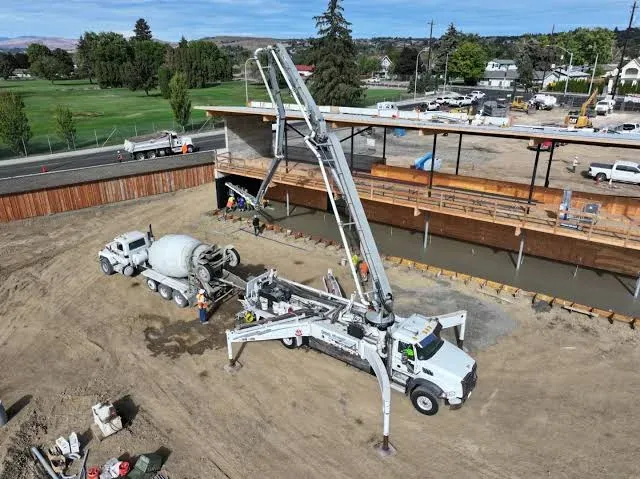
Picture an Idaho pump setup and you rarely picture a downtown canyon. You picture a boom truck parked at the edge of a new subdivision pad on the outskirts of Meridian, or on a graded foothill lot above the valley floor, with a long steel boom swinging out over the pour — and a line of poles and open conductors running the road behind it. That is the defining scene of concrete pumping in Idaho, and it is why the trade is its own operating model here and not a coverage line. An Idaho pumping contractor does not pour and finish installed work, and does not run a fleet of delivery trucks. A pumping contractor places concrete for other crews, through a boom, a line, or a trailer pump, on the subdivision pads, tilt-up walls, commercial slabs, and foundations a fast-growing but still largely low-rise state builds. The boom is what sets this trade apart from every other concrete operation in Idaho, and here it mostly works out in the open, under long rural overhead runs, rather than up the face of a high-rise.
Two exposures define the pump-truck model, and they carry equal weight. The first is the power-line exposure. A boom is a long, conductive steel arm, and Idaho’s ordinary condition — an open subdivision, a valley-edge lot, a rural site with poles and conductors following the road — puts that arm under overhead lines on setup after setup. Contact is a known catastrophic hazard: it can energize the boom, the truck, and the ground around it, with severe and frequently fatal third-party bodily injury to spotters, finishers, and bystanders. That third-party bodily injury and property damage runs through general liability, and we describe its severity qualitatively, without dressing it in statistics it does not need. The second is the boom pump truck itself. An Idaho pumping contractor typically owns ONE very-high-value mobile asset — often the most expensive item in the business — and its auto liability on long rural highways and mountain grades and at the placement site, plus the physical damage that protects the asset, run through commercial auto. Neither exposure belongs to an installation crew or a delivery fleet; both belong only to pumping.
This page covers how concrete pumping insurance is built for that model in Idaho: placing under the state’s long overhead runs, where a boom still earns its keep in the Treasure Valley, the contractor-registration and competitive-comp reality a pump crew works under, the coverage stack it leans on, and the drivers that move cost. Pumping is the straddle in the middle of the trade — but it is not a blend of the operations beside it. It is the boom: the exposure only a pump has, on the truck only a pumper runs. If your Idaho operation also pours and finishes installed work, the Idaho concrete contractor page is built for that model; if you also haul ready-mix, the Idaho ready-mix page is built for that one.
Running a pump truck in Idaho? Get a quote built around the boom — the power-line exposure and the high-value truck.
Get a Free QuoteThe long-overhead-run problem in a low-rise state
Most pumping markets are framed around vertical density — a boom’s value is its height, and the hazard is the conductor a tall pour swings toward. Idaho inverts that. The state is growing fast, but it is still overwhelmingly a low-rise, spread-out place, and its defining pumping exposure is not congested vertical work; it is the long overhead distribution run. Poles and open conductors follow nearly every rural road, thread the raw edges of new subdivisions before service goes underground, and cross the valley-floor and foothill sites where most Idaho concrete is placed. A boom does not need a high-rise to meet a line here. It only needs the open sky an ordinary subdivision pad or commercial pad sits under, and that sky is crossed by wire almost everywhere the work happens.
That changes where the severity lives. In a dense downtown, a spotter is watching a specific conductor above a specific pour, and the whole crew treats the setup as a wire job from the first outrigger. On an open Idaho lot, the line can read as background — a pole run at the property edge, a service drop to a nearby structure, a distribution line along the county road — and background is exactly where clearance discipline slips. The boom is long, the lot is open, the operator is reaching across the pad, and the arm passes through airspace nobody flagged as hazardous because the site did not feel like a wire site. The catastrophe does not require a tall building; it requires a long boom and an unflagged line, and Idaho supplies both in volume.
The terrain sharpens it further. The Treasure Valley floor is flat and buildable, but its edges rise into the foothills, and the rest of the state is mountain-valley country spread across the Rockies and the high plains. Setups on graded foothill lots put the truck on a slope with the pour above or below it, forcing careful outrigger leveling and a boom geometry that swings the reach through more airspace than a flat pad would — and more of that airspace, on a valley-edge or rural site, is occupied by an overhead run. Long highway and mountain-grade travel between a yard and a scattered set of jobs adds road exposure on top of the placement exposure. None of this is high-rise risk. All of it is boom-under-a-line risk, and it is the through-line of the whole state. We separate that power-line exposure from the truck exposure so a program is weighted to the risk the work actually carries rather than to a vertical profile Idaho does not have.
Where a boom still earns its keep in the Treasure Valley
None of that means a boom is idle in Idaho — it means its value shows up in a different shape. The Treasure Valley around Idaho’s core metros of Boise, Meridian, and Nampa is the growth engine, and the volume there is horizontal: subdivision after subdivision of foundation and flatwork pours, commercial pads for the retail and warehouse building that follows rooftops, and tilt-up wall work where a boom places concrete into forms faster and more precisely than any other method. That is where a boom earns its keep in Idaho — not by reaching many stories up, but by moving high volumes of concrete efficiently across spread-out pads and into tilt-up panels, day after day, on the horizontal build that a booming valley demands.
There is a genuine vertical corner, and it matters because it concentrates a sharper version of the same exposure. Downtown Boise carries the state’s only real cluster of mid-rise and taller commercial work, where a long boom’s height becomes essential and the placement sits in a tighter, more built-up setting closer to a denser overhead. It is limited and concentrated — Boise is the one place in Idaho where the trade looks like the vertical pumping people picture — but it exists, and a contractor who works it runs the tallest-reach, tightest-clearance jobs in the state. Around it, Idaho Falls, Pocatello, and Coeur d’Alene anchor smaller regional markets where the work is again mostly low-rise commercial and residential placement under local overhead, and the long rural runs between towns reassert themselves the moment a crew leaves the built-up core.
The honest read is a state in transition. The fast horizontal subdivision and tilt-up volume of the Treasure Valley is the present tense of Idaho pumping; a slowly rising base of Boise mid-rise is the leading edge of where it may go; and the long rural overhead runs and mountain access are the wrapper around all of it, shaping most setups regardless of what is being poured. A program built for an Idaho boom operation has to hold both characters at once — the open, spread, overhead-lined default and the tighter downtown-Boise exception — without pricing either as if it were the whole state. We weight the stack to the two exposures the model actually carries and read where a given contractor’s work actually sits along that transition.
Idaho registration and workers comp
Two facts frame how an Idaho pump operation’s program is built, and neither is a monopolistic-state quirk. The first is registration. Idaho regulates contractors through registration rather than a competency-exam license, and there is no separate concrete-contractor credential to hold. The state requires contractors to register for construction work above a low threshold, issued through the Idaho Contractors Board within the Division of Occupational and Professional Licenses. The exact classification depends on the work you perform, and the general contractor or project owner layers its own insurance, certificate-of-insurance, and additional-insured requirements on top of that registration. The gate in Idaho is the registration and the contract stacked on it, not a trade-specific concrete or pumping license — and we confirm the credential that actually applies to your pumping work rather than inventing one the state does not issue.
The second is workers comp, and here Idaho is a straightforward competitive-market state. Comp is placed with a private carrier — Idaho is not a monopolistic state fund, so the coverage for the operator, spotter, and finishing crew on the pour runs through a private policy we place alongside the rest of the program. That matters for a pump crew because placement is a hazardous operation and the crew is typically small; a single boom-side incident can be severe, and comp is the line that responds to an injured crew member. Many general contractors and project contracts require it regardless of headcount. We structure comp to the real crew, the operator and spotter payroll classifications, and the way the work is done, and we coordinate it with the general liability, commercial auto, umbrella, and property lines beside it so the whole operation is covered and nothing falls in the gap between them.
Read together, the two facts describe a state where nothing is reserved to a government monopoly and nothing is left to a nonexistent statewide competency license — the entire program is placed in the private market, and the gate to working is a registration plus whatever a project’s contract demands. That is a cleaner build than a monopolistic state, but it puts more weight on getting the private stack right, because every line that responds to a pump operation’s worst day is one we place. Pumping demand in Idaho tracks that build directly: the boom serves the horizontal subdivision and commercial volume of Boise, Meridian, and Nampa, the mid-rise corner of downtown Boise, and the regional work around Idaho Falls, Pocatello, and Coeur d’Alene — and on nearly all of it, the boom is working under the overhead that defines the trade’s worst exposure.
The coverage stack for an Idaho boom operation
Here is the stack an Idaho pumping contractor carries, weighted for the boom model — with comp placed in the competitive private market and every line coordinated around the two co-equal exposures. Each line links to its full page, and because pumping leads with two exposures at once, general liability and commercial auto are the co-signature placements.
- General Liability Insurance — co-signature: the power-line exposure. The third-party bodily injury and property damage when a boom contacts an overhead line during placement — the catastrophic, often fatal loss that defines pumping, and the one Idaho’s long rural runs make an everyday-setup risk — along with the ordinary on-site injury and damage the work can cause.
- Commercial Auto Insurance — co-signature: the boom pump truck. Auto liability on long Idaho highways and mountain grades and while maneuvering at the placement site, plus physical damage protecting the single most expensive asset the business owns.
- Umbrella Liability Insurance — excess limits above general liability and commercial auto for the catastrophic power-line claim that runs past a primary layer, which is exactly why an Idaho boom operation working under open overhead runs tends to need real excess.
- Workers Compensation Insurance — placed in Idaho’s competitive private market for the operator, spotter, and finishing crew on the pour, structured to the real payroll classifications and coordinated with the liability lines rather than treated as a formality.
- Commercial Property Insurance — the lighter line for the boom model: the yard, shop, and stored equipment against fire, theft, and the external perils a facility carries, since the highest-value asset is the truck on commercial auto rather than a fixed plant.
What moves cost for an Idaho pump operation
Premium tracks the operation, not a sticker price. The drivers that move it most are the type and replacement value of the pump equipment you run — boom trucks versus line or trailer pumps — the heights and site conditions you place in and how often that puts a boom under Idaho’s open overhead runs, your payroll and the operator and spotter classifications behind it, your driving records and auto-loss history across long rural highway and mountain-grade travel, the limits your contracts demand, and your clearance and spotting discipline on open and valley-edge sites. Because comp is a private-market line here, it is priced alongside the general liability, commercial auto, umbrella, and property rather than reserved to a state fund. We price to that real picture and stand behind any figure we give — verified ranges come from us directly, never a generic guess.
Claims scenarios
These are plausible Idaho pumping claim categories, described qualitatively and with generic carrier language — every claim is handled by the carrier, never named here — and with no fabricated cost or frequency figures.
- A boom contacts an overhead line. A boom swung across an open Treasure Valley subdivision pad or a valley-edge foothill lot touches an energized roadside conductor and a spotter or bystander is injured — a catastrophic third-party bodily-injury claim on general liability, with the severity that drives the need for an umbrella above it.
- The pump truck is in an accident. The boom truck is in a collision on a long rural Idaho highway or a mountain grade, or is damaged maneuvering on a graded site — auto liability and physical damage on commercial auto, protecting the high-value asset.
- A line or pipe fails under pressure. A pumping line or pipe lets go during placement and causes injury or damages property that is not yours — a third-party general-liability exposure on the operation.
- A crew member is hurt on the pour. An operator, spotter, or finisher is injured during placement — a workers compensation claim placed in Idaho’s competitive private market, coordinated with the liability lines beside it.
Underwriting an Idaho boom risk
Carriers writing the pumping class in Idaho look at the boom and the discipline around it: the type, age, and value of the pump equipment, the heights and site conditions the work puts a boom into and how close that brings it to the overhead runs that cross open and rural sites, your driving records and auto-loss history over long rural highway and mountain-grade travel, your operator and spotter payroll, and your clearance and spotting practices. A well-maintained pump truck with documented clearance procedures, trained spotters, and a clean liability and auto history opens more markets; aging equipment, a power-line or serious auto loss, or thin safety documentation narrows them. Because so much Idaho work happens on open sites where a line can read as background, underwriters weigh how a contractor treats an ordinary subdivision or valley-edge lot as a wire job — that habit is worth more here than in a state where every job is visibly a canyon. A contractor who also installs or hauls gets that portion underwritten separately so the pumping book is not subsidizing — or stranding — the rest. We position your operation to the carriers most likely to want a boom risk rather than sending one generic submission everywhere.
Why Concrete Guard Insurance
We write one class — concrete contractors — and within it we treat Idaho pumping as the boom operation it is, not as a version of a general contractor or a mixer fleet, and not as a vertical high-rise profile the state does not actually have. We weight your stack toward the two exposures the pump-truck model actually carries: the power-line bodily-injury exposure on general liability and the high-value boom truck on commercial auto, with an umbrella sized to the catastrophic severity of a power-line loss under Idaho’s long rural overhead runs. We read the seam between the work and the truck so a boom-contact injury runs to general liability and the truck itself runs to commercial auto, we place comp in the competitive private market and confirm the contractor registration that actually applies, and we underwrite any installation or hauling you also do on its own terms. Start with a quote, or talk it through with us first.
Learn more
Concrete pumping is one of three operating models we write in Idaho, and the coverage stack shifts with the work. The two signature exposures for this model live on the general liability page (the power-line exposure) and the commercial auto page (the boom truck), with umbrella liability close behind for the catastrophic severity. The model itself is detailed on the Concrete Pumping Insurance pillar. If your Idaho operation also pours and finishes installed work, the Idaho concrete contractor page leads with the completed-operations profile; if you also haul ready-mix, the Idaho ready-mix page leads with the motor-carrier trucking profile.
Coverage for Idaho concrete pumping contractors
- General Liability Insurance
- Commercial Auto Insurance
- Commercial Property Insurance
- Workers Compensation Insurance
- Umbrella Liability Insurance
Insurance by operating model
Get covered
Primary sources
Frequently asked questions about Idaho concrete pumping insurance
Why does the power-line exposure lead a pumping page for a low-rise state like Idaho?
Because a boom is a long, conductive steel arm, and Idaho’s defining condition is not vertical density but the long overhead distribution run — poles and open conductors that follow every rural road and thread the edges of fast-growing Treasure Valley subdivisions. Most of the state’s pumping work is horizontal and low-rise: subdivision pads, tilt-up walls, commercial slabs, and foundation pours on graded foothill and valley lots where the truck sets up in the open, not in a shielded downtown canyon. That open setting is exactly where a swung boom and a roadside line can meet. Contact can energize the boom, the truck, and the ground around it, causing severe and frequently fatal third-party bodily injury by electrocution to spotters, finishers, and bystanders, along with property damage. We describe that severity plainly and qualitatively, without inventing statistics, because it does not need them. General liability is built to respond to that third-party bodily injury and property damage, which is exactly why an umbrella sits above it for an Idaho pump operation. Clearance from lines, trained spotters, and treating every line as energized sit alongside the coverage, not in place of it.
Is my boom pump truck covered on the road and at the pour in Idaho?
Yes — commercial auto generally responds both while the truck is driven on Idaho roads, including long rural highway runs and mountain grades between the yard and a job, and while it is positioned, leveling outriggers, and maneuvering at the placement site, because the unit is in use as a vehicle in both settings. Physical damage — collision and comprehensive — protects the asset itself against an accident, theft, fire, or other covered peril, which matters because the boom pump truck is typically the single most expensive item an Idaho pumping contractor owns. The line between an auto loss and a general-liability loss depends on what happened: damage to the truck is commercial auto, while third-party harm caused by the work, including a boom contacting a power line, is general liability. We read that seam against your operation before binding.
How does Idaho workers comp work for a pump crew?
Idaho runs a competitive private workers-compensation market, so comp for the operator, spotter, and finishing crew on the pour is placed with a private carrier rather than a state fund — Idaho is not a monopolistic state. Placement is a hazardous operation, and for a typically small crew, a single boom-side incident can be severe, so comp is not a formality. Many general contractors and project contracts require it regardless. We structure comp to the real crew, the operator and spotter payroll classifications, and the way the work is done, and we coordinate it with the general liability, commercial auto, umbrella, and property lines beside it so nothing falls in the gap between them.
Do concrete pumping contractors need a license in Idaho?
Idaho does regulate contractors, but through registration rather than a competency-exam license, and there is no separate concrete-pumping credential. The state requires contractors to register for construction work above a low threshold, issued through the Idaho Contractors Board within the Division of Occupational and Professional Licenses — registration, not a trade-specific concrete license. The exact classification depends on the work you perform, and the general contractor or project owner layers its own insurance, certificate-of-insurance, and additional-insured requirements on top of that registration. We confirm the credential that actually applies to your pumping work in Idaho — the contractor registration and the requirements a project stacks on it — and never invent a separate pumping license the state does not issue.
How is Idaho concrete pumping insurance different from a construction or ready-mix policy?
The boom. A concrete construction contractor pours and finishes installed work, and the exposure that defines that model is completed operations — a slab or foundation that fails downstream after the pour. A ready-mix operation runs a mixer fleet under federal and state motor-carrier rules, where auto liability across many trucks is the dominant line. Pumping is neither: it places concrete through a boom, which creates the power-line bodily-injury exposure no installation crew or delivery fleet carries, and it concentrates value in ONE very-high-value pump truck rather than a labor-heavy crew or a fleet. A policy rated to either neighbor underprices the power-line severity and the high-value truck both.
I both pump and pour or haul concrete in Idaho — which page is mine?
This page is built for the pumping side: the boom, the power-line bodily-injury exposure on general liability, and the high-value boom pump truck on commercial auto. If you also pour and finish installed concrete, that work carries the completed-operations exposure of an installation model and lives on our Idaho concrete contractor page. If you also haul ready-mix, that is a motor-carrier trucking operation and lives on our Idaho ready-mix page. An operation that does more than one is not a single blended policy; it is each scope underwritten on its own terms, so the pumping book neither subsidizes nor strands the rest.
Insure your Idaho pump truck the way it runs
Tell us about the boom you run, the open and valley-edge placements you take on, and the truck you depend on, and we will market it to carriers that write the concrete pumping class.