
Workers compensation is the coverage for your own crew when a worker is hurt on the job, and for a concrete contractor it is one of the heaviest lines on the program — because the work is physical and the crew carries real injury exposure. It is built to pay for medical care, replace a portion of lost wages, provide disability benefits, and, through the employers-liability piece, stand behind the business when a workplace injury becomes a liability. In most states it is legally required once you have employees, which makes it not optional but foundational.
The part worth understanding well is that a piece of its cost is genuinely in your hands. This post explains what workers comp covers for a concrete crew, describes the injury exposure honestly and without inventing statistics, and then focuses on the experience modification factor — the experience mod, or EMR — the part of the cost your safety and claims record actually moves. It also covers how premium is built on payroll and class of work, and the four monopolistic states where coverage runs through a state fund rather than a private carrier. Throughout, the distinction that matters most holds: workers comp is for your crew, general liability is for third parties.
Why workers comp is the concrete crew’s heaviest line
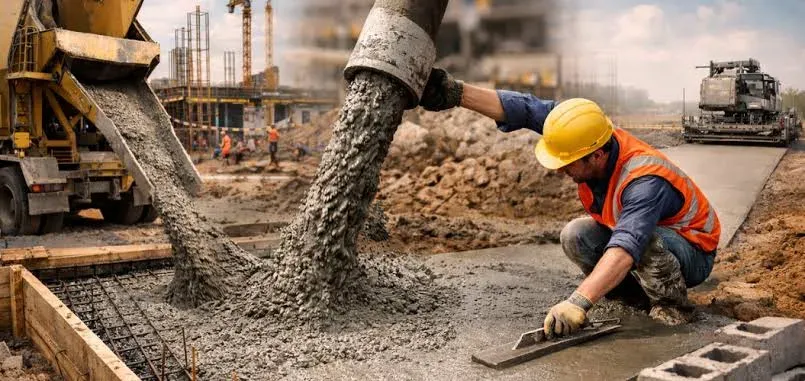
Concrete is among the more physically demanding trades, and that shapes everything about this line. The install and finishing hands carry the heaviest of it — lifting and placing materials, pouring and finishing, setting and stripping forms, working bent and kneeling for hours, around heavy material and equipment. Strains and overexertion, struck-by hazards, slips and falls, and dust exposure including silica are part of the physical reality of the work. The pump crew and the concrete construction crews doing the pour carry their own exposure too, from the equipment they run to the demands of the job.
We describe this exposure in plain, qualitative terms on purpose — the point is that concrete work is genuinely hard on the people who do it, and that is exactly why the coverage matters. Workers compensation is the line that responds when the physical demands of the trade turn into an injury, and it is built to take care of the worker and protect the business at the same time. Because the crew is where the exposure lives, it is also where the cost lives — which is what makes the experience mod worth managing rather than accepting.
Real-World Scenario: A finisher on a large pour reaches and lifts awkwardly late in a long shift and injures his back, and he is off the job for weeks of treatment and recovery. Workers compensation is the line that responds: it pays for the medical care and replaces a portion of the wages he loses while he heals, and the employers-liability piece stands behind the business if the injury turns into a liability. But the story does not end when the worker recovers. That claim becomes part of the loss record the experience mod is built on, which is why how the injury is prevented, handled, and closed out matters not just for the worker but for what the coverage costs the business over the years that follow.
What the experience mod actually is
Of everything on a workers comp policy, the experience mod is the piece a concrete contractor should understand best, because it is the one the business can move. The experience modification factor — the experience mod, or EMR — reflects your own claims history and adjusts your premium up or down relative to others doing the same work. Put simply, it compares your loss record against what is expected for your class of work and turns that comparison into a factor applied to your premium.
A record of fewer and less severe claims pulls the mod in your favor; a worse record pushes it the other way. It is not a penalty or a reward handed down arbitrarily — it is a mechanism that ties your cost to your own experience over time. We do not promise a number, because honest advice does not work that way, and the exact calculation depends on the rating system that applies to you. What we do is explain how the mod works and where its levers are, so it stops being a line item you feel you cannot change.
How the mod becomes a cost you can control
The reason the experience mod matters so much for a concrete contractor is that it is not fixed by the trade you are in — it is driven by your own record over time. That makes it a controllable cost, and the levers are the things a good operation already cares about. A genuine safety program that reduces the frequency and severity of injuries pulls the mod one way. Prompt, well-managed handling of the claims that do happen — and getting workers back to appropriate duty when they are able — keeps individual claims from doing more damage to the record than they need to.
None of that moves the mod overnight, because the mod reflects a record built over years, not a single quarter. But that is exactly why it rewards a business that treats safety as an operating discipline rather than a poster on the wall. For a labor-heavy concrete crew, the mod is one of the largest long-term costs the business can actually affect, which is why it is worth managing deliberately. We do not promise a figure — we focus on the levers, because that is the honest and the useful thing to do.
How the premium is built: payroll and class of work
Understanding the mod is easier once you see where it sits in the premium. Workers compensation premium is built primarily on your payroll and how that payroll is classified by the kind of work your employees do. Workers comp uses payroll-based class codes to group similar work together, so the payroll of a crew doing physical concrete work is rated to that work rather than to something less demanding. The experience mod is then applied on top of that base, adjusting it up or down for your own record.
Getting the classification right matters more than any single figure. If your payroll is classified accurately to the work your crews actually do, the premium reflects the real operation rather than getting corrected at audit after the fact. We treat this qualitatively on purpose and read your operation before quoting, so there are no surprises when the audit comes around — the classification, the payroll, and the mod all describing the business as it really runs.
The monopolistic states: North Dakota, Ohio, Washington, and Wyoming
There is a piece of honesty this line owes every concrete contractor, because it changes how coverage works depending on where your crews are. In four states — North Dakota, Ohio, Washington, and Wyoming — workers compensation is provided through a state fund rather than private carriers. In those states, the workers compensation coverage runs through the state fund, not through a private policy an agency places.
We are straight about that: we do not write private workers comp in a monopolistic state, and we will not imply otherwise. Notably, the experience mod as it works in the private market is a rating mechanism, and the monopolistic states run their own systems — another reason a contractor working across state lines cannot assume one approach answers everywhere. What we do is help you understand where your crews work and how that maps to the coverage you carry, so you know exactly how your workers comp is handled in each place rather than assuming a single policy covers every state your crews travel to.
Workers comp vs general liability: who gets hurt
It is worth naming the seam plainly, because the two lines are easy to blur. Workers compensation covers injuries to your own crew — the people doing the physical work. General liability covers bodily injury and property damage to third parties — the public, another contractor’s workers, a property owner around your pour. They are separate lines built for separate exposures, and a concrete business needs both. There is a further seam to keep clean: the trucks. A hurt worker runs to workers comp, a third-party injury runs to general liability, and a claim involving the pump truck or mixer fleet on the road runs to commercial auto. Each line answers its own exposure, and we write them together so none is left assumed.
Getting workers comp built around your crew
The takeaway is simple: workers compensation is the line that takes care of a hurt worker and protects the business at the same time, and it is foundational for a trade built on the hands that pour, finish, pump, and haul. The part of its cost you can most affect is the experience mod, which rewards the safety and claims discipline a good operation already practices. Make sure the coverage is there, that the payroll is classified to the work your crews really do, that the monopolistic states are handled honestly, and that the mod is managed as the controllable cost it is rather than accepted as a fixed one.
When you are ready, start a quote and tell us about your crews and where they work, read the full workers compensation page to see how the line fits together, or browse the coverage overview to see where each part of the program sits. For how the mod and the rest of the program feed into what a policy actually costs, see what drives concrete insurance cost in Texas; for the coverage that answers for the work you leave behind, see what completed operations is. The point of understanding the mod is so you can move it — a cost you manage on purpose is worth far more than one you treat as out of your hands.