

There is no set price for ready-mix insurance in Wyoming, and any figure quoted before an underwriter has looked at your fleet is a guess. A carrier builds the cost from your specific operation — and in the least-populated state in the country, that operation is defined by distance. A Wyoming mixer fleet is a regulated motor carrier that often runs long, empty highway and mountain pass to reach a pour, and that road exposure, not a labor line, is where the cost concentrates. This guide walks the drivers that decide what a Wyoming ready-mix producer pays.
That answer disappoints owners who just want a number, but it is the honest one, and for a ready-mix operation the drivers are distinct enough that understanding them beats a fake average. A fleet delivering inside Cheyenne and one hauling to a remote well site are the same class only in name. Below is what moves the number, led from what makes Wyoming unusual.
Distance is the Wyoming variable
Wyoming pairs the nation’s thinnest population with some of the longest empty stretches between towns, so a mixer fleet here lives or dies on distance. Energy extraction defines the delivery map: Powder River Basin coal, oil, and gas country in the northeast, and the trona and gas fields around Green River in the southwest, send ready-mix on long runs to remote industrial and well-site pours over high mountain passes and wind-exposed corridors. Those distances and grades are exactly what strain the workability window for wet concrete — the industry references the ASTM C94 standard — because a remote energy-site pour far from a batch plant burns freshness that an in-town Cheyenne or Casper delivery never touches. Plant siting and dispatch timing therefore carry a Wyoming operation as much as the trucks do.
For the full Wyoming market and regulatory picture behind these drivers, see our Wyoming ready-mix insurance page. This guide is the companion cost explainer to it.
The mixer fleet is the operation
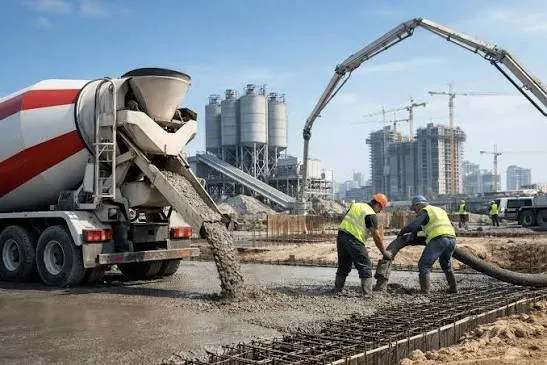
For a ready-mix producer the fleet is the business, and in Wyoming the trucks run harder and farther than almost anywhere. Commercial auto covers the fleet’s liability and physical damage, and it is the leading line for this model — the way general liability leads for an install crew and a single boom truck leads for a pumper. The cost scales with the number of trucks, their value, the miles they run, and the records of the drivers behind the wheel. When those miles are long rural runs across open country, the exposure sits squarely where commercial auto responds. How many mixers you run, what they are worth, and how far they routinely travel are the inputs that move this driver most.
A regulated motor carrier: FMCSA, USDOT, and WYDOT
A Wyoming mixer fleet is not just a set of trucks — it is a regulated motor carrier, and that profile shapes the cost. A fleet that crosses state lines operates under the Federal Motor Carrier Safety Administration and the U.S. Department of Transportation with a USDOT number, and a for-hire interstate carrier carries the MCS-90 endorsement, which guarantees a public settlement up to the applicable federal minimum. A fleet operating only within Wyoming answers instead to the Wyoming Department of Transportation, whose ports-of-entry weigh points sit on the state’s highways. Your FMCSA safety scores, your USDOT standing, and your driver qualification records are inputs a carrier reads closely — a strong profile prices better, a weak one narrows the market. This regulatory axis is unique to the ready-mix model; an install crew and a pumper never carry it.
Real-World Scenario: A for-hire producer runs interstate loads out of a Wyoming batch plant under its USDOT number and the MCS-90 endorsement, feeding a Powder River Basin energy project across a state line, while a second operator keeps its trucks inside Wyoming, registered with WYDOT and delivering around Cheyenne and Laramie. Both run mixers, but the underwriter reads them apart — the interstate carrier’s federal safety profile and the in-state fleet’s shorter, denser routes each price on their own terms. Same ready-mix class, but it is the motor-carrier picture and the length of the hauls, not the concrete, that a carrier is really pricing.
Load shift, rollover, and long grades
The distances a Wyoming fleet covers do more than test the workability window; they raise the road exposure that sits on commercial auto. A mixer truck carries a high center of gravity and a moving load, which makes it a real rollover risk — and mountain passes, grades, and wind-exposed corridors sharpen that risk on the long energy-field runs. A carrier reads your routes, your dispatch discipline, and your rollover record when it prices the exposure, and telematics and load-securement discipline are levers that show up in the record. On Wyoming’s routes, the driving the load forces is the whole story.
Where workers comp fits — and the state fund
Your plant crew and drivers put payroll on workers compensation, and in Wyoming that line has a distinctive shape: the state is monopolistic, so workers compensation is available only through the Wyoming state fund, and private carriers cannot write it here. For a ready-mix operation the comp line matters — concrete is labor-touching work — but it sits behind commercial auto in the cost picture rather than leading it, which is exactly what separates ready-mix from a general concrete crew where crew payroll leads. We are direct that the comp itself runs through the state fund, and we place the rest of the program — general liability, commercial auto, property, and umbrella — around it with private carriers in the market overseen by the Wyoming Department of Insurance.
The coverage choices that move the premium
What you buy is itself a driver. The limits your customers and contracts require push a ready-mix producer toward an umbrella that sits over the auto exposure, and higher limits cost more than lower ones — which matters when a single fleet loss on a remote highway can run high and far from help. Whether you carry commercial auto at the limits your routes and the federal minimum call for, and whether you schedule the fleet and the plant property to real value, all feed the number. For a rural fleet these are deliberate choices, not places to under-buy.
Where Wyoming ready-mix runs
Wyoming’s demand map follows its energy and infrastructure work more than its towns. Cheyenne, the capital in the southeast near the Colorado line, and Casper, the central oil hub, anchor the population, with Laramie, Gillette, Rock Springs, and Sheridan spread across the high plains and basins. Between them lie the Powder River Basin coal, oil, and gas country in the northeast and the trona and gas fields around Green River in the southwest — the remote industrial and well-site pours that pull a fleet onto its longest runs over high mountain passes. Weather sharpens the delivery math: high-elevation cold on the passes and summer heat both move the pour window a carrier already reads through the workability lens, and the wind-exposed corridors add their own driving risk to a loaded drum. None of this is a line-item on a quote, but all of it tells a carrier how hard and how far your trucks actually run. That is why describing your real routes, your longest hauls, and the sites you serve matters more for a Wyoming operation than it would for a fleet that never leaves a single compact metro.
Getting an accurate Wyoming quote
The path to a real number is to describe the real operation. Tell a broker the size and value of your fleet, your USDOT and motor-carrier profile, your driver records, the routes you run and how far, your claims history, and the limits your contracts require. From there a carrier with genuine rural motor-carrier and ready-mix appetite can price it. When you are ready, start a quote and tell us about your fleet and your distances, or browse the full coverage overview to see how each line fits. For the broader cost picture across concrete models, see our concrete insurance cost guide, and for the Wyoming market behind these drivers, the Wyoming ready-mix insurance page. The number at the end will reflect your business, which is the only number worth having.