Ready mix insurance · Vermont
Ready Mix Concrete Business Insurance in Vermont
Insurance for the Vermont ready-mix operation — a fleet of mixer trucks delivering wet concrete is a trucking business first, and in Vermont it is terrain, not traffic, that shapes the haul. Commercial auto is the dominant line, the fleet runs under the federal motor-carrier regime (DOT and FMCSA, the USDOT number, and the MCS-90 endorsement), and Vermont workers comp lands on the drivers and the batch-plant yard crew.

A ready-mix operation in Vermont is its own operating model, not a coverage line — and what defines its insurance is a fleet of mixer trucks hauling heavy, perishable loads across some of the most demanding terrain in the country. A producer batches concrete and delivers it with those trucks, and in Vermont it is the mountains and the two-lane roads, not city traffic, that decide how a loaded drum runs. That is a very different risk picture from a crew that pours flatwork or a contractor that runs a single pump, and it demands a program built around the trucks, the grades, and the drivers rather than a generic business policy.
Start where Vermont ready-mix risk actually starts: the terrain and the clock. The Green Mountains form a spine down the state, and a heavy loaded mixer climbs those grades slowly and descends them with real care, while river valleys and winding rural two-lane routes stretch the distance between dispersed valley and hillside jobsites. That matters because ready-mix concrete is perishable — the ASTM C94 workability guideline describes how long a batched load stays placeable from the plant to the forms — and in Vermont it is the slow climbs and the winding routes that eat into that window rather than congestion. Scheduling has to account for elevation and distance as much as for the set-up clock, and a batch plant serving spread-out sites is planning around geography first.
On top of that terrain sits the exposure at the center of the whole model: the fleet itself. The mixer trucks are the operation, and they create liability the moment they leave the yard. A fully loaded mixer carries a liquid load that is high and that shifts as the drum turns — a center of gravity that makes rollover a severe risk, sharpened on a mountain descent and on narrow, off-camber routes where there is little room for error — and any at-fault accident is potentially catastrophic. The line that answers for all of it is commercial auto: auto liability for the third-party harm the trucks cause and physical damage for the trucks themselves. For ready-mix that is the dominant line, and the MCS-90, where it applies to a for-hire interstate fleet, is the federal financial-responsibility endorsement that backstops the public after a covered loss.
This page covers how ready mix insurance is built for the Vermont trucking-first model — the mountain-grade haul, the coverage stack it leans on, the federal-and-state regulatory axis, the competitive workers-comp market that covers the drivers, and the registration-and-contract gate that stands in for a license. Ready-mix is not the install model and it is not the single-pump model; the Vermont concrete construction insurance page leads with completed-operations on installed work that must survive deep freeze-thaw, and the Vermont concrete pumping insurance page is built around mountainous boom-setup terrain and the rural overhead-line exposure. Many Vermont producers do more than one, and each scope is rated on its own terms.
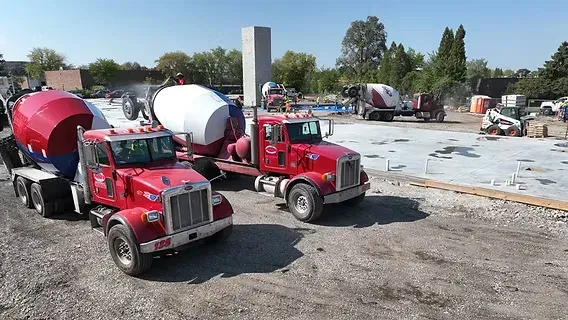
Running a mixer fleet in Vermont? Get a quote built around commercial auto, the federal motor-carrier layer, and the grades you actually climb.
Get a Free QuoteGreen Mountain grades and winding routes: the terrain a loaded drum fights
What makes Vermont distinctive for a ready-mix fleet is that terrain, not traffic, is the governing constraint, and a heavy loaded mixer is exactly the vehicle that terrain punishes. The Green Mountains run the length of the state, so a loaded drum spends real time on grade — climbing slowly enough to stretch delivery time, and descending carefully enough that brakes and stability are constant concerns on a truck carrying a high, shifting liquid load. Between the ridges, river valleys and winding two-lane rural roads connect dispersed valley and hillside jobsites, so even a short straight-line distance can be a long, slow haul in practice. Grade-restricted rural roads add their own limits on where a loaded truck can travel at all. The result is a fleet whose delivery radius is defined by elevation and switchback as much as by mileage, and whose driving exposure builds on descent and on narrow shoulders rather than in a metro core. We build the commercial-auto and fleet program around the routes your trucks actually climb, and we keep the terrain qualitative rather than attaching a grade or a distance figure we cannot verify for your roads.
Coverage breakdown for a Vermont ready-mix fleet
Here is the stack a Vermont ready-mix operation carries, weighted for the trucking-first model. Each line links to its full page — and commercial auto, carrying the fleet, the federal motor-carrier layer, and the MCS-90, is the signature placement for this model.
- Commercial Auto Insurance — the signature line: auto liability for the third-party harm the mixer fleet causes and physical damage for the trucks themselves, plus the federal motor-carrier layer a USDOT-numbered Vermont fleet runs under — DOT and FMCSA, the ISO covered-auto symbols, and the MCS-90 endorsement for a for-hire fleet crossing into New York or New Hampshire.
- Umbrella Liability Insurance — excess limits above commercial auto and the other primary lines for the serious fleet loss: a fully loaded mixer running away on a Green Mountain descent or an at-fault accident on a winding two-lane route is exactly the severity an umbrella is built to sit behind.
- Workers Compensation Insurance — medical and lost-wage coverage for drivers and the batch-plant yard crew — placed with a private carrier in Vermont’s competitive comp market, structured to real driver and yard payroll rather than a generic class.
- General Liability Insurance — third-party bodily injury and property damage around the delivery and the placement site, lighter for the fleet model than for an install contractor but still part of the program.
- Commercial Property Insurance — the batch plant, the yard, stored aggregate, cement, and materials, and the equipment against fire, theft, and the perils a producer’s fixed site carries, with business income for a covered shutdown.
Vermont’s regulatory axis: a mixer fleet as a motor carrier
A Vermont mixer fleet is regulated as a motor carrier, and the federal rulebook lands on it in a way it never does for a shop or a generic business. Most Vermont delivery is intrastate, and a fleet that keeps its loads inside the state registers through Vermont DMV Commercial Vehicle Operations and answers to the state Agency of Transportation. But the moment a for-hire mixer crosses into New York or New Hampshire it enters interstate commerce and falls under the Federal Motor Carrier Safety Administration (FMCSA) and the U.S. Department of Transportation (DOT), identified by a USDOT number and governed by the federal safety rules for its trucks and drivers, and it must carry the MCS-90 endorsement. The MCS-90 — the real federal financial-responsibility endorsement tied to the Motor Carrier Act of 1980 — guarantees a member of the public can be paid up to the applicable federal minimum, after which the carrier can seek reimbursement from the insured. It is a surety mechanism backstopping the public, not primary coverage that broadens your own protection. We name the federal and state bodies and the MCS-90 honestly and never attach a regulation citation, a penalty figure, or an MCS-90 dollar-minimum we cannot verify — the federal minimum is described qualitatively.
Vermont workers comp: private-market coverage for drivers and the yard crew
Vermont runs a competitive workers-compensation market, so comp is placed with a private carrier rather than a monopolistic state fund. For a ready-mix operation the exposure sits in two clear places: the drivers, who are on the road for most of the shift across grade and long rural runs, and the batch-plant yard crew, who load, wash out, and work around heavy equipment and stored aggregate, cement, and materials. Concrete is a labor-intensive, comp-heavy trade, so we structure comp to the real driver and yard payroll, the payroll classifications, and the way the crews actually work, and coordinate it with the commercial auto, general liability, and property lines beside it. We read the coverage against how your crews really operate rather than treating it as a box to check, and we never quote a rate we have not developed for your operation.
Licensing in Vermont: registration and the contract, not a license
Vermont does not issue a statewide license to work as a general or concrete contractor — there is no state concrete-contractor license to hold, and hauling or delivering ready-mix is not a state-licensed trade. Residential contractors above a set value must register with the Office of Professional Regulation (OPR), but that is a registration rather than a trade license. What otherwise applies is the local gate — municipal permitting and inspection for concrete and construction work — and the contract, where a general contractor or project owner sets its own insurance, certificate-of-insurance, and additional-insured requirements. The motor-carrier registration the fleet already carries is separate again — a USDOT number for an interstate fleet, Vermont DMV credentials for an intrastate one. We are honest that the gate in Vermont is registration and the contract rather than a statewide license, and we never imply a credential the state does not issue.
The Vermont delivery markets a mixer fleet serves
Vermont construction demand is a low-density mix — small-scale residential, agricultural, and municipal work plus resort and second-home building — that keeps pours modest and hauls long, and for a ready-mix fleet that reads as dispersed delivery across long rural routes. Burlington and South Burlington on Lake Champlain form the state’s only real metropolitan delivery market, where the highest-value commercial pours cluster; Essex and Colchester round out that Greater Burlington demand; and Montpelier and Rutland anchor the secondary centers a fleet reaches at distance over grade. Beyond those, the work is spread across small towns and countryside, so a batch plant is often serving jobsites that are far apart and connected only by winding valley and hillside roads. The metros matter to a ready-mix program as the markets the fleet serves and the distances it covers, not as a list of office locations — and in Vermont those distances are long and slow.
Claims scenarios
These are plausible Vermont ready-mix claim categories, described qualitatively and with generic carrier language — every claim is handled by the carrier, never named here — and with no fabricated cost, frequency, or penalty figures.
- A loaded mixer rolls on a descent. A fully loaded truck shifts and rolls on a Green Mountain grade or a narrow off-camber route, with the potential for serious third-party harm and a major loss — the auto-liability and physical-damage exposure, with an umbrella behind it for the severity.
- An at-fault road accident. A mixer causes third-party bodily injury or property damage on a winding two-lane route, crossing into New York or New Hampshire, or maneuvering at the pour — a commercial-auto liability claim, with the MCS-90 backstopping the public where the federal rules apply to a for-hire interstate fleet.
- A driver or yard injury. A driver or a batch-plant worker is hurt loading, delivering, or working around the yard — a Vermont private-market workers compensation claim, coordinated with the rest of the program.
- A loss at the batch plant. Fire, theft, or a covered peril damages the plant, the yard, or stored materials — a commercial-property claim, distinct from the rolling exposure of the fleet.
Why Concrete Guard Insurance
We write one class — concrete contractors — and in Vermont we treat ready-mix as the trucking operation it is. We weight your stack toward commercial auto and the umbrella severity a loaded mixer fleet carries on grade, build the program around the mountain routes your trucks actually climb, name the DOT and FMCSA regime and the MCS-90 endorsement precisely for a USDOT-numbered fleet, account for the Vermont DMV path an intrastate fleet runs, place comp in the competitive market for your drivers and yard crew, and structure general liability and the batch-plant property around the fleet rather than ahead of it. We place coverage with carriers that want the ready-mix class. Start with a quote, or talk it through with us first.
Learn more
Ready-mix is one of three operating models we write in Vermont, and the coverage stack shifts with the work. The signature exposure for this model lives on the commercial auto page, with umbrella liability close behind for fleet severity. If your crews also pour and finish flatwork and foundations, the Vermont concrete construction insurance page leads with the completed-operations exposure; if you also run a boom pump, the Vermont concrete pumping insurance page is built around that single high-value truck and the overhead-line exposure.
Coverage for a Vermont ready-mix fleet
- Commercial Auto Insurance
- Umbrella Liability Insurance
- Workers Compensation Insurance
- General Liability Insurance
- Commercial Property Insurance
Insurance by operating model
Get covered
Primary sources
Frequently asked questions about Vermont ready mix insurance
Why does terrain drive a Vermont ready-mix program more than traffic?
Because Vermont is a rural, low-rise state where the Green Mountains, river valleys, and winding two-lane roads — not city gridlock — decide how a loaded mixer runs. A heavy drum truck climbs a grade slowly and has to descend one with real care, and the winding rural routes between dispersed valley and hillside jobsites stretch delivery time. That matters because ready-mix concrete is perishable: the ASTM C94 workability guideline describes how long a batched load stays placeable from the plant to the forms, and in Vermont the grades and the distance eat into that window rather than congestion. Scheduling has to account for elevation and distance as much as for the set-up clock. We read the commercial-auto and fleet program against the routes your trucks actually climb rather than treating Vermont as a flat delivery map, and we keep the workability window and the grade qualitative — never a fabricated mileage, minute, or percent-grade figure.
Does a Vermont ready-mix fleet need a USDOT number or an MCS-90?
It depends on how and where the fleet runs. A Vermont mixer fleet that crosses state lines — a for-hire run into New York or New Hampshire, for example — operates under the Federal Motor Carrier Safety Administration (FMCSA) and the U.S. Department of Transportation (DOT), which is built around a USDOT number identifying the carrier and the federal motor-carrier safety rules for its trucks and drivers; a for-hire interstate carrier is also where the MCS-90 endorsement typically attaches. A fleet operating only within Vermont answers instead to Vermont DMV Commercial Vehicle Operations and the Agency of Transportation. The MCS-90 is a real federal financial-responsibility endorsement tied to the Motor Carrier Act of 1980; it generally guarantees a member of the public can be paid up to the applicable federal minimum, after which the carrier can seek reimbursement from the insured. We name the federal and state bodies your fleet actually answers to and describe the federal minimum qualitatively rather than guess at a figure.
Why is commercial auto the main line for a Vermont ready-mix operation?
Because the fleet is the business. A Vermont ready-mix producer delivers concrete with a fleet of mixer trucks, and that fleet is a trucking operation — so the line that covers the trucks, commercial auto, carries the heaviest exposure. A loaded mixer is among the heaviest vehicles on the road, with a high, shifting center of gravity that makes rollover a severe risk, and Vermont sharpens that on mountain grades, off-camber descents, and narrow winding routes where there is little room for error. The fleet runs under the federal motor-carrier regime on top of ordinary road liability. That is a very different center of gravity from an install crew, whose signature exposure is the completed work it leaves behind, or a pumping contractor, whose program turns on a single high-value boom truck. For ready-mix, commercial auto and the federal layer are the spine.
How does workers comp work for mixer-truck drivers in Vermont?
Vermont runs a competitive workers-compensation market, so comp is placed with a private carrier rather than a state fund. For a ready-mix operation the exposure sits in two places: the drivers, who are on the road for most of the shift across grade and long rural runs, and the batch-plant yard crew, who load, wash out, and work around heavy equipment and stored materials. Concrete is a labor-intensive, comp-heavy trade, so we structure comp to the real driver and yard payroll, the payroll classifications, and the way the crews actually work, and coordinate it with the commercial auto, general liability, and property lines beside it. We do not quote a rate we have not developed for your operation.
Does Vermont require a license to run a ready-mix concrete business?
Vermont does not issue a statewide license to work as a general or concrete contractor — there is no state concrete-contractor license to hold, and hauling or delivering ready-mix is not a state-licensed trade. Residential contractors above a set value must register with the Office of Professional Regulation, but that is a registration rather than a trade license. What otherwise applies is the local gate — municipal permitting and inspection for concrete and construction work — and the contract, where a general contractor or project owner sets its own insurance, certificate-of-insurance, and additional-insured requirements. The motor-carrier registration a mixer fleet already carries is separate again: a USDOT number for an interstate fleet, Vermont DMV credentials for an intrastate one. We are honest that the gate in Vermont is registration and the contract, not a statewide license.
Is Vermont ready-mix insurance different from concrete or pumping coverage?
Yes — the operating model changes the program even within Vermont. The ready-mix model is the trucking-first, auto-dominant fleet this page is built for: commercial auto, the federal motor-carrier layer, the mountain-grade and winding-route haul, and the load-shift and rollover severity of a loaded mixer on terrain. A concrete construction operation leads with the completed work it installs — the slab or foundation that must survive deep Vermont freeze-thaw — and a labor-heavy crew, which is the focus of the Vermont concrete construction page. A concrete pumping contractor builds the program around a single high-value boom truck and the catastrophic overhead-line exposure on rural pours, the focus of the Vermont concrete pumping page. The shared Vermont facts — the OPR registration, the competitive comp market, the metros you serve — apply to all three, but they frame differently for a mixer fleet under federal trucking rules. If you do more than one, each scope is rated on its own terms.
Insure your Vermont mixer fleet the way it runs
Tell us how your fleet runs — local, for-hire, or across state lines, and which grades you climb — and we will market it to carriers that write the ready-mix class, with commercial auto and the federal motor-carrier layer covered, not assumed.