
Ready mix insurance · Oregon
Ready Mix Concrete Business Insurance in Oregon
Insurance for the Oregon ready-mix operation — a fleet of mixer trucks delivering wet concrete is a trucking business first. Commercial auto is the dominant line, the fleet runs under the federal motor-carrier regime (DOT and FMCSA, the USDOT number, and the MCS-90 endorsement) plus Oregon’s distinctive weight-mile road tax, and workers comp lands on the drivers and the batch-plant yard crew in a competitive private market.

A ready-mix operation in Oregon is its own operating model, not a coverage line — and the thing that defines its insurance is the fleet. A producer batches concrete and delivers it with a fleet of mixer trucks, and that fleet is a trucking business first: it runs the heaviest vehicles on the road, under the federal motor-carrier rulebook, against a clock that does not stop. Oregon adds a wrinkle almost no other state carries — it taxes the truck by the road rather than at the pump — so the mixer fleet is not just a fleet to insure but a fleet whose miles and declared weight are metered and reported. That is a very different risk picture from an Oregon crew that pours flatwork or a contractor that runs a single pump, and it demands a program built around the trucks, the drivers, and the regulation they operate under rather than a generic business policy.
Start where Oregon ready-mix risk actually starts: a mixer fleet is regulated as a motor carrier, and Oregon layers its own road-tax regime on top. A fleet that runs only within Oregon enrolls through the Oregon Department of Transportation (ODOT), Commerce and Compliance Division, and pays the Oregon weight-mile tax — a levy based on the truck’s declared weight and the miles it travels rather than on fuel — while a fleet that crosses state lines also operates under the Federal Motor Carrier Safety Administration (FMCSA) and the U.S. Department of Transportation (DOT), carrying a USDOT number, the federal safety regime, and, for a for-hire interstate carrier, the MCS-90 endorsement. We name the federal and state bodies an Oregon mixer fleet actually answers to, describe the weight-mile regime qualitatively, and never invent a rule, a tax rate, or a number the fleet does not carry.
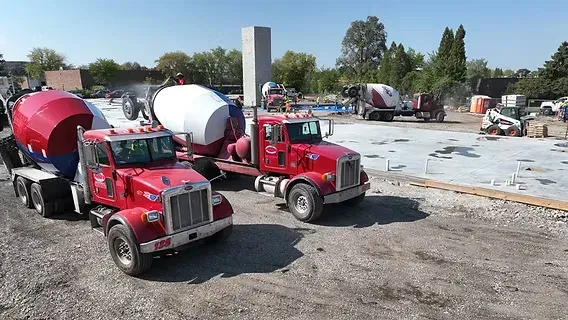
One exposure sits at the center of this model: the fleet itself. The mixer trucks are the operation, and they create liability the moment they leave the yard. A loaded mixer is among the heaviest vehicles on the road, carrying a liquid load that is high and that shifts as the drum turns — a center of gravity that makes rollover a severe risk and any at-fault accident on a congested Willamette Valley arterial or a mountain grade a potentially catastrophic one. The line that answers for all of it is commercial auto: auto liability for the third-party harm the trucks cause and physical damage for the trucks themselves. For ready-mix, that is the dominant line, not a supporting one — and the MCS-90, where it applies, is the federal financial-responsibility endorsement that backstops the public after a covered loss.
The load adds its own pressure on top of the driving exposure: ready-mix concrete is perishable, beginning to set up if it is not placed in time, so an Oregon fleet runs against the ASTM C94 workability window — the roughly 90-minute or 300-revolution guideline for delivering and placing a load — as it serves markets that pull in two directions. This page covers how ready mix insurance is built for the Oregon trucking-first model: the weight-mile-and-federal regulatory axis, the coverage stack it leans on, the competitive private workers-comp market that answers for the drivers, and the CCB license that stands over the concrete work. Ready-mix is not the install model and it is not the single-pump model; the Oregon concrete construction insurance page leads with completed-operations on installed work and Cascadia seismic ground, and the Oregon concrete pumping insurance page is built around a single high-value boom truck and the overhead power-line exposure. Many Oregon producers do more than one, and each scope is rated on its own terms.
Running a mixer fleet in Oregon? Get a quote built around commercial auto, the federal motor-carrier layer, the weight-mile regime, and the trucks you run.
Get a Free QuoteThe Oregon weight-mile tax: taxing the mixer by the road
What sets an Oregon mixer fleet apart from one in almost any other state is how the state charges it to use the road. Rather than collecting the bulk of its truck taxation at the fuel pump, Oregon taxes many heavy commercial vehicles by weight and distance. An intrastate fleet running trucks above the heavy-truck threshold enrolls through ODOT’s Commerce and Compliance Division and pays the Oregon weight-mile tax, calculated from the truck’s declared weight and the miles it travels and filed on a regular reporting cycle. For a producer whose loaded mixers cover ground all day between the batch plant and the pour, that means the fleet’s mileage, declared weight, registration, and compliance records are a live, ongoing part of running the business — not a one-time filing but a rolling account of how far and how heavy the trucks run.
The weight-mile regime is a tax-and-registration matter rather than an insurance line, but it sits directly against the motor-carrier picture that shapes the program. A fleet that is already metering its miles and declared weight, keeping its ODOT enrollment current, and running loaded trucks on tight schedules is a fleet whose operating discipline and exposure both live in the same place: the road. That is where the mixer earns its keep and where it creates the liability commercial auto answers for. We treat the weight-mile obligation as context for the fleet we are insuring — evidence of a real, road-metered trucking operation — and we describe it qualitatively, never stating a tax rate, a mileage figure, or a filing amount we cannot verify against the rules that apply to your specific fleet.
The federal motor-carrier layer: FMCSA, USDOT, and the MCS-90
On top of the state road tax sits the federal motor-carrier regime, and it lands on a mixer fleet in a way it never does for a shop or a generic business. A fleet operating in interstate commerce — a for-hire load moving north or south across the Oregon line on I-5, for example — generally falls under the FMCSA and the U.S. Department of Transportation, identified by a USDOT number and governed by the federal safety rules for its trucks and drivers. A fleet that runs only within Oregon answers instead to ODOT’s Motor Carrier Transportation Division and the weight-mile regime rather than carrying the full interstate federal apparatus, and where the line between the two falls turns on where and how the fleet actually runs.
The MCS-90 — the real federal financial-responsibility endorsement tied to the Motor Carrier Act of 1980 — typically attaches to a for-hire or interstate carrier’s auto liability policy and guarantees a member of the public can be paid up to the applicable federal minimum, after which the carrier can seek reimbursement from the insured. It is a surety mechanism backstopping the public, not primary coverage that broadens your own protection. The federal picture also runs on real identifiers the auto policy is built around — the ISO covered-auto symbols that define which vehicles a policy answers for. We name the federal and state bodies, the USDOT number, and the MCS-90 honestly and do not attach a regulation citation, a penalty figure, or an MCS-90 dollar-minimum we cannot verify; the federal minimum is described qualitatively because the verified figure is something to confirm against the rules that apply to your fleet rather than guess at.
Willamette Valley congestion and the delivery window
Ready-mix concrete is perishable, and the clock is a real underwriting fact for an Oregon fleet. The ASTM C94 workability guideline — commonly framed as the roughly 90-minute or 300-revolution window for delivering and placing a load — is the timing every producer runs against, and Oregon’s geography pulls that window in two directions. On one end are the congested Willamette Valley runs: Portland, Salem, and Eugene traffic can eat into the window not because the haul is long but because the trip is slow, with metro congestion and tight pour scheduling compressing the time a loaded drum has before the concrete starts to set. On the other end are the longer hauls to coastal and higher-elevation sites, where distance rather than density sets the timing and a mixer covers real ground on mountain and coastal grades to reach the pour.
Both ends of that geography feed the same risk that commercial auto answers for. A congested valley run keeps the loaded truck in stop-and-go traffic where low-speed collisions and the perishable clock both bear down; a long coastal or mountain haul puts a heavy, high, shifting load on grades and curves where rollover severity is highest. Demand tracks where Oregon builds: Portland-metro technology-campus and industrial construction, along with multifamily work, anchors ready-mix demand along the I-5 corridor, with Gresham, Hillsboro, and fast-growing Bend adding markets a fleet serves at varying distances. The metros matter to a ready-mix program as the markets the fleet serves and the distances it covers — because the slower the traffic and the longer the haul, the harder both the driving exposure and the perishable load press against the clock.
Workers comp for the drivers and the batch-plant yard crew
Oregon runs a competitive private workers-compensation market, so comp is carried and placed with a private carrier rather than a monopolistic state fund. For a ready-mix producer the exposure is real on both sides of the operation. The drivers are on the road for most of the day in loaded trucks, exposed to the same highway risk the auto program answers for; the batch-plant yard crew loads the trucks, washes out the drums, and works around moving equipment and stored materials, where lifting, slips, and material-handling injuries drive the claims. Concrete is a labor-heavy, injury-prone trade to begin with, and the mixer fleet stacks a highway exposure on top of the yard work.
Because Oregon is not a monopolistic state, comp is a placement decision rather than a state-fund default, and it is rarely optional in practice — general contractors, developers, and project contracts commonly require it regardless of headcount, and the Oregon contractor license already presumes the business carries liability coverage. We structure comp to the real driver and yard payroll, the payroll classifications that fit the work each crew actually does, and the way the operation runs, then coordinate it with the commercial auto, general liability, and property lines beside it so the trucking exposure and the yard exposure are both accounted for rather than assumed.
The Oregon contractor license through the CCB
Unlike a number of states, Oregon does license contractors, and that is a genuine credential rather than a formality. Anyone working for compensation on construction or improvements to real property must hold a license from the Oregon Construction Contractors Board (CCB), covering both residential and commercial contractors, with a surety bond and liability insurance required as a condition of licensure. There is no separate ready-mix or trucking-specific contractor license, but a producer whose crews place or finish concrete for compensation is within the licensed activity, and the exact classification depends on the work being done.
That structure has a useful consequence for a ready-mix operation: because the CCB license itself requires liability coverage, Oregon effectively presumes a licensed producer is insured before it works. On top of the CCB credential and its built-in insurance requirement, the mixer fleet carries the motor-carrier side — a USDOT number for an interstate fleet, ODOT weight-mile enrollment for an intrastate one — and a general contractor or project owner layers its own certificate-of-insurance and additional-insured requirements over both. The gate in Oregon is a real state license plus the contract plus the road registration, and we confirm the CCB credential that actually applies to your concrete work rather than assuming one that does not.
Coverage breakdown for an Oregon ready-mix fleet
Here is the stack an Oregon ready-mix operation carries, weighted for the trucking-first model. Each line links to its full page — and commercial auto, carrying the fleet, the federal motor-carrier layer, and the MCS-90, is the signature placement for this model.
- Commercial Auto Insurance — the signature line: auto liability for the third-party harm the mixer fleet causes and physical damage for the trucks themselves, plus the federal motor-carrier layer a USDOT-numbered Oregon fleet runs under — DOT and FMCSA, the ISO covered-auto symbols, and the MCS-90 endorsement — with the Oregon weight-mile registration an intrastate fleet carries through ODOT sitting alongside it.
- Umbrella Liability Insurance — excess limits above commercial auto and the other primary lines for the serious fleet loss: a fully loaded mixer rollover on a mountain grade or an at-fault accident in I-5 congestion is exactly the severity an umbrella is built to sit behind.
- Workers Compensation Insurance — medical and lost-wage coverage for the drivers on the road and the batch-plant yard crew who load, wash out, and work around the plant — placed with a private carrier, because Oregon runs a competitive comp market rather than a monopolistic state fund.
- General Liability Insurance — third-party bodily injury and property damage around the delivery and the placement site, lighter for the fleet model than for an install contractor but still part of the program — and part of what the Oregon contractor license already presumes you carry.
- Commercial Property Insurance — the batch plant, the yard, and stored aggregate, cement, and materials against fire, theft, and the perils a producer’s fixed site carries, with business income for a covered shutdown.
Claims scenarios along the I-5 corridor
These are plausible Oregon ready-mix claim categories, described qualitatively and with generic carrier language — every claim is handled by the carrier, never named here — and with no fabricated cost, frequency, or penalty figures.
- A loaded mixer rolls over on a grade. A fully loaded truck shifts and rolls on a mountain or coastal grade, or on a fast interchange in the I-5 corridor, with the potential for serious third-party harm and a major loss — the auto-liability and physical-damage exposure, with an umbrella behind it for the severity.
- An at-fault accident in valley congestion. A mixer causes third-party bodily injury or property damage in stop-and-go Willamette Valley traffic or maneuvering at the pour — a commercial-auto liability claim, with the MCS-90 backstopping the public where the federal rules apply to the fleet.
- A driver or yard injury. A driver or a batch-plant worker is hurt loading, delivering, washing out, or working around the yard — a workers compensation claim placed with a private carrier in Oregon’s competitive market.
- A loss at the batch plant. Fire, theft, or a covered peril damages the plant, the yard, or stored aggregate, cement, and materials — a commercial-property claim, distinct from the rolling exposure of the fleet.
Why Concrete Guard Insurance
We write one class — concrete contractors — and in Oregon we treat ready-mix as the trucking operation it is. We weight your stack toward commercial auto and the umbrella severity a loaded mixer fleet carries, name the DOT and FMCSA regime and the MCS-90 endorsement precisely for a USDOT-numbered fleet, account for the ODOT weight-mile registration an intrastate fleet runs under, place workers comp for the drivers and the batch-plant yard crew in Oregon’s competitive private market, confirm the CCB contractor license that applies to your concrete work, and structure general liability and the batch-plant property around the fleet rather than ahead of it. We place coverage with carriers that want the ready-mix class. Start with a quote, or talk it through with us first.
Learn more
Ready-mix is one of three operating models we write in Oregon, and the coverage stack shifts with the work. The signature exposure for this model lives on the commercial auto page, with umbrella liability close behind for fleet severity. If your crews also pour and finish flatwork and foundations, the Oregon concrete construction insurance page leads with the completed-operations exposure and Cascadia seismic ground; if you also run a boom pump, the Oregon concrete pumping insurance page is built around that single high-value truck and the overhead power-line exposure.
Coverage for an Oregon ready-mix fleet
- Commercial Auto Insurance
- Umbrella Liability Insurance
- Workers Compensation Insurance
- General Liability Insurance
- Commercial Property Insurance
Insurance by operating model
Get covered
Primary sources
Frequently asked questions about Oregon ready mix insurance
Does an Oregon ready-mix fleet pay the weight-mile tax?
Oregon is unusual: it taxes many commercial trucks by the road rather than at the pump. An intrastate mixer fleet running trucks above the heavy-truck threshold generally enrolls through the Oregon Department of Transportation (ODOT), Commerce and Compliance Division, and pays the Oregon weight-mile tax, which is calculated from the truck’s declared weight and the miles it travels and filed on a regular reporting cycle rather than collected as fuel tax. That structure changes how a mixer fleet is administered — a producer running loaded trucks across the Willamette Valley all day is accounting for its mileage and declared weight on an ongoing basis, and the fleet’s records, registration, and compliance posture become part of how it operates. It is a tax-and-registration regime, not an insurance line, but it sits right next to the motor-carrier picture we build the program around. We describe the weight-mile regime qualitatively and never state a rate or a filing figure we cannot verify against the rules that apply to your fleet.
Does an Oregon ready-mix fleet need a USDOT number or an MCS-90?
It depends on how and where the fleet runs. An Oregon mixer fleet that crosses state lines — a for-hire load heading north or south on I-5, for instance — operates under the Federal Motor Carrier Safety Administration (FMCSA) and the U.S. Department of Transportation (DOT), built around a USDOT number identifying the carrier and the federal motor-carrier safety rules for its trucks and drivers; a for-hire interstate carrier is also where the MCS-90 endorsement typically attaches. A fleet operating only within Oregon answers instead to ODOT’s Motor Carrier Transportation Division and enrolls in the weight-mile regime rather than carrying the full interstate federal apparatus. The MCS-90 is a real federal financial-responsibility endorsement tied to the Motor Carrier Act of 1980; it generally guarantees a member of the public can be paid up to the applicable federal minimum, after which the carrier can seek reimbursement from the insured. We name the federal and state bodies your fleet actually answers to and describe the federal minimum qualitatively rather than guess at a figure.
Why is commercial auto the main line for an Oregon ready-mix operation?
Because the fleet is the business. An Oregon ready-mix producer delivers concrete with a fleet of mixer trucks, and that fleet is a trucking operation — so the line that covers the trucks, commercial auto, carries the heaviest exposure. A loaded mixer is among the heaviest vehicles on the road, with a high, shifting center of gravity that makes rollover a severe risk, and the fleet runs under the federal motor-carrier regime and Oregon’s weight-mile road tax on top of ordinary road liability across Willamette Valley traffic and mountain and coastal grades. That is a very different center of gravity from an install crew, whose signature exposure is the completed work it leaves behind, or a pumping contractor, whose program turns on a single high-value boom truck and the power-line hazard. For ready-mix, commercial auto and the federal layer are the spine, and umbrella, workers compensation, general liability, and property are built around them.
How does Oregon workers comp work for mixer-truck drivers?
Oregon runs a competitive private workers-compensation market, so comp is carried and placed with a private carrier rather than a monopolistic state fund. For a ready-mix producer that matters because the exposure is real on both sides of the operation: the drivers are on the road for most of the day in loaded trucks, and the batch-plant yard crew loads, washes out, and works around moving equipment and stored materials. Concrete is a labor-heavy, injury-prone trade, and a mixer fleet adds a highway exposure on top of the yard work. General contractors, developers, and project contracts also commonly require comp regardless of headcount. We structure comp to the real driver and yard payroll, the payroll classifications that fit the work, and the way the crews actually operate, and coordinate it with the commercial auto, general liability, and property lines beside it.
Does Oregon require a license to run a ready-mix concrete business?
Oregon does license contractors, and that is a genuine credential rather than a technicality. Anyone working for compensation on construction or improvements to real property must hold a license from the Oregon Construction Contractors Board (CCB), covering both residential and commercial contractors, with a surety bond and liability insurance required as a condition of licensure. There is no separate ready-mix or trucking-specific contractor license, but a producer whose crews place or finish concrete for compensation is within the licensed activity, and the exact classification depends on the work. On top of the CCB license and its built-in insurance requirement, a mixer fleet also carries the motor-carrier side — a USDOT number for an interstate fleet and ODOT weight-mile enrollment for an intrastate one — and a general contractor or project owner layers its own certificate-of-insurance and additional-insured requirements over both. We confirm the CCB credential that actually applies to your Oregon concrete work and never assume one that does not.
Is Oregon ready-mix insurance different from concrete or pumping coverage?
Yes — the operating model changes the program even within Oregon. The ready-mix model is the trucking-first, auto-dominant fleet this page is built for: commercial auto, the federal motor-carrier layer, Oregon’s weight-mile road tax, and the load-shift and rollover severity of a loaded mixer. A concrete construction operation leads with the completed work it installs — the slab or seismic-aware foundation that can fail downstream — and a labor-heavy crew, which is the focus of the Oregon concrete construction page. A concrete pumping contractor builds the program around a single high-value boom truck and the catastrophic overhead power-line exposure on the pour, which is the Oregon concrete pumping page. The shared Oregon facts — the competitive private comp market, the CCB contractor license, the metros you serve — apply to all three, but they frame differently for a mixer fleet under federal trucking rules and the weight-mile regime. If you do more than one, each scope is rated on its own terms.
Insure your Oregon mixer fleet the way it runs
Tell us how your fleet runs — intrastate under the weight-mile regime, for-hire, or across state lines on I-5 — and we will market it to carriers that write the ready-mix class, with commercial auto and the federal motor-carrier layer covered, not assumed.