Concrete pumping insurance · New Mexico
Concrete Pumping Contractor Business Insurance in New Mexico
Insurance for the New Mexico concrete pumping contractor — boom, line, and trailer pump operators placing concrete for other crews across a spread, low-rise high-desert market. The pump-truck model carries two exposures at once: the power-line bodily-injury risk on the long rural overhead runs that feed a spread, and the high-value boom pump truck as the single most expensive asset you own — read against the New Mexico contractor license and the competitive private workers-comp market.

What defines a concrete pumping contractor in New Mexico is not how tall it builds but how far it reaches. This is a spread, low-rise, high-desert market — one that never fully densifies into the vertical downtown work other states offer — and a pump crew’s defining exposure here is the long overhead distribution run. Most days the boom sets up on residential and light-commercial pours strung out along development that thins fast into open country, where poles and open overhead conductors line the road frontage of nearly every site. Concrete pumping is its own operating model, not a coverage line, and the boom is what makes it so: a pumping contractor does not pour and finish installed work, and does not run a fleet of delivery trucks. It places concrete for other crews, through a boom, a line, or a trailer pump, and in New Mexico it does that across more miles of rural overhead than congested urban line conflict. That is exposure-by-distance, and it is a risk picture nothing generic fits.
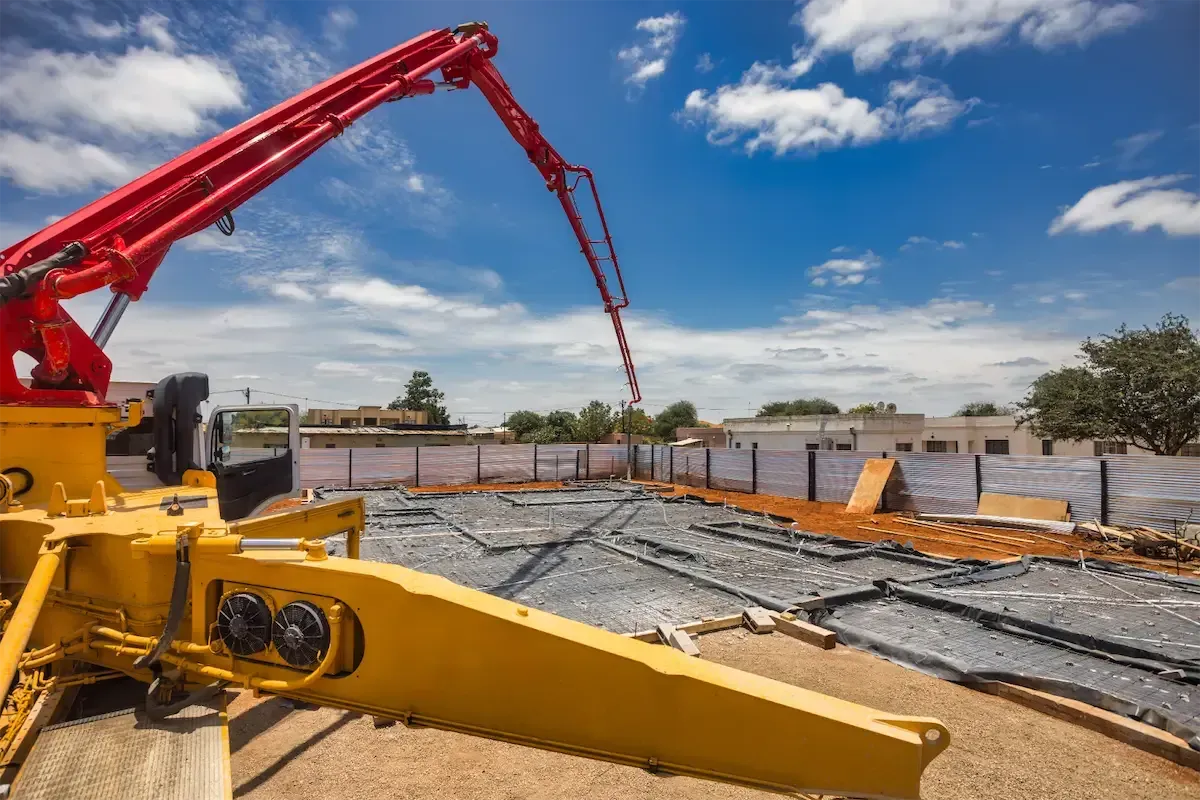
Two exposures define the pump-truck model, and they carry equal weight. The first is the power-line exposure. A boom is a long, conductive steel arm swung into position over a pour, and on New Mexico’s spread sites — where a low, single-story pour sits directly beneath the open distribution line running past its frontage — boom contact is a known catastrophic hazard. Contact can energize the boom, the truck, and the ground around it, with severe and frequently fatal third-party bodily injury to spotters, finishers, and bystanders. That third-party bodily injury and property damage runs through general liability, and we describe its severity qualitatively, without dressing it in statistics it does not need. The second is the boom pump truck itself. A New Mexico pumping contractor typically owns ONE very-high-value mobile asset — often the most expensive item in the business, and one that runs long miles between sparse jobs across the state’s basins and mesas — and its auto liability on the road and at the placement site, plus the physical damage that protects the asset, run through commercial auto. Neither exposure belongs to an installation crew or a delivery fleet; both belong only to pumping.
This page covers how concrete pumping insurance is built for that model in New Mexico: the long-overhead exposure that leads the trade here, the spread, low-rise desert market that shapes where a boom works, the contractor license and competitive comp a pump crew works under, the coverage stack it leans on, and the drivers that move cost. Pumping is the straddle in the middle of the trade — but it is not a blend of the operations beside it. It is the boom: the exposure only a pump has, on the truck only a pumper runs. If your New Mexico operation also pours and finishes installed work, the New Mexico concrete contractor page is built for that model; if you also haul ready-mix, the New Mexico ready-mix page is built for that one.
Running a pump truck in New Mexico? Get a quote built around the boom — the power-line exposure and the high-value truck.
Get a Free QuoteThe long-overhead problem in New Mexico
Pumping risk is boom risk, and New Mexico concentrates it not in dense vertical canyons but along open road frontage. The state does not offer the packed downtown high-rise pours where a boom threads a narrow gap between towers and a service drop; instead, its worst exposure is quieter and more constant — the long overhead distribution run. On a spread, low-rise site, the open conductor that lines the road frontage sits closer to a boom’s working arc than a distracted crew expects, and because so much of the work is one-story residential and light-commercial placement across development that never densifies, the boom spends more of its life under open overhead than boxed in by buildings. That is the power-line severity at the center of the trade here: the single most serious loss is not a fire or a slip but a boom touching an energized line, a third-party bodily-injury event that can be catastrophic and often fatal, and the kind of loss that runs straight past a primary limit into an umbrella.
The distinctive angle is exposure-by-distance. A pump crew in a dense coastal metro fights congested urban line conflicts on tight sites; a New Mexico crew fights something different — more miles of open overhead running past low, spread-out pours, with fewer buildings to force clearance but far more frontage line to clear on the crew’s own judgment. The counterweight is real: less vertical congestion, fewer signal and service-drop tangles overhead. But the trade-off is that the exposure is everywhere and rarely obvious, present on the routine one-story pour as much as the occasional larger job. We weight the stack toward the two lines the pump-truck model actually leans on — general liability for the power-line injury and commercial auto for the truck — and we treat that long-overhead exposure as the lead risk it is here, not a footnote.
A spread, low-rise desert market
New Mexico builds wide, not tall, and the geography explains why. Most placement concentrates in the Rio Grande corridor around Albuquerque and its Rio Rancho suburbs, with a secondary market in Santa Fe and a fast-growing one in the Las Cruces and Mesilla Valley area to the south; Roswell anchors work out east. Between those centers is sparse rural work — long hauls to single pours where the nearest other job may be an hour’s drive. It is a low-rise, spread-out map: the state does not offer dense downtown high-rise pours, so a boom’s reach is spent on foundations, residential and light-commercial slabs, and the occasional mid-rise rather than on tall vertical work across New Mexico.
The terrain shapes the setup as much as the market does. Boom placement in New Mexico contends with high-desert basin-and-mesa ground and the mountain fringes — the Sandias above Albuquerque, the Organs above Las Cruces — where leveling, outrigger footing, and wind on an extended boom all matter more than they would on a flat urban pad. Two operations with similar revenue can carry very different exposures depending on the size of boom they run and how far they range: a contractor working mostly inside the Albuquerque corridor concentrates its miles, while one chasing scattered rural pours across the basins piles up road exposure on that single high-value truck. We separate the power-line exposure from the truck exposure, and the pumping work from any installation or hauling in the same book, so none is mispriced.
New Mexico licensing and comp for a pump crew
New Mexico is a licensing-present state, and that is the honest starting point. New Mexico licenses contractors through the New Mexico Construction Industries Division (CID), and a contractor license issued through the CID is required for contracting work, with classifications organized by trade. The exact classification depends on the work a crew actually performs, so pumping and placing concrete is read against that framework rather than a separate statewide pumping license the state does not issue. On top of the state credential, a general contractor or project owner layers its own insurance, certificate-of-insurance, and additional-insured requirements. We confirm the credential the work actually calls for — the license is real — and we never invent one that does not apply.
Workers compensation is the other half of the regulatory picture, and New Mexico runs a competitive private market. Comp is placed with a private carrier rather than a state fund, and it is not elective the way it is in Texas. For a typically small pumping crew of an operator and a spotter or finisher on the pour, placement is a hazardous operation, and comp covers medical care and lost wages for on-the-job injury. A single boom-side incident can be severe, and many general contractors and project contracts require comp regardless. We structure comp to the real crew, the operator and spotter payroll classifications, and the way the work is done, and coordinate it with the general liability, commercial auto, and property lines beside it rather than treating it as a box to check.
Coverage built around the boom
Here is the stack a New Mexico pumping contractor carries, weighted for the boom model. Each line links to its full page — and because pumping leads with two exposures at once, general liability and commercial auto are the co-signature placements for this model.
- General Liability Insurance — co-signature: the power-line exposure. The third-party bodily injury and property damage when a boom contacts an overhead line during placement — the catastrophic, often fatal loss that defines pumping, and the one the state’s long rural overhead keeps constant — along with the everyday on-site injury and damage the work can cause.
- Commercial Auto Insurance — co-signature: the boom pump truck. Auto liability on New Mexico roads — including the long miles between sparse jobs — and maneuvering at the placement site, plus physical damage protecting the single most expensive asset the business owns.
- Umbrella Liability Insurance — excess limits above general liability and commercial auto for the catastrophic power-line claim that runs past a primary layer, which is exactly why a New Mexico boom operation tends to need real excess.
- Workers Compensation Insurance — placed in New Mexico’s competitive private market: medical and lost-wage coverage for the operator, spotter, and placing crew on the pour, structured to the real payroll classifications.
- Commercial Property Insurance — the lighter line for the boom model: the yard, shop, and stored equipment against fire, theft, and the external perils a facility carries, since the highest-value asset is the truck on commercial auto rather than a fixed plant.
What concrete pumping insurance costs in New Mexico
Premium tracks the operation, not a sticker price. The drivers that move it most are the type and replacement value of the pump equipment you run — boom trucks versus line or trailer pumps — the heights and conditions you place in and how often that puts a boom near the open overhead lining a spread site’s frontage, your payroll and the operator and spotter classifications it covers, your driving records and auto-loss history over the long rural miles a New Mexico truck runs, the limits your contracts demand, and your safety and clearance discipline. The distance a truck ranges across the basins and the frontage line it works under tend to push the commercial-auto and general-liability side of the program. We price to that real picture and stand behind any figure we give — verified ranges come from us directly, never a generic guess.
Claims scenarios on New Mexico pours
These are plausible New Mexico pumping claim categories, described qualitatively and with generic carrier language — every claim is handled by the carrier, never named here — and with no fabricated cost or frequency figures.
- A boom contacts an overhead line. A boom swung into position over a low, spread-out New Mexico pour touches the energized distribution line running past the site’s frontage and a spotter or bystander is injured — a catastrophic third-party bodily-injury claim on general liability, with the severity that drives the need for an umbrella above it.
- The pump truck is in an accident. The boom truck is in a collision on the long rural run to a scattered New Mexico pour or is damaged maneuvering on uneven high-desert ground — auto liability and physical damage on commercial auto, protecting the high-value asset.
- A line or pipe fails under pressure. A pumping line or pipe lets go during placement and causes injury or damages property that is not yours — a third-party general-liability exposure on the operation.
- A crew member is hurt on the pour. An operator, spotter, or finisher is injured during placement — a workers compensation claim placed with a private carrier in New Mexico’s competitive market.
How New Mexico carriers underwrite a boom risk
Carriers writing the pumping class in New Mexico look at the boom and the discipline around it: the type, age, and value of the pump equipment, the heights and site conditions the work puts a boom into and how close that brings it to the open overhead lining a spread site, your driving records and auto-loss history over the long rural miles the truck runs, your operator and spotter payroll, and your clearance and spotting practices. A well-maintained pump truck with documented clearance procedures, trained spotters, and a clean liability and auto history opens more markets; aging equipment, a power-line or serious auto loss, or thin safety documentation narrows them. A contractor who also installs or hauls gets that portion underwritten separately so the pumping book is not subsidizing — or stranding — the rest. We position your operation to the carriers most likely to want a boom risk rather than sending one generic submission everywhere.
Why Concrete Guard Insurance
We write one class — concrete contractors — and within it we treat New Mexico pumping as the boom operation it is, not as a version of a general contractor or a mixer fleet. We weight your stack toward the two exposures the pump-truck model actually carries: the power-line bodily-injury exposure on general liability and the high-value boom truck on commercial auto, with an umbrella sized to the catastrophic severity of a power-line loss in a state where open overhead lines the frontage of nearly every spread pour. We read the seam between the work and the truck so a boom-contact injury runs to general liability and the truck itself runs to commercial auto, we confirm the CID credential that actually applies, we place comp in the competitive private market, and we underwrite any installation or hauling you also do on its own terms. Start with a quote, or talk it through with us first.
Learn more
Concrete pumping is one of three operating models we write in New Mexico, and the coverage stack shifts with the work. The two signature exposures for this model live on the general liability page (the power-line exposure) and the commercial auto page (the boom truck), with umbrella liability close behind for the catastrophic severity. The model itself is detailed on the Concrete Pumping Insurance pillar. If your New Mexico operation also pours and finishes installed work, the New Mexico concrete contractor page leads with the completed-operations profile; if you also haul ready-mix, the New Mexico ready-mix page leads with the motor-carrier trucking profile.
Coverage for New Mexico concrete pumping contractors
- General Liability Insurance
- Commercial Auto Insurance
- Commercial Property Insurance
- Workers Compensation Insurance
- Umbrella Liability Insurance
Insurance by operating model
Get covered
Primary sources
Frequently asked questions about New Mexico concrete pumping insurance
What happens if a pump boom contacts a power line in New Mexico?
It is the catastrophic exposure that defines concrete pumping, and New Mexico — a spread, low-rise market where open distribution line runs past the frontage of nearly every site — keeps it constant rather than rare. A boom is a long, conductive steel arm swung into position over a pour, and contact with an overhead power line can energize the boom, the truck, and the ground around it, causing severe and frequently fatal third-party bodily injury by electrocution to spotters, finishers, and bystanders, along with property damage. We describe that severity plainly and qualitatively, without inventing statistics, because it does not need them. General liability is built to respond to the third-party bodily injury and property damage that boom contact causes, which is exactly why an umbrella sits above it for a New Mexico pump operation. Prevention — clearance from lines, trained spotters, treating every conductor as energized — sits alongside the coverage, not in place of it.
Is my boom pump truck covered on the road and at the pour in New Mexico?
Yes — commercial auto generally responds both while the truck is driven on New Mexico roads and while it is positioned and maneuvering at the placement site, because the unit is in use as a vehicle in both settings. That road exposure carries real weight here, because a pump truck often runs long miles between sparse rural pours across the state’s basins and mesas. Physical damage — collision and comprehensive — protects the asset itself against an accident, theft, fire, or other covered peril, which matters because the boom pump truck is typically the single most expensive item a New Mexico pumping contractor owns. The line between an auto loss and a general-liability loss depends on what happened: damage to the truck is commercial auto, while third-party harm caused by the work, including a boom contacting a power line, is general liability. We read that seam against your operation before binding.
Do concrete pumping contractors need a license in New Mexico?
New Mexico does license contractors. A contractor license issued through the New Mexico Construction Industries Division (CID) is required for contracting work, with classifications organized by trade, and the exact classification depends on the work you actually perform. Pumping and placing concrete is read against that framework rather than a separate statewide pumping license the state does not issue. On top of the state credential, a general contractor or project owner layers its own insurance, certificate-of-insurance, and additional-insured requirements. We confirm the credential the work actually calls for — the license is real — and we never invent one that does not apply.
How does workers comp work for a pump crew in New Mexico?
New Mexico runs a competitive private workers-compensation market, so comp is placed with a private carrier rather than a state fund, and it is not elective the way it is in Texas. For a typically small pumping crew — an operator and a spotter or finisher on the pour — placement is a hazardous operation, and comp covers medical care and lost wages for on-the-job injury. A single boom-side incident can be severe, and many general contractors and project contracts require comp regardless. We structure comp to the real crew, the operator and spotter payroll classifications, and the way the work is done, and coordinate it with the general liability, commercial auto, and property lines beside it rather than treating it as a box to check.
How is New Mexico concrete pumping insurance different from a New Mexico concrete contractor or ready-mix policy?
The boom. A concrete construction contractor pours and finishes installed work, and the exposure that defines that model is completed operations — a slab or foundation that fails downstream after the pour. A ready-mix operation runs a mixer fleet under federal and state motor-carrier rules, where auto liability across many trucks is the dominant line. Pumping is neither: it places concrete through a boom, which creates the power-line bodily-injury exposure no installation crew or delivery fleet carries, and it concentrates value in ONE very-high-value pump truck rather than a labor-heavy crew or a fleet. A policy rated to either neighbor underprices the power-line severity and the high-value truck both.
I both pump and pour or haul concrete in New Mexico — which page is mine?
This page is built for the pumping side: the boom, the power-line bodily-injury exposure on general liability, and the high-value boom pump truck on commercial auto. If you also pour and finish installed concrete, that work carries the completed-operations exposure of an installation model and lives on our New Mexico concrete contractor page. If you also haul ready-mix, that is a motor-carrier trucking operation and lives on our New Mexico ready-mix page. An operation that does more than one is not a single blended policy; it is each scope underwritten on its own terms, so the pumping book neither subsidizes nor strands the rest.
Insure your New Mexico pump truck the way it runs
Tell us about the boom you run, the placements you take on, and the truck you depend on, and we will market it to carriers that write the concrete pumping class.