

There is no published price for ready-mix insurance in Minnesota, and any figure quoted before an underwriter has looked at your fleet is a guess. A carrier builds the cost from your specific operation — and Minnesota puts a distinctive stamp on that operation before you even reach the trucks: the spring thaw and the frost-line calendar govern when and how a loaded mixer can run. Underneath the seasonal reality sits the constant that drives the cost — a mixer fleet regulated as a motor carrier. This guide walks the drivers that decide what a Minnesota ready-mix producer pays.
The honest answer disappoints owners who just want a number, but the drivers here are specific enough that understanding them beats a fake average. Below is what moves the number, and why Minnesota’s frost and thaw shape so much of it.
The spring-thaw problem a loaded mixer cannot dodge
Minnesota’s spring load restrictions are among the most formalized in the country, and they hit a loaded mixer hard. MnDOT divides the state into frost zones and imposes reduced axle limits during the thaw, typically lasting weeks with end dates announced only days in advance — a genuine scheduling problem for a fleet that cannot lighten a full drum. On top of that, the long winter produces one of the region’s most compressed pour calendars, concentrating fleet utilization into the frost-free months. Wet concrete still has to reach the forms inside its workability window — the industry references the ASTM C94 standard — and the heaviest demand, Twin Cities metro commercial, infrastructure, and industrial work along I-35, I-94, and I-90, falls inside the exact metro frost zone that gets restricted each spring. Where and how a fleet runs during the thaw is a real cost variable, and a producer who can show a carrier how it schedules around the restrictions and the short season gives it something concrete to price.
For the full Minnesota market and regulatory picture behind these drivers, see our Minnesota ready-mix insurance page. This guide is the companion cost explainer.
The mixer fleet — your dominant cost driver
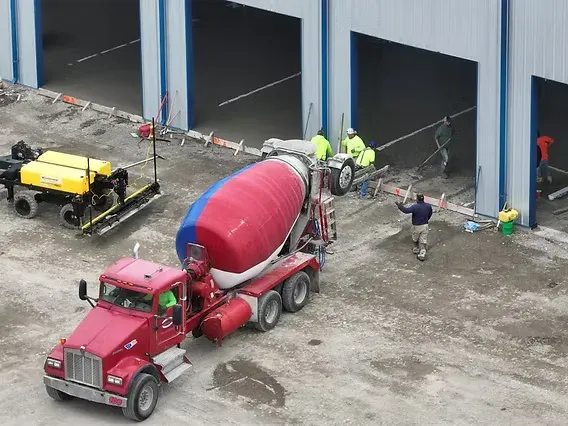
For a ready-mix producer the fleet is the operation, and the mixer trucks are on the road constantly through the working season. Commercial auto covers the fleet’s liability and physical damage, and it is the leading line for this model — the way general liability leads for an install crew and a single boom truck leads for a pumper. The cost scales with the number of trucks, their value, the miles they run, and the records of the drivers behind the wheel. A Minnesota fleet running metro and greater-Minnesota routes concentrates its exposure on the road, which is exactly where commercial auto responds. Fleet size, truck value, and how hard the trucks run in the compressed season are the inputs that move this driver most.
The motor-carrier and DOT profile
A Minnesota mixer fleet is a regulated motor carrier, and that profile shapes the cost. A fleet operating only within Minnesota handles registration and credentials through Driver and Vehicle Services (DVS) under the Department of Public Safety, while a for-hire fleet crossing into Wisconsin, Iowa, or the Dakotas operates under the Federal Motor Carrier Safety Administration and the U.S. Department of Transportation with a USDOT number and the MCS-90 endorsement, which guarantees a public settlement up to the applicable federal minimum. Your FMCSA safety scores, USDOT standing, and driver qualification records are inputs a carrier reads closely. This regulatory axis is signature to the ready-mix model — an install crew and a pumper never carry it.
Real-World Scenario: A for-hire producer runs interstate loads out of a Twin Cities plant under its USDOT number and the MCS-90 endorsement, feeding a project across the Wisconsin line, while a second operator keeps its trucks inside Minnesota, credentialed through DVS and delivering across the metro. Both run mixers, and both plan around the spring thaw, but the underwriter reads them apart — the interstate carrier’s federal safety profile and the in-state fleet’s metro routes each price on their own terms. Same ready-mix class, but the motor-carrier picture, not the concrete, is what a carrier is really pricing.
Load shift, rollover, and the delivery window
Wet concrete’s workability window presses against Minnesota’s realities in its own way: heavy loads, tight schedules in a short season, and thaw-restricted routes all raise the load-shift and rollover exposure that sits on commercial auto. A mixer’s high center of gravity and moving load make it a real rollover risk, and a carrier reads your routes, your dispatch discipline, and your rollover record when it prices it. Telematics and load-securement discipline are levers that show up in the record — and disciplined thaw-season routing is one more.
Drivers, hiring, and workers comp
Because commercial auto leads this model, the people driving the trucks are a direct cost input — motor-vehicle records, experience, and driver qualification files feed how a carrier prices the fleet. Your drivers and plant crew also put payroll on the workers compensation line, which in Minnesota is a competitive private market overseen by the Minnesota Department of Commerce, placed with a private carrier and structured to the real crews and payroll classifications. For a ready-mix operation the comp line sits behind commercial auto rather than leading it — unlike a general concrete crew, where crew payroll leads. Minnesota licenses residential building contractors through the Department of Labor and Industry while commercial general contracting is not state-licensed; either way the fleet cost turns on the motor-carrier profile above.
Coverage limits and the umbrella
What you buy is itself a driver. The limits your customers and contracts require push a ready-mix producer toward an umbrella that sits over the auto exposure, and higher limits cost more than lower ones — which matters when a single fleet loss on the road can run high. Whether you carry commercial auto at the limits your routes and the federal minimum call for, whether you schedule the fleet and plant property to real value, and how your general liability limits are set all feed the number. For a fleet operation these are deliberate choices, not places to under-buy.
Where Minnesota ready-mix demand concentrates
Minnesota’s heaviest ready-mix demand sits in the Twin Cities, where Minneapolis, Saint Paul, and the surrounding metro drive commercial, institutional, and infrastructure pours along I-35, I-94, and I-90. Rochester’s medical construction, Duluth’s Lake Superior industrial edge, Bloomington and Plymouth’s suburban work, and the flat farmland of greater Minnesota add steadier, more dispersed demand. That metro concentration matters because it overlaps the frost zones MnDOT restricts each spring, so the same corridor that carries the most volume is the one that gets axle-limited during the thaw. Layer on one of the region’s most compressed pour calendars — a long winter that pushes fleet utilization into the frost-free months — and a Minnesota fleet’s routes and schedule become as much a cost variable as its trucks. A carrier reads how you route and dispatch through both the thaw restrictions and the short season, and how a for-hire load into Wisconsin, Iowa, or the Dakotas changes the regulatory picture. Describing your real operating calendar tells a carrier far more than a statewide average, which cannot capture a state where the ground itself sets the schedule.
Getting an accurate Minnesota quote
The path to a real number is to describe the real operation: the size and value of your fleet, your USDOT and motor-carrier profile, your driver records, the metro and greater-Minnesota routes you run, how you handle thaw-season scheduling, your claims history, and the limits your contracts require. From there a carrier with genuine motor-carrier and ready-mix appetite can price it. When you are ready, start a quote and tell us about your fleet and your routes, or browse the full coverage overview to see how each line fits. For the broader picture across concrete models, see our concrete insurance cost guide, and for the Minnesota market behind these drivers, the Minnesota ready-mix insurance page. The number at the end will reflect your business, which is the only number worth having.