

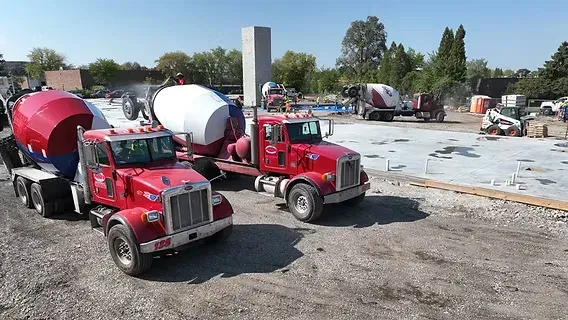
Your operating model is the first thing that decides what a concrete business is worth, because it sets how much of the value lives on the balance sheet versus in the earnings. An asset-heavy ready-mix operation, a labor-heavy flatwork crew, and a pumping business are three different valuation problems — even at the same revenue. This is general education, not legal, tax, or financial advice; confirm any valuation of your specific business with your own certified business appraiser, M&A advisor, and CPA.
Most trades value on earnings and stop there. Concrete does not, because the three operating models carry very different amounts of hard assets, and that asset spread is the distinctive lever in this trade. Establish where your operation sits on it before you reach for any multiple — because a ready-mix producer with a plant and a fleet and a flatwork crew with a few work trucks are not the same kind of thing to a buyer, and no single benchmark speaks for both. The broader valuation picture covers every driver; this guide isolates the one that separates concrete from the rest.
Two ways value is measured: earnings and assets
A valuation is built one of two ways, and which one fits depends on where the value sits. The income, or earnings, approach capitalizes what the business produces — it answers what a buyer will pay for a durable, transferable stream of earnings, and it is the natural fit for a business whose value is its book of work and its people. The asset-based approach starts from what the business owns — the plant, the fleet, the equipment, net of what it owes — and it fits an operation whose value is genuinely tied up in hard assets.
This is a standard, well-established principle, not a concrete quirk. Valuation references such as Dannible & McKee, Wipfli, and Sofer Advisors describe the income approach as the natural fit for asset-light, backlog-driven contractors and the asset-based approach as the fit for equipment- and facility-heavy operations — with net asset value often acting as a floor beneath the earnings result. Concrete is unusual in that its three models land in different places on that same line, which is why the model is the first thing to establish.
The asset spread: where each model sits
Picture a line. At one end, value that lives almost entirely in earnings; at the other, value that lives in hard assets on the balance sheet. The three concrete operating models occupy three different points on it.
A flatwork or install operation sits at the earnings end. It is labor-heavy and asset-light — the value is the book of work, the crews, and the general-contractor relationships, with relatively few hard assets behind it, so it is valued primarily on its earnings. A ready-mix operation sits at the asset end: a batch plant and a mixer fleet are real balance-sheet assets, so it is valued on assets and earnings, and the hard assets can carry value beyond what the earnings multiple alone would produce. Concrete pumping sits between the two, an earnings-driven operation carrying one or two high-value pump trucks as genuine asset value.
Ready-mix: value on the balance sheet and in the earnings
A ready-mix producer is the asset-heavy end of the trade. The batch plant, the mixer fleet, the yard and the routes are real, appraisable hard assets, and net asset value can set a floor beneath the earnings result — the operation is worth at least what its assets carry, and its durable earnings on top of that. This is why the asset-based approach matters more here than anywhere else in concrete, and why a ready-mix deal tends to draw a different, more capital-minded buyer.
It is also why the genuinely asset-rich end of construction materials trades on richer multiples than contractors do. M&A advisory Capstone Partners has reported average transaction multiples around nine times EV/EBITDA in its rock-products-and-aggregates coverage — the aggregates-and-materials tier, an asset-rich different animal from a flatwork crew, and a useful marker for how the market prices hard-asset producers. That figure describes producers at scale, not an owner-operator ready-mix yard, and it is quoted on EBITDA rather than SDE, so read it as evidence that asset intensity carries value, not as a multiple to apply to your operation.
Flatwork and install: earnings, and what transfers with them
At the other end, a flatwork or install operation is valued almost entirely on the durability and transferability of its earnings, because that is where the value lives. There is no plant and no fleet to set a floor — the assets are a few work trucks and tools — so the question a buyer asks is whether the earnings survive the sale. That puts the weight on the book of work, the general-contractor relationships, the crews, and how much of it all runs without the owner.
That earnings-only character cuts both ways. A labor-heavy operation can be leaner and more profitable per dollar of assets, and it can be worth a strong earnings multiple when the work is repeat, the customer base is spread, and a management bench holds it together. But because nothing on the balance sheet backs it up, an owner-dependent flatwork crew can also transfer poorly — much of what a buyer is paying for walks out the door with the seller. On an asset-light operation, the transferability of the earnings is the value.
Pumping: earnings plus a high-value truck
Concrete pumping sits in the middle, and it earns the middle honestly. Like a flatwork crew it is earnings-driven — a buyer is paying for the durable stream of pumping work and the relationships that feed it — but unlike a flatwork crew it carries one or two boom or line pumps that are genuine, high-value, transferable hard assets. That gives a pumping operation more balance-sheet weight than an install crew and less than a ready-mix producer, which is exactly the middle of the spread.
For a buyer, that means reading two things at once: the durability of the pumping earnings and the condition, age, and value of the trucks. A well-maintained pump with useful life left reduces reinvestment risk and is part of what conveys; a tired one is a cost the buyer prices in. The commercial auto schedule that covers those trucks is part of the hard-asset story that transfers with the deal.
Why the same revenue produces different worth
Real-World Scenario: Two concrete businesses come up for sale with the same annual revenue. One is a flatwork install operation — a strong book of general-contractor relationships, experienced crews, a few work trucks, and not much else on the balance sheet. The other is a ready-mix producer of the same revenue: a batch plant, a fleet of mixer trucks, and the routes it runs. A buyer values them differently, and not by a little. The ready-mix operation carries hard assets that set a floor under its value, so it is read on assets and earnings both; the flatwork operation has almost nothing on the balance sheet, so it is read almost entirely on how durable and transferable its earnings are. Same revenue, different worth — and the gap is the operating model and where it sits on the asset spread.
The lesson is not that one model is worth more than another — a lean, transferable flatwork operation can be a better business than a capital-heavy ready-mix yard. The lesson is that they are valued by different methods, so a single benchmark cannot speak for both, and comparing your operation to a multiple built for a different model is how owners talk themselves into a wrong number.
Turning the model into a defensible number
The asset spread tells you which valuation approach fits and roughly where the reference ranges sit; it does not tell you your number. A certified business appraiser or M&A advisor builds a defensible value from your real financials, chooses the income or asset-based approach that fits your model — or weighs both when you run more than one — and a CPA handles the earnings normalization and tax. The insurance side meets the deal quietly: clean general liability loss runs help the sell side, and the commercial-auto schedule on the pump or mixer fleet is part of the assets that convey. For the wider set of drivers, start with what a concrete business is worth; to see how buyers underwrite each model, read who buys concrete businesses and SDE vs EBITDA for concrete businesses; and for the cost side of running the operation in the meantime, see what drives concrete insurance cost. When you are ready to make sure the operation is insured to the way it actually runs, start a quote. This is general education to sharpen the conversation with your own appraiser, M&A advisor, and CPA — not a substitute for their advice on your specific business.