

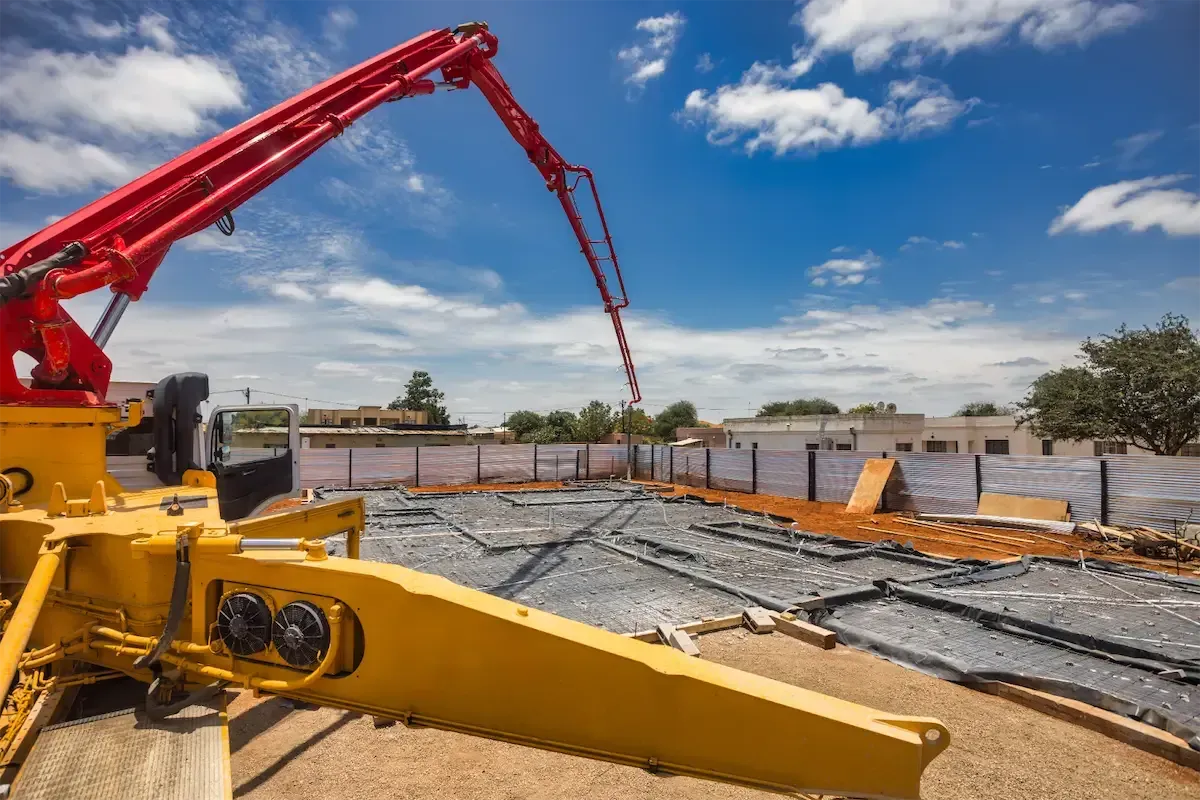
A concrete pumping contractor in Wyoming will not find a published price, and any figure quoted before an underwriter has studied the operation is guesswork. What a carrier actually does is assemble the cost from your specific business, and in Wyoming that business looks different from almost anywhere else: a high-value boom truck logging long miles to remote energy-field pours, set beneath some of the longest overhead transmission runs in the country, with workers compensation flowing through the state fund rather than a private market. This guide walks the drivers behind a Wyoming pumper’s number.
Two facts shape the whole picture before any single line is priced. Wyoming is the nation’s most sparsely populated state, so its pumping work is overwhelmingly rural and energy-driven — Powder River Basin coal, oil, and gas in the northeast, the trona and gas fields near Green River in the southwest, and a growing wind footprint scattered across wide-open country. And Wyoming is one of a small handful of monopolistic workers-comp states. Put those together and the cost conversation for a pumper here leans hard on the boom truck and the overhead line, with comp handled a way most states do not share.
Beyond Cheyenne and Casper the map thins fast to towns like Laramie, Gillette, Rock Springs, and Sheridan, with long stretches of high plains, mountain range, and basin between them, so a single boom truck can be the only one for a wide radius. The ground compounds the distance: high-elevation freeze-thaw meets expansive bentonite clay in the southeast, and foundations there are often engineered against both deep frost heave and swelling soil, so a boom frequently reaches over slabs detailed with moisture barriers or post-tensioning. Cold, altitude, and wind press on curing and on the crew’s working window, which puts a premium on placing a pour cleanly the first time. Because the paying work tracks extraction and infrastructure schedules rather than steady metro build-out, a pumper’s utilization can swing with the energy cycle — and a truck that idles between remote jobs and then runs hard on a distant pad presents a different picture than one in constant rotation, which a carrier factors into how the operation is rated.
The overhead transmission line — pumping’s gravest Wyoming exposure
The exposure that most defines a Wyoming pumper is the one strung across the open country: long, high-voltage overhead transmission and distribution runs serving remote extraction and infrastructure sites. A boom places concrete in three dimensions, and contact between the boom and an energized line is the catastrophic event a carrier prices against — it can be fatal, and it is exactly the kind of loss general liability and an umbrella are built to answer. On unguarded, wide-open energy sites the boom often works nearest the highest lines with the least around it to signal clearance, which is why a carrier weighs your spotter protocol and placement discipline so closely. This is not a fixed charge added to a rate; it is a severity the underwriter is trying to read, and a pumper who can describe clearance procedure on remote sites gives them a reason to read it down.
The boom truck across long, empty distances
For any pumper the truck is the operation, and it is a high-value, specialized asset that concentrates a large amount of value in a single unit. That already makes commercial auto — the line covering the truck’s physical damage and its liability, on the road and while set up — a leading driver. Wyoming adds a wrinkle few states do: the distances. A boom truck here often runs long stretches of open highway and mountain pass to reach a remote pad, so the road exposure that rides with those miles is real and a carrier weighs it. The value, type, and reach of the boom, how it holds up over that mileage, and how it is maintained all feed the number, because a loss involving the truck far from anywhere is both expensive and central to whether the operation keeps working.
Workers comp runs through the Wyoming state fund
Wyoming is a monopolistic workers-comp state, which changes how this line even enters the conversation. Workers compensation is available only through the state fund — the Wyoming Workers Compensation Division — and private carriers cannot write it here. So comp is not a line we shop on the open market; we are direct that it runs through the fund, and we place and price the rest of the program privately. That distinction matters more in a labor-heavy trade, but a pumping operation runs a smaller crew — an operator and a spotter rather than a full finishing crew — so comp is a lighter share of a pumper’s cost regardless of who carries it. The boom truck and the transmission-line exposure lead here, not payroll.
Line and pipe failure on remote pours
Beyond the boom and the overhead lines, the delivery system is its own exposure. A line or pipe that fails under pressure during a pour can injure the crew and damage the site, and on a remote energy pad far from help that consequence is not smaller for being distant. A carrier reads this into the general liability picture, and documented line and pipe inspection and maintenance are levers — a clean maintenance record lowers the frequency of exactly the on-site losses an underwriter is weighing.
Claims history and how carriers read it
Your loss record is a driver you have been writing for years. A clean history opens more markets and prices better, while a serious power-line, auto, or general-liability loss in recent years narrows the field. Carriers read the story behind a loss as much as the loss itself — one incident followed by corrected clearance and spotter procedure reads differently than a pattern. The durable lever is operational discipline: documented boom-to-line clearance on open sites, spotter protocol, and operator training under OSHA standards all show up in the record a carrier prices for a concrete pumping operation. The Wyoming Department of Insurance oversees the admitted market these programs are placed in.
Coverage limits, umbrella, and energy-contract requirements
What you buy is itself a driver. Because the transmission-line exposure is catastrophic, the limits energy operators and general contractors require tend to push a Wyoming pumper toward an umbrella more firmly than lower-risk trades, and higher limits cost more than lower ones. Whether you carry general liability at the limits the boom exposure calls for, whether you schedule the truck and any property to real value, and how your limits are set all feed the number. On remote energy work these are not places to under-buy, because the single catastrophic loss the coverage exists to answer is the whole reason the class underwrites as it does.
Real-World Scenario: A crew hauls a boom truck out to a Powder River Basin well pad, sets up on open ground crossed by a long high-voltage transmission run, and places concrete for a remote foundation with nothing around to mark the line’s height but the operator’s own clearance protocol. Miles away, another crew works an in-town Casper slab under ordinary street-side distribution. Same trade, same two lead drivers — the truck and the overhead line — but the remote pour concentrates both the road exposure and the severity of the line contact. The pumper who can document clearance and spotter discipline on that open site gives a carrier a reason to price the severity down.
How to get an accurate Wyoming quote
A real number comes from describing a real operation. Tell a broker the boom truck you run and its value, the pours you place and how far they sit from a plant, the transmission and distribution lines your work runs near, your clearance and spotter discipline, your crew, your claims history, and the limits your energy and infrastructure contracts require. From there a carrier with genuine pumping appetite can price it. When you are ready, start a quote and tell us about the equipment and the placements, or browse the coverage overview to see how each line fits. For the market picture behind these drivers, see the Wyoming concrete pumping insurance page, and for how pumping sits beside the other concrete trades, the concrete insurance cost overview. The number at the end will reflect your business — the only number worth having.