

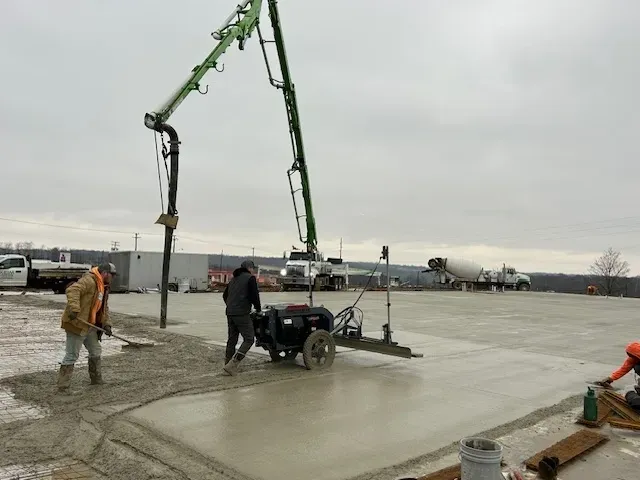
Wisconsin hands a concrete pumping contractor a legacy industrial lakefront on one side of the state and steep, unglaciated bluff country on the other, and it works them very differently. But the cost of insuring either lands on the same two factors, and neither is the crew: the boom pump truck as a single very expensive asset, and the overhead power-line contact that follows a boom into the air. No one has posted a real Wisconsin number for either, because a carrier assembles the premium from your specific operation rather than a rate card.
That assembly matters more for a pumper than for a general concrete crew. A one-truck operation working Fox Valley slabs and a fleet threading booms through Milwaukee infill share a class name and little else, so a carrier reads them from separate pictures. Below is what genuinely moves the number for a Wisconsin pumping operation, roughly in the order it counts.
Why a Wisconsin pumping “average” misleads
A premium is the output of an underwriting model, not a sticker. The carrier takes your real exposures — the boom truck you run, how close your pours sit to overhead lines, your crew, your loss history, and the limits your contracts require — and prices each line against them. Change one input and the number moves.
Wisconsin makes a blended figure especially thin because its pumping spans genuinely different ground. Milwaukee’s older industrial lakefront webs dense near-downtown and heavy-industrial districts with legacy overhead grid, while Madison and the Fox Valley around Green Bay and Appleton run growth pours. Its distinctive terrain wrinkle is the Driftless Area of the southwest — an unglaciated region of steep ridges, coulees, and river bluffs where flat outrigger setup and clean boom reach are genuinely harder than on the glaciated plains that cover the rest of the state. A pumper working Milwaukee infill and one on a Driftless bluff price from different realities.
The boom truck: the single asset that carries the program
For a pumping contractor the truck is not one vehicle among several — it is the operation, and it concentrates a large amount of value in a single specialized unit. That is why the commercial auto line covering its physical damage and its liability, both on the highway and set up over a pour, leads the cost. A finishing crew’s trucks are ordinary; they follow the crew and the finished work. A pumper’s truck is the work. Its value, the reach of the boom, how many units you run, and the maintenance and operating discipline behind them are weighed closely, because a truck loss is expensive and it takes you off the job — and on a steep Driftless bluff, the setup and footing that keep the truck safe are themselves part of the story. Scheduling that unit to its real value is where this driver is decided.
Milwaukee’s legacy grid and the Driftless bluffs
The second signature cost is why pumping underwrites unlike any other concrete trade, and Wisconsin sharpens it at both ends. Milwaukee’s older lakefront inherits a dense legacy overhead grid that webs near-downtown neighborhoods and heavy-industrial districts, putting a boom close to energized lines on urban infill and rebuild work. Out in the dairy country and small towns, work stretches under spread rural overhead runs. A boom moves concrete in three dimensions, and contact between that boom and an energized line is the catastrophic event a carrier prices against — it can cause serious bodily injury, and it is exactly what general liability and an umbrella exist to answer. Add the Driftless bluffs, where sloped, cut sites make level setup harder near the same overhead line, and the severity picture is real. Because it is high, a carrier weighs your clearance protocol, spotter discipline, and placement record heavily — not as a fixed surcharge, but as an exposure priced on how you manage it.
Real-World Scenario: A crew sets a boom on a Milwaukee infill lot for a rebuild, working reach near the legacy overhead line webbing the old industrial district, while another sets up on a cut, sloped Driftless site near La Crosse where the road-frontage distribution line runs beside an awkward bench. Different ground, same defining exposure — the boom near energized conductors — and the same two lead drivers, the truck and the power-line risk. The operator who can describe clearance and spotter procedure clearly gives a carrier a reason to price the severity down.
When a line or pipe gives way
Sitting under the truck and the overhead line is a third exposure: the delivery system under pressure. A pipe or hose that fails during placement can injure a crew member and damage the site around it, so it counts toward the general liability a carrier prices. A documented inspection routine on your lines and couplings helps, because it reduces the on-site failures an underwriter is otherwise forced to price.
A lean crew, the DSPS credential, and private comp
A pumping operation runs lean — usually an operator and a spotter, not a labor-heavy finishing crew. Workers compensation is still a real line, and Wisconsin runs a competitive private market for it, overseen alongside the admitted market by the Wisconsin Office of the Commissioner of Insurance. Wisconsin does license contractors — there is no general statewide commercial contractor license, but residential one- and two-family dwelling work requires a Dwelling Contractor certification through the Department of Safety and Professional Services — and general contractors commonly require comp regardless. But because the crew is small, the payroll-driven comp line is generally a smaller share of a pumper’s cost than the truck and the power-line exposure, which is exactly why pumping is a different cost conversation than a finishing operation.
Reading your claims history
Your claims file is a driver you have been writing for years. A clean record broadens the market and prices better; a serious power-line, auto, or liability loss in recent years narrows it and pushes the cost up. Carriers weigh the context of a loss — one incident with clearance and spotter corrections behind it reads differently than a repeating series. The reliable lever is documented discipline: boom-to-line clearance, spotter protocol, and operator training under OSHA standards, all of which land in the record a carrier prices for a concrete pumping operation.
Coverage limits and the umbrella
What you carry is a driver of its own. Since a power-line contact is a catastrophic loss, the limits general contractors require tend to push a Wisconsin pumper onto an umbrella sooner than most trades, and higher limits cost more than lower ones. Whether your general liability matches the boom exposure, whether the truck and any property are scheduled to true value, and how the limits are set all feed the figure. This is a poor place to under-buy, because the single catastrophic loss the coverage answers is exactly why the class prices the way it does.
Building an accurate Wisconsin quote
An accurate figure starts with an accurate description of the operation. Tell a broker the boom truck you run and its value, the pours you place and how close they sit to overhead lines, your clearance and spotter discipline, your crew, your loss history, the limits your contracts require, and where you work — Milwaukee legacy grid, Madison and Fox Valley growth, Driftless bluff country, or a mix. From there a carrier with real pumping appetite can price it, and you can compare like for like. When you are ready, start a quote and tell us about your equipment and your placements, browse the full coverage overview, or read the market picture on the Wisconsin concrete pumping insurance page. To see how these drivers compare across the trade, the concrete insurance cost overview sets them side by side.