

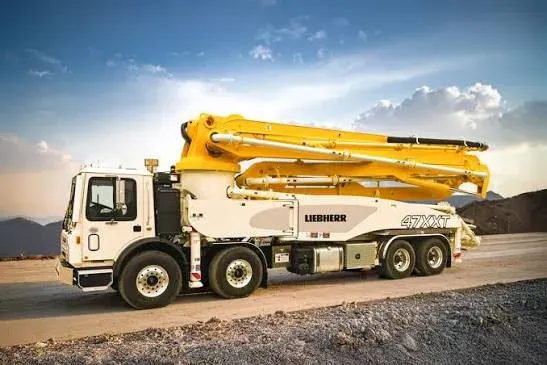
There is no published price for concrete pumping insurance in West Virginia, and any figure you see quoted before an underwriter has looked at your operation is a guess. What a carrier actually does is build the cost from your specific business — and in the most uniformly mountainous state a pump operator will ever work, the terrain drives every part of the equation. Start from the hardest thing a mountain-state pumper does: setting a boom on a hillside bench or up a hollow, where the truck cannot sit level or reach the pour from the obvious side, under a power line that follows the ridge. That is the West Virginia pumping cost picture in a single image, and this guide walks the drivers behind it.
Why the mountains lead the West Virginia pumping conversation
Most cost guides start with the truck. Here it is worth starting with the ground, because in West Virginia the ground decides how the truck gets used. Placement sites sit in narrow valleys, on cut hillside benches, and up hollows where a boom frequently cannot set up level or reach a pour from the near side. That makes stabilization, outrigger footing, and off-side reach planning the core daily challenge — the operator is constantly solving for a setup the terrain will not simply hand over. Steep slope stability is the signature ground concern, compounded by karst sinkhole potential in the eastern carbonate belts, so the surface a boom stabilizes on is not something a carrier takes for granted.
High-rise work is limited. Charleston in the Kanawha Valley, Huntington on the Ohio River, and Morgantown are the notable built-up nodes, with Parkersburg and Wheeling rounding out the market. But most West Virginia pumping is spread, low-rise placement where the difficulty comes from the mountains and the roadside lines rather than urban density. That is why a statewide “average” is close to meaningless for this class — a pumper working level valley pours and one reaching booms across sloping benches near long distribution runs are the same class only in name, and a carrier prices them from different pictures.
For the full market picture — the pumping economy across the metros and the mountain counties, the licensing reality, and the private-market workers-compensation system — see our West Virginia concrete pumping insurance page. This guide is the companion to it: that page is the market overview, this one is the cost explainer. The rest of what follows is the drivers, in roughly the order they move the number.
Stabilization and reach on steep ground
The West Virginia twist on the pumping class is where the boom sets down. On a level valley pour the setup is ordinary; on a hillside bench, in a narrow valley, or up a hollow it is not. The truck may not be able to sit level, the obvious approach may not clear the pour, and the operator has to solve for off-side reach with the boom working harder and the outriggers landing on ground that slopes, drains, or gives. Outrigger footing and cribbing, ground assessment before the truck sets, and reach planning that respects both the slope and the load are the daily discipline here — and slope stability plus karst sinkhole potential in the eastern carbonate belts mean the ground itself is an underwriting variable. A carrier reads how you handle uneven footing, because a stabilization failure on a slope is one of the losses the class is priced against, and it shows up on both the commercial auto and the general liability side.
The boom pump truck — your leading cost driver
For a pumper the truck is the operation, and it is a high-value, specialized asset. A boom pump truck concentrates a large amount of value in a single unit, which is why the commercial auto line that covers its physical damage and its liability — on winding mountain roads and while set up on sloping ground — is a leading driver of your cost. This is the opposite of a general install crew, whose vehicles are ordinary work trucks. The value, type, and reach of the boom, how many trucks you run, and how they are maintained and stabilized on uneven footing are inputs a carrier weighs closely, because a loss involving the truck is both likely to be expensive and central to whether you can keep working. Scheduling the truck to its real value is where this driver is won.
The ridge-run power lines — the catastrophic general-liability driver
The second signature driver is the reason pumping underwrites differently from any other concrete work, and West Virginia gives it a rural, follow-the-ridge shape. Distribution lines run for long stretches along winding roadsides and over hollows rather than in a tidy city grid, so a boom placing concrete in three dimensions frequently works near energized lines on constrained, sloping ground. Contact between the boom and an overhead line is the severe event carriers price against — it can cause serious bodily injury, and it is exactly the kind of catastrophic loss that general liability and an umbrella are built to answer. Because the severity is high, a carrier weighs your clearance discipline, your spotter protocol, and your placement record heavily. On the long roadside runs the risk is that lines are strung where the terrain forced the setup — this is not a fixed surcharge, it is a real exposure priced on how you manage it.
Real-World Scenario: A crew works up a narrow hollow above Morgantown, cribbing the outriggers on a cut bench so the boom can reach a foundation the truck could not approach from the road, all while a distribution line follows the ridge overhead. Miles away, another crew sets a boom for a built-up pour in the Kanawha Valley near Charleston, threading between the structure and roadside lines. Different sites, same defining exposures — the steep setup and the boom working near energized lines — and the same two lead cost drivers, the truck and the power-line risk. The pumper who can describe stabilization and clearance protocol clearly gives a carrier a reason to price the severity down.
Line and pipe failure on the pour
Beyond the boom and the lines, the delivery system itself is an exposure. A line or pipe that fails under pressure during a pour can cause injury and property damage on the site, so it is a real part of the general liability picture a carrier prices. Disciplined line and pipe inspection and maintenance are levers here — a documented maintenance record reads well, because it lowers the frequency of exactly the on-site losses an underwriter is trying to weigh, and on constrained mountain sites where crews and bystanders are close to the work, that frequency matters.
The operator-and-spotter crew — a lighter workers-comp line
Unlike a labor-heavy install crew, a pumping operation typically runs a smaller crew — an operator and a spotter rather than a full finishing crew. Workers compensation is still a real line, and West Virginia is a competitive market, so comp is placed with a private carrier rather than a state monopoly. Because the crew is smaller, the payroll-driven comp line is generally a smaller share of a pumper’s cost than it is for a general concrete crew — which is precisely why pumping is a different cost conversation than the West Virginia concrete contractor cost picture, where payroll leads. For a pumper the boom truck and the power-line exposure sit ahead of comp in what moves the number.
Licensing and how it reaches your cost
West Virginia does license contractors: a statewide contractor license is required for construction work above a set value, with general building, general engineering, and residential classifications, issued through the West Virginia Contractor Licensing Board. That credential is part of operating cleanly, and the general contractor or owner you work for typically layers its own certificate-of-insurance and additional-insured requirements on top — which is where licensing meets your coverage. Confirm the credential that actually applies to your work rather than assuming one that does not, and check any specific policy question against the West Virginia Offices of the Insurance Commissioner. Carrying the license and the coverage the contracts demand keeps you eligible for the work and reads well to an underwriter.
Claims history and the coverage you carry
Your loss record is a driver you have already been writing for years. A clean history opens more markets and prices better; a serious power-line, auto, or setup-related loss in the last several years narrows the field. Carriers read the story behind the losses too — a single incident followed by corrected clearance and stabilization procedures reads differently than repeated, similar events, and operator training under OSHA standards shows up in the record. What you buy is a driver as well: because the power-line exposure is catastrophic, the limits your general contractors require push a pumper toward an umbrella more firmly than most trades, and whether you schedule the truck and any property to real value feeds the number. For a concrete pumping operation these are not places to under-buy blindly.
Getting an accurate West Virginia quote
The path to a real number is to describe your real operation. Tell a broker the boom truck you run and its value, the sites you place and how steep and constrained the setups get, your stabilization and outrigger discipline, how close your work sits to the roadside and ridge-line power lines, your crew, your claims history, the limits your contracts require, and where in West Virginia you work. From there a carrier with genuine pumping appetite can price it, and you can compare apples to apples instead of chasing a headline figure. When you are ready, start a quote and tell us about your equipment and your placements, or browse the full coverage overview to see how each line fits together. For the market picture behind these drivers, see the West Virginia concrete pumping insurance page. The number at the end will reflect your business, which is the only number worth having.