

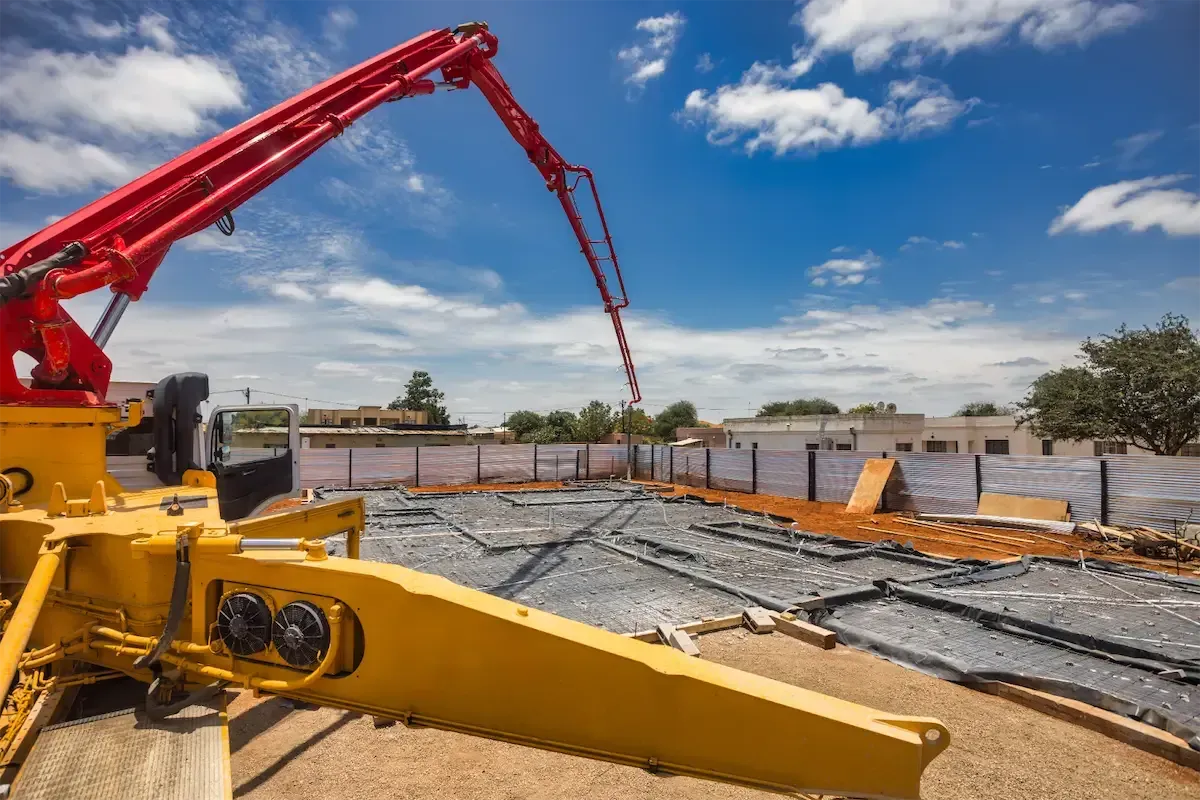
There is no published price for concrete pumping insurance in Virginia, and any figure quoted before an underwriter has studied the operation is guesswork. A carrier assembles the cost from your specific business, and for a pumper it gathers around two drivers a general concrete crew never carries: a high-value boom pump truck and the overhead power-line exposure of placing concrete in three dimensions. What makes Virginia distinctive is the sheer range of ground a boom sets on — the state runs a west-to-east gradient from mountains to sea, and a single operation can work all of it. This guide walks the drivers behind a Virginia pumper’s number.
Virginia is really three placement worlds joined in one state. The far southwest is steep Appalachian coalfield terrain of ridges and hollows. The central Piedmont carries Richmond and its older downtown grid. Northern Virginia — Arlington, Tysons, and the inner suburbs — is a dense, high-value market where vertical construction and a historic data-center building surge concentrate the work. And east of the fall line the ground flattens into the Hampton Roads tidewater around Norfolk and Virginia Beach. A pumper’s cost reads differently depending on which of those a truck spends its days in, which is why a statewide average tells you almost nothing.
The ground shifts as much as the skyline does: a salt-exposed Chesapeake and Atlantic coast around Chesapeake and Newport News, karst limestone valleys prone to sinkholes through the west, and the Central Virginia Seismic Zone remembered for the Mineral earthquake all shape the foundations a boom places over. A pumper feeding concrete for a coastal footing detailed against salt intrusion is working a different pour than one placing a valley slab over solution-prone limestone, and both differ again from a data-center mat in the Northern Virginia corridor.
One state, three placement worlds — where the overhead line lives
The exposure that makes pumping underwrite unlike any other concrete work is the overhead power line, and Virginia hands it three faces. A boom places concrete in three dimensions, and contact between it and an energized line is the severe event carriers price against — capable of fatal injury, and exactly the loss general liability and an umbrella exist to answer. In the southwest coalfields the boom sets on graded ridge-and-hollow lots served by long rural overhead runs. In Northern Virginia it threads tight urban overhead on high-rise and data-center pours. In Hampton Roads it reaches flat across coastal sites strung with roadside distribution. The geography changes; the catastrophic exposure does not, and a carrier prices it on how you manage clearance rather than on a fixed charge.
The boom truck that works all three worlds
For a pumper the truck is the operation, and it is a high-value, specialized asset that concentrates a large amount of value in a single unit. That is why the commercial auto line covering its physical damage and its liability — on the road and set up on site — leads the cost, the opposite of a general install crew whose vehicles are ordinary work trucks. Virginia stretches this driver, because the same boom truck may climb mountain grades in the southwest, crawl congested Northern Virginia traffic, and run coastal routes near Hampton Roads in the course of its work. The value, type, and reach of the boom, how many trucks you run, and how they are maintained and operated are inputs a carrier weighs closely, because a truck loss is both expensive and central to keeping the operation running.
Virginia’s three-class contractor license
Virginia licenses contractors, and it does so in a distinctive way: three classes by project size, each with exam, experience, and net-worth requirements, issued through the Virginia Department of Professional and Occupational Regulation’s Board for Contractors. The class that applies to your concrete work is part of the cost picture a carrier reads, alongside the certificate-of-insurance and additional-insured requirements a general contractor or project owner layers on top. We confirm the class that actually fits your work rather than assume one, because standing and contract obligations are part of the operation being priced.
A smaller crew in a competitive comp market
Virginia runs a competitive workers compensation market, so comp is placed with a private carrier and structured to the real crews and payroll classifications. But a pumping operation runs a smaller crew than a labor-heavy finishing crew — an operator and a spotter rather than a full team — so the payroll-driven comp line is generally a lighter share of a pumper’s cost than a general concrete contractor’s. That is what makes pumping a different cost conversation than the Virginia concrete contractor cost picture, where payroll leads. For a pumper the truck and the overhead line lead, and comp coordinates with the general liability, commercial auto, and property beside it.
Line and pipe failure on the pour
Beyond the boom and the lines, the delivery system is its own exposure. A line or pipe that fails under pressure during a pour can injure the crew and damage the site, so it is a real part of the general liability picture a carrier prices. Disciplined line and pipe inspection and maintenance are levers here — a documented record reads well because it lowers the frequency of exactly the on-site losses an underwriter is weighing, whether the pour is a congested Northern Virginia site or a mountain lot in the far southwest.
Claims history and the record a carrier reads
Your loss history is a driver you have already been writing. A clean record opens more markets and prices better, while a serious power-line, auto, or general-liability loss in recent years narrows the field. Carriers read the story behind a loss — one incident followed by corrected clearance and spotter procedure reads differently than a pattern. The durable lever is operational discipline: documented boom-to-line clearance, spotter protocol, and operator training under OSHA standards all show up in the record a carrier prices for a concrete pumping operation. The Virginia State Corporation Commission’s Bureau of Insurance oversees the admitted market these programs are placed in.
Limits, umbrella, and the Northern Virginia jobsite
What you buy is a driver. Because the power-line exposure is catastrophic, the limits general contractors require push a Virginia pumper toward an umbrella more firmly than most trades, and Northern Virginia’s large commercial and data-center jobsites often carry the steepest limit requirements of all. Higher limits cost more than lower ones. Whether you carry general liability at the limits the boom exposure calls for, whether you schedule the truck and any property to real value, and how your limits are set all feed the number. For a pumper these are not places to under-buy, because the single catastrophic loss the coverage exists to answer is the whole reason the class underwrites as it does.
Real-World Scenario: A crew climbs into the southwest coalfields to place a foundation on a ridge lot, leveling outriggers on grade beneath a long rural overhead run. The same operation, days later, sets a boom on a tight Northern Virginia site for a mid-rise pour, threading past dense urban lines in heavy traffic, then finishes the month reaching flat across a Hampton Roads slab under roadside distribution. Three placements, one defining exposure — the boom near an energized line — and one pair of lead drivers, the truck and the power line. The pumper who documents clearance and spotter protocol across all three gives a carrier a reason to price the severity down.
How to get an accurate Virginia quote
A real number comes from describing a real operation. Tell a broker the boom truck you run and its value, the pours you place and how close they sit to overhead lines, whether you work mountain lots, dense urban sites, or flat coast, your clearance and spotter discipline, your crew, your claims history, the limits your contracts require, and the license class you hold. From there a carrier with genuine pumping appetite can price it. When you are ready, start a quote and tell us about your equipment and placements, or browse the coverage overview to see how each line fits. For the market picture behind these drivers, see the Virginia concrete pumping insurance page, and for how pumping compares with the other concrete trades, the concrete insurance cost overview. The number at the end will reflect your business — the only number worth having.