
Cost Guides

Concrete Pumping Insurance Cost in Vermont

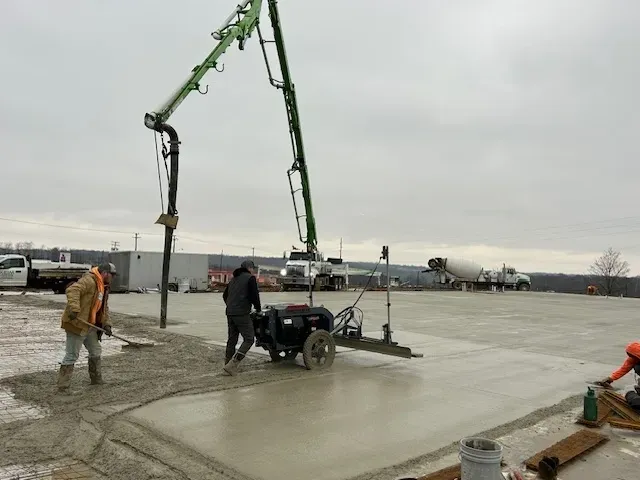
A boom pump placing concrete into a ride-behind laser screed as mixer trucks wait — concrete pumping insurance

There is no published price for concrete pumping insurance in Vermont, and any figure quoted before an underwriter has seen your operation is a guess. A carrier builds the cost from your specific business — and for a pumper it is led by two things a general concrete crew does not carry: a high-value boom pump truck, and the overhead power-line exposure of placing concrete in three dimensions.

Vermont is among the most rural states in the country, and its pumping exposure reflects that almost entirely. The Green Mountains form a spine down the state, so boom setup frequently contends with sloped, hilly ground where leveling and reach are harder than on flat lots, and outside Burlington the work is dispersed across small towns served by long rural overhead lines. The state has essentially no high-rise construction. There is no statewide contractor license — local permitting and the contract set the gate. Below are the drivers that move the number, in roughly the order they matter here.

Why Vermont concrete pumping has no sticker price

A premium is the output of an underwriting model, not a sticker. A carrier takes your specific exposures — the boom truck you run, the pours you place and how close they sit to overhead lines, your loss history, and the limits your contracts require — and prices each line against them. Change any input and the number moves. For a pumper the cost concentrates in two places most trades never share: one very expensive vehicle, and a catastrophic power-line exposure.

Vermont makes a statewide “average” misleading because the work is so dispersed and low-rise. Burlington is the state’s only real metropolitan area, a low-rise city on Lake Champlain, and the highest-value commercial pours cluster there and around secondary centers like Montpelier and Rutland; everything else is spread across countryside and small towns on mountainous ground. A pumper on a Burlington foundation and one leveling a boom on a remote hillside lot price from different pictures.

For the full market picture — the rural building pattern, the Green Mountain terrain, and the licensing reality — see our Vermont concrete pumping insurance page. That page is the market overview; this one is the cost explainer.

What builds a Vermont concrete pumper’s insurance cost — the two signature drivers Two highlighted lead boxes at the top — the boom pump truck’s value on commercial auto, and the overhead power-line exposure on general liability — converge downward into a stack of supporting driver boxes: line and pipe failure on the pour; the operator-and-spotter crew on workers compensation; the claims and placement record; and coverage limits and umbrella. Every driver feeds a bottom box labeled the premium a carrier builds from the truck and the work. No figures are shown — each driver is weighed against the specific operation, not applied as a fixed surcharge. What builds your pumping insurance cost The boom pump truck’s value Overhead power-line exposure Line and pipe failure on the pour The operator-and-spotter crew (lighter WC) Your claims and placement record Coverage limits and umbrella The premium a carrier builds from the truck
The pumping cost picture is led by two signature drivers a general concrete crew does not carry — the boom truck and the power-line exposure — with the crew, claims, and coverage feeding the premium.

Mountain setup and rural overhead lines — the catastrophic driver

The exposure that most shapes a Vermont pumper’s general-liability cost is boom-to-power-line contact, and here it takes a rural, mountainous form. A boom places concrete in three dimensions, and contact between the boom and an overhead line is the severe, often-fatal event carriers underwrite against — exactly the catastrophic loss that general liability and an umbrella exist to answer. Because Vermont has essentially no high-rise construction, the danger comes from reaching a boom over spread, low-rise, and mountainous sites served by long-run overhead distribution line along rural roads. The Green Mountain terrain adds a second layer — a boom truck must set and level carefully on sloped ground before it can safely reach a pour, often near the very line that follows the road in. Because the severity is high, a carrier weighs your clearance discipline, spotter protocol, placement record, and OSHA clearance practice heavily. This is a severity priced on how you manage it, not a fixed charge.

The boom pump truck — one high-value asset over mountain grade

For a pumper the truck is the operation, and it is a high-value, specialized asset. A boom pump truck concentrates a large amount of value in a single unit, which is why the commercial auto line covering its physical damage and its liability is a leading driver of your cost — the opposite of a general install crew, whose vehicles are ordinary work trucks. Vermont adds pressure the truck feels directly: navigating the Green Mountains, river valleys, and grade-restricted rural roads to reach dispersed jobsites, and threading deep-winter conditions for much of the year, both of which weigh on the road exposure. The value, reach, and upkeep of the boom, and how carefully it is driven and set up, are inputs a carrier watches closely, because a loss involving the truck is expensive and central to whether you keep working. Scheduling the truck — and any owned property — to real value is where this driver is won.

Real-World Scenario: One crew places a low-rise commercial foundation in Greater Burlington near the street-side lines of the state’s only real metro, while another levels a boom truck on a sloped hillside lot in the Green Mountains where the rural distribution line follows the winding road it drove in on. Different ground, same defining exposure — the boom near energized lines — and the same two lead drivers, the truck and the power-line risk. The pumper who documents clearance and setup discipline on sloped rural sites gives a carrier a reason to price the severity down.

Line and pipe failure on the pour

Beyond the boom and the lines, the delivery system itself is an exposure. A line or pipe that fails under pressure during a pour can cause injury and property damage on the site, so it is a real part of the general liability picture a carrier prices. Disciplined inspection and maintenance are levers — a documented maintenance record reads well, because it lowers the frequency of exactly the on-site losses an underwriter weighs.

The crew, the record, and the coverage you buy

A pumping operation typically runs a smaller crew — an operator and a spotter — so the payroll-driven workers compensation line, placed with a private carrier in Vermont’s competitive market, is generally a smaller share of a pumper’s cost than a general concrete crew’s. Your loss record is a driver you have been writing for years: a clean history opens more markets and prices better. And what you buy is a driver too — because the power-line exposure is catastrophic, the limits your general contractors require push a pumper toward an umbrella more firmly than most trades. The Vermont Department of Financial Regulation, Insurance Division regulates the carriers writing those lines.

Getting an accurate Vermont quote

The path to a real number is to describe your real operation. Tell a broker the boom truck you run and its value, the pours you place and how close they sit to overhead lines, whether you work Greater Burlington or dispersed mountain sites, your clearance and spotter discipline, your crew, your loss history, and the limits your contracts require. From there a carrier with genuine pumping appetite can price it. When you are ready, start a quote and tell us about your equipment and your placements, browse the full coverage overview, or see how pumping cost compares across states in the national concrete insurance cost guide. For a concrete pumping operation, the number at the end will reflect your business, which is the only number worth having.

The bottom line

Vermont concrete pumping insurance has no published price, because a carrier builds it from your operation — and for a pumper it is led by the boom pump truck on commercial auto and the overhead power-line exposure on general liability. In one of the most rural states in the country, that means mountainous Green Mountain setup terrain and long rural overhead lines rather than high-rise cores — Vermont has essentially none. There is no statewide contractor license; local permitting and the contract set the gate.

Frequently asked questions

How much does concrete pumping insurance cost in Vermont?

There is no honest single number, because a pumper’s premium is built from the operation rather than a rate card. The biggest drivers are the value and type of your boom pump truck on commercial auto and the overhead power-line-contact exposure that shapes your general liability — and in Vermont that plays out on sloped mountain setups and along long rural overhead lines rather than in high-rise cores, which the state essentially lacks. Your line and pipe failure exposure, your small operator-and-spotter crew, your loss record, and your limits round it out. We rate your real operation rather than quote a guess — start a quote and we price to the equipment and the work.

Why can’t you give me a concrete pumping insurance price online?

Because an honest price requires your real operation, and a number posted before an underwriter sees it is a guess. A single-truck pumper on Greater Burlington foundations and one leveling a boom on a sloped hillside lot served by a long rural overhead line carry different exposures, so a carrier prices them differently. Posting an average would only mislead. What we can do is explain the drivers — the boom truck and the power-line severity above all — and market your real operation to carriers that understand the pumping class. A licensed agent prices it from there.

How does the power-line exposure work in a rural state like Vermont?

It plays out on open, spread ground rather than in tall buildings. A boom places concrete in three dimensions, and contact with an overhead line is the catastrophic, often-fatal general-liability event carriers price against. Outside Burlington, Vermont’s work is dispersed across small towns and countryside served by long-run overhead distribution line along rural roads — precisely where a boom swinging into an energized conductor becomes the exposure. Vermont has essentially no high-rise construction, so the danger comes from reaching over spread, low-rise, and mountainous sites. Your clearance discipline, spotter protocol, and placement record are what a carrier prices that severity on, not a fixed surcharge.

Is there a Vermont contractor license that affects my pumping cost?

No statewide trade license. Vermont does not require one to work as a general or concrete contractor; residential contractors above a set value must register with the Office of Professional Regulation, which is a registration rather than a trade license. The gate is local permitting and the contract rather than a statewide credential. Because there is no license to rate, the pumping premium turns entirely on the operation — the boom truck, the power-line exposure, your loss record, and your limits — plus whatever local permits and contract insurance requirements apply on a given job.

Why is the boom pump truck the leading cost driver?

Because for a pumper the truck is the operation, and it is a high-value, specialized asset. A boom pump truck concentrates a large amount of value in a single unit, so the commercial-auto line covering its physical damage and its liability is a leading driver — the opposite of a general install crew running ordinary work trucks. In Vermont the truck also navigates the Green Mountains, river valleys, and grade-restricted rural roads to reach dispersed jobsites and threads deep-winter conditions, both of which weigh on the road exposure. The value, reach, and upkeep of the boom are inputs a carrier watches closely, because a truck loss is expensive and central to whether you can keep working.

How can I lower my Vermont concrete pumping insurance cost?

The durable levers are operational. A clean loss record, documented boom-to-power-line clearance and spotter protocols that limit the catastrophic general-liability exposure on rural sites, careful setup and outrigger footing on sloped mountain ground, disciplined line and pipe maintenance, operator training, scheduling your boom truck to its real value, and matching your limits to the contracts you sign all help a carrier price you accurately. Safe driving on winding rural grades reads well on commercial auto too. We market your operation to carriers with genuine pumping appetite rather than sending one generic submission everywhere.

About the author

Nate Jones, CPCU

Nate Jones, CPCU, is the founder of Wexford Insurance and Concrete Guard Insurance, a specialty insurance agency placing concrete contractor coverage in 48 states across a 23-carrier specialty panel. He places concrete pumping contractors across Vermont — from the low-rise commercial work of Greater Burlington and secondary centers like Montpelier and Rutland to the dispersed small-town and countryside placement served by long rural overhead lines across sloped Green Mountain ground — and weights each program toward the commercial-auto exposure on a high-value boom truck and the power-line-contact exposure that decides what a pumper actually pays in a deeply rural, low-rise state. Connect via the Concrete Guard Insurance quote form or call 317-942-0549.

Insure your concrete operation with a CPCU-led agency

Tell us how you work — an install crew, a pump truck, a ready-mix fleet, or all three — and we will market it to carriers that write the class.