

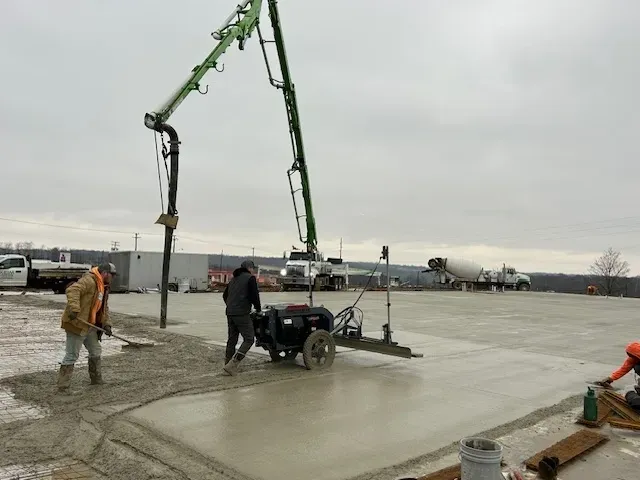
A South Dakota concrete pumping contractor will not find a published price, and any figure quoted before an underwriter has studied the operation is guesswork. A carrier builds the cost from your specific business, and for a pumper it gathers around two things a general concrete crew does not carry: a high-value boom pump truck and the overhead power-line exposure of placing concrete in three dimensions. South Dakota is genuinely two states for a pump-truck operator, divided roughly by the Missouri River, and a pumper’s cost reads differently depending on which side the work sits on. This guide walks the drivers behind a South Dakota pumper’s number.
East River, Sioux Falls is the fast-growing commercial and multi-family engine along the Big Sioux, where most of the higher-value vertical and mid-rise pours — and the boom setups that reach them near street-side overhead utilities — actually happen. West River is Black Hills country around Rapid City, where hilly, rising terrain and tighter mountain-town sites change the boom-reach and outrigger-setup problem entirely from the flat eastern plains. Between and beyond the two metros lies spread, low-rise agricultural work fed by long rural overhead runs. A pumper’s cost reads from that split, not from any statewide average.
The ground splits with the map, too: hard freeze-thaw cycling meets Pierre Shale expansive clay in the west around Rapid City and glacial till in the east toward Aberdeen, Brookings, and Watertown, so compacted base preparation and heave-resistant detailing sit under many of the foundations a boom places on either side of the river. A pumper feeding a swelling-clay footing West River is solving a different placement than one on stable till in the east.
East River and West River — where the boom truck works
For a pumper the truck is the operation, and it is a high-value, specialized asset that concentrates a large amount of value in a single unit. That makes commercial auto — the line covering its physical damage and its liability, on the road and while set up — a leading driver, the opposite of a general install crew whose vehicles are ordinary work trucks. South Dakota stretches this driver two ways: East River the truck runs the fast-growing Sioux Falls corridor and long flat farmland stretches between jobs, while West River it climbs rising Black Hills grades and works tighter mountain-town lots. Both add real road and setup exposure, and a spread state means a truck logs long rural miles between them. The value, type, and reach of the boom, how many trucks you run, and how they are maintained across that mileage are inputs a carrier weighs closely, because a truck loss is both expensive and central to whether you can keep working.
Overhead lines from Sioux Falls streets to the Black Hills
The second signature driver is the one that makes pumping underwrite unlike any other concrete work: the overhead power line. A boom places concrete in three dimensions, and contact between it and an energized line is the severe event carriers price against — capable of fatal injury, and exactly the loss general liability and an umbrella exist to answer. South Dakota hands this exposure three faces: the street-side overhead utilities a boom works near on Sioux Falls vertical and mid-rise pours, the rising Black Hills town lots where terrain and overhead combine West River, and the long rural distribution runs that thread spread agricultural work across the plains. Metro, mountain-town, or open country, the catastrophic exposure is the same, and a carrier prices it on how you manage clearance rather than on a fixed charge.
No statewide license — the excise-tax and local gate
South Dakota has no statewide general- or concrete-contractor license — the credential that trips up owners in other states simply does not exist here. What the state does require is a contractor’s excise-tax license from the Department of Revenue, which is a tax registration rather than a trade license, and some localities layer their own licenses on top. So the gate is that registration plus local permitting. None of that lifts the obligations a carrier reads: your registration and permitting standing and the certificate-of-insurance and additional-insured terms a general contractor or project owner sets all remain part of the operation being priced, and we name the gate for what it actually is.
A smaller crew and a competitive comp market
South Dakota runs a competitive workers compensation market, so comp is placed with a private carrier and structured to the real crews and payroll classifications. But a pumping operation runs a smaller crew than a labor-heavy finishing crew — an operator and a spotter rather than a full team — so the payroll-driven comp line is generally a lighter share of a pumper’s cost than a general concrete contractor’s. That is what makes pumping a different cost conversation than the South Dakota concrete contractor cost picture, where payroll leads. For a pumper the truck and the overhead line lead, and comp coordinates with the general liability, commercial auto, and property beside it.
Line and pipe failure on the pour
Set apart from the boom and the overhead line is a third exposure most people overlook: the delivery line itself. Concrete moves through it under real pressure, and a section or coupling that fails mid-pour can injure the crew and damage the site, which lands it in the general liability a carrier is sizing. The lever here is unglamorous but effective — inspection records and timely replacement of worn line thin the frequency losses that underpin the rarer catastrophic ones, and a documented history of that reads well at renewal.
Claims and the record a carrier reads
The loss runs behind your operation are a driver you have been building for years. A record clean of power-line, auto, and liability claims earns access to more markets and a keener price; a serious recent loss pulls the field in the other direction. Carriers also read for trajectory — one incident answered with corrected clearance and spotter procedures reads nothing like a repeating pattern. The lever that lasts is field discipline: boom-to-line clearance, a spotter on every set, and operator training tied to OSHA practice, all of which stay attached to a concrete pumping operation through every renewal. The South Dakota Division of Insurance oversees the admitted market these programs are placed in.
Coverage limits and umbrella
The coverage you elect is a driver too. Because a line-contact loss is catastrophic, the general contractors a South Dakota pumper serves press for higher liability limits and an umbrella more insistently than they would with most trades, and more limit costs more. Whether your general liability is sized to the boom exposure, whether the truck and any property are scheduled at real value, and where your limits land all shape the number — and buying thin is the wrong economy for this class, because the single severe event the coverage answers is the whole reason the trade underwrites the way it does.
Real-World Scenario: A crew works a Sioux Falls mid-rise pour East River, threading a boom past street-side overhead in the state’s busiest growth corridor. The same operation, a long drive later, sets up on a rising Black Hills town lot West River, leveling outriggers on grade with a rural distribution run crossing the approach. Two very different worlds, one defining exposure — the boom near an energized line — and one pair of lead drivers, the truck and the power line. The pumper who documents clearance and spotter protocol on both sides of the Missouri gives a carrier a reason to price the severity down.
How to get a real South Dakota quote
A real figure comes out of a real account of the work. Hand a broker the boom truck and its value, the pours you place and their distance from overhead lines, whether the day is a Sioux Falls corridor pour, a Black Hills town lot, or a spread rural site, the clearance and spotter routine you keep, the crew, the loss history, the limits your contracts set, and your registration and permitting standing. A carrier with real pumping appetite prices from there. When you are ready, open a quote and set out your equipment and placements, or read the coverage overview to see how the lines connect. The market context is on the South Dakota concrete pumping insurance page, and the cross-trade comparison on the concrete insurance cost overview. The figure you end with will reflect your business — the only one worth having.