

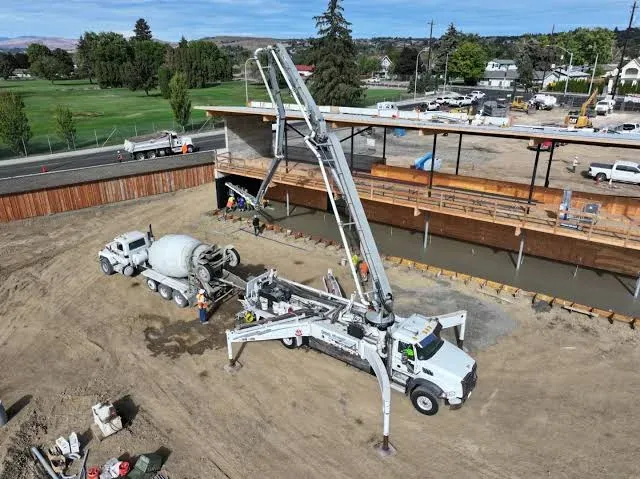
There is no published price for concrete pumping insurance in Ohio, and any number quoted before an underwriter has looked at your operation is a guess. Ohio also carries a structural twist a pumper should understand first: workers comp is not a private-market line here, so the program a carrier actually builds and prices is general liability, commercial auto, property, and umbrella. Within that program, the cost is led by two things a general concrete crew does not carry — a high-value boom pump truck and the overhead power-line exposure of placing concrete in three dimensions. This guide walks the drivers that decide what an Ohio pumping contractor pays.
That answer frustrates owners who just want a figure, but it is the honest one, and the state-fund wrinkle actually sharpens it. Because comp is handled outside the private market, the boom truck and the power-line severity carry even more of the private-market conversation than they would elsewhere. A single-truck pumper working newer Columbus subdivisions and a fleet threading booms through Cleveland’s dense old grid are the same class only in name, and a carrier prices them from different pictures.
Ohio’s state-fund comp wrinkle — what it does to a pumper’s private-market number
Start with the part of Ohio that is genuinely different. Ohio is a monopolistic workers-compensation state: comp is available only through the Ohio Bureau of Workers Compensation, and private carriers cannot write it here. That does not remove comp from your obligations — it moves it out of the program a private carrier prices for you. What a carrier builds instead is general liability, commercial auto, property, and an umbrella. We are direct about that split rather than implying comp rides inside the private quote.
For a pumper this matters more than it might for a labor-heavy install crew, because a pumping operation already runs a smaller crew — an operator and a spotter rather than a full finishing crew. With comp out of the private program and the crew small to begin with, the private-market cost sits almost entirely on the boom truck and the catastrophic power-line exposure. That is the opposite emphasis from a general concrete contractor, and it is why pumping is a different cost conversation. For the full market picture, see our Ohio concrete pumping insurance page — that page is the overview, this one is the cost explainer.
The boom pump truck across the Three-C spread
For a pumper the truck is the operation, and in Ohio it works across a polycentric map with no single dominant skyline. A pump operation spreads reach along the Three-C spine of Columbus, Cleveland, and Cincinnati plus mid-size hubs like Dayton, Akron, and Toledo, which means the fleet logs road miles between separate metro economies. A boom pump truck concentrates a large amount of value in one unit, so the commercial auto line that covers its physical damage and its on-road and on-site liability is a leading driver of your cost. The value and reach of the boom, how many trucks you run across those metros, and how disciplined the maintenance is are inputs a carrier weighs closely, because a loss involving the truck is both expensive and central to whether you keep working. Scheduling each unit to its real value is where this driver is won.
Overhead lines over Cleveland and Cincinnati legacy grids
The second signature driver is the reason pumping underwrites unlike any other concrete work, and Ohio sharpens it. Cleveland and Cincinnati carry dense legacy overhead grids inherited from their old industrial and streetcar eras, so a boom threading between energized primary lines on infill and older-neighborhood pours faces the catastrophic exposure squarely. Columbus, growing outward with more modern subdivisions, mixes newer buried service with older overhead arterials, and Cincinnati’s Ohio River hillsides add graded setups where reach and outrigger footing get complicated near lines. Contact between the boom and an overhead conductor is the severe event a general liability policy and an umbrella are built to answer, so a carrier weighs your clearance discipline, spotter protocol, and placement record heavily. It is a real exposure priced on how you manage it, not a fixed line item.
Real-World Scenario: One crew sets a boom for an infill pour in an older Cleveland neighborhood, working the machine between the structure and the energized primary line of a dense legacy grid, while another crew places a warehouse slab on an open Columbus-edge subdivision reached by newer buried service and a few arterial overhead runs. Different grids, same defining exposure — the boom near energized lines — and the same two lead drivers, the truck and the power-line risk. The operator who can describe clearance protocol and placement discipline clearly gives a carrier a reason to price the severity down.
Line and pipe failure on the pour
Beyond the boom and the lines, the delivery system itself is an exposure. A line or pipe that fails under pressure during a pour can injure people and damage property on the site, so it is a real part of the general-liability picture a carrier prices. Documented line and pipe inspection and maintenance are levers here — a clean maintenance record reads well, because it lowers the frequency of exactly the on-site losses an underwriter is trying to weigh across a busy Three-C schedule.
What your loss record does to the number
Your claims history is a driver you have been writing for years. A clean record opens more markets and prices better; a serious power-line, auto, or general-liability loss in the last several years narrows the field and raises the number. Carriers also read the story behind the losses — one incident followed by corrected clearance and spotter procedures reads differently than repeated, similar events. The durable lever is operational discipline: documented boom-to-line clearance, spotter protocol, and operator training under OSHA standards all show up in the record a carrier prices for a concrete pumping operation. Local permitting and contract requirements set the gate in Ohio rather than a statewide license, and the Ohio Department of Insurance oversees the private market your program is placed in.
Coverage limits and the umbrella push
Finally, what you buy is a driver. Because the power-line exposure is catastrophic, the limits your general contractors require push a pumper toward an umbrella more firmly than most trades, and higher limits cost more than lower ones. Whether you carry general liability at the limits the boom exposure calls for, whether you schedule the truck and any property to real value, and how your limits are set all feed the number. For a pumper these are not places to under-buy blindly — the single catastrophic loss the coverage exists to answer is the whole reason the class underwrites the way it does.
The freeze-thaw season and the boom truck’s idle math
Northeast Ohio pairs some of the country’s most punishing freeze-thaw cycles with dense glacial clay, so deep footings and freeze-durable concrete define slab and foundation work, and cold-weather pour limits compress the workable season. For a pumper that seasonality is a quiet cost input, because a high-value boom truck that sits through hard winter stretches still carries its physical-damage value — the commercial-auto driver does not pause when the pours do. How you schedule the unit across the active season, whether you chase work across the Three-C metros to keep it earning, and how you store and maintain it through the cold months all feed the picture a carrier builds. It is also why matching the truck’s scheduled value to reality matters more in a seasonal state than in a year-round one — you are insuring an expensive asset that works hard in the warm months and waits out the cold ones, and an underwriter would rather see that reflected honestly than guessed at. The glacial clay and freeze-durable mix requirements also push a lot of Ohio placement into foundation and slab work where the boom reaches down and across rather than straight up, which keeps the horizontal-reach exposure near roadside and arterial overhead in the picture alongside the tighter urban infill of the older metros.
How to get an accurate Ohio quote
The path to a real number is to describe your real operation. Tell a broker the boom truck you run and its value, the pours you place and how close they sit to overhead lines across the Three-C metros, your clearance and spotter discipline, your crew, your claims history, and the limits your contracts require. From there a carrier with genuine pumping appetite can price the private-market program — and you can compare apples to apples instead of chasing a headline rate. When you are ready, start a quote and tell us about your equipment and placements, browse the full coverage overview to see how each line fits, or read the broader concrete insurance cost picture. The number at the end will reflect your business, which is the only number worth having.