

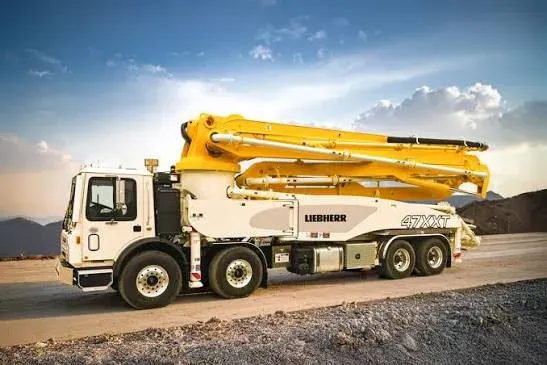
A New York concrete pumping contractor will not find a published price, and any figure quoted before an underwriter has studied the operation is guesswork. A carrier builds the cost from your specific business, and for a pumper it gathers around two things a general concrete crew does not carry: a high-value boom pump truck and the overhead power-line exposure of placing concrete in three dimensions. New York pushes both to an extreme few states approach, because New York City holds the most demanding vertical placement environment in the country — booms lifting concrete for high-rises across Manhattan, Brooklyn, Queens, and the Bronx on some of the tightest, most congested lots imaginable. This guide walks the drivers behind a New York pumper’s number.
The state is really several placement worlds at once. In the city, reach and precision at height define the work amid dense surrounding structures. In the outer boroughs, suburbs, and upstate, extensive overhead distribution changes the risk entirely. And upstate metros like Buffalo, Rochester, Syracuse, and Albany bring mid-rise commercial pours, while the Adirondacks and Catskills present mountainous, rural terrain with long roadside overhead and harder boom setups. A pumper’s cost reads from which of those a truck spends its days in, not from any statewide average.
The environment even shapes the concrete itself: a wide freeze-thaw range plus exceptionally heavy road salt statewide — and combined sea and road salt on Long Island — drives durable, salt-resistant mixes, so a boom in Yonkers or on a Long Island site is often placing a pour formulated for a punishing exposure. It is one more way the work a truck does, not a rate table, decides what a carrier is pricing.
The most extreme vertical placement in the country
For a pumper the truck is the operation, and it is a high-value, specialized asset that concentrates a large amount of value in a single unit — which is why the commercial auto line covering its physical damage and its liability, on the road and while set up, leads the cost, the opposite of a general install crew whose vehicles are ordinary work trucks. New York City presses this driver harder than almost anywhere: high-rise placement on the tightest, most congested lots imaginable puts a premium on reach, precision, and the value tied up in the boom. The truck also crawls extreme city traffic and truck-route restrictions between jobs. The value, type, and reach of the boom, how many trucks you run, and how they are maintained in that punishing environment are inputs a carrier weighs closely, because a truck loss is both expensive and central to whether you can keep working.
Overhead lines beyond the Manhattan core
The second signature driver is the one that makes pumping underwrite unlike any other concrete work: the overhead power line. A boom places concrete in three dimensions, and contact between it and an energized line is the severe event carriers price against — capable of fatal injury, and exactly the loss general liability and an umbrella exist to answer. New York’s twist is that much of Manhattan’s core grid runs underground, which can mask the risk — but the outer boroughs, the surrounding suburbs, and all of upstate carry extensive overhead distribution, and that is where a boom swinging into an energized conductor becomes the often-fatal event. Upstate metros add mid-rise pours near legacy overhead, and the Adirondacks and Catskills add long roadside runs on rural sites. Buried core or overhead everywhere else, the catastrophic exposure is the same, and a carrier prices it on how you manage clearance rather than on a fixed charge.
No statewide license — the local gate
New York does not require a statewide license to work as a general or concrete contractor — there is no state concrete-contractor license to hold. Contractor licensing is handled at the local and municipal level, such as the New York City consumer-protection program, so the real gate is local permitting and the contract rather than a statewide credential. That does not remove obligations from the picture: a carrier still reads your local licensing and permitting standing and the certificate-of-insurance and additional-insured requirements a general contractor or project owner sets. We are honest that the gate here is local and contractual, and price the program to the operation behind it.
A smaller crew and a competitive comp market
New York runs a competitive workers compensation market, so comp is placed with a private carrier and structured to the real crews and payroll classifications. But a pumping operation runs a smaller crew than a labor-heavy finishing crew — an operator and a spotter rather than a full team — so the payroll-driven comp line is generally a lighter share of a pumper’s cost than a general concrete contractor’s. That is what makes pumping a different cost conversation than the New York concrete contractor cost picture, where payroll leads. For a pumper the truck and the overhead line lead, and comp coordinates with the general liability, commercial auto, and property beside it.
Line and pipe failure on the pour
Beyond the boom and the lines, the delivery system is its own exposure. A line or pipe that fails under pressure during a pour can injure the crew and damage the site, so it is a real part of the general liability picture a carrier prices. On a high-rise pour that consequence can carry down to a busy street below, so disciplined line and pipe inspection and maintenance are real levers — a documented record reads well because it lowers the frequency of exactly the on-site losses an underwriter is weighing.
Claims and the clearance record
Your loss history is a driver you have already been writing. A clean record opens more markets and prices better, while a serious power-line, auto, or general-liability loss in recent years narrows the field. Carriers read the story behind a loss — one incident followed by corrected clearance and spotter procedure reads differently than a pattern. The durable lever is operational discipline: documented boom-to-line clearance, spotter protocol, and operator training under OSHA standards all show up in the record a carrier prices for a concrete pumping operation. The New York State Department of Financial Services oversees the admitted market these programs are placed in.
Coverage limits and umbrella
What you buy is a driver. Because the power-line exposure is catastrophic and city high-rise work concentrates severe potential, the limits general contractors require push a New York pumper toward an umbrella more firmly than most trades, and large city jobsites often carry the steepest requirements. Higher limits cost more than lower ones. Whether you carry general liability at the limits the boom exposure calls for, whether you schedule the truck and any property to real value, and how your limits are set all feed the number. For a pumper these are not places to under-buy, because the single catastrophic loss the coverage exists to answer is the whole reason the class underwrites as it does.
Real-World Scenario: A crew sets a boom on a razor-tight Brooklyn lot to lift concrete for a high-rise, working at height among surrounding buildings in dense traffic with a spotter managing every swing. The same operation, weeks later, reaches a boom across a rural Catskills site where a long roadside distribution run crosses the approach and the ground is uneven. Extreme vertical and remote overhead — one defining exposure, the boom near an energized line, and one pair of lead drivers, the truck and the power line. The pumper who documents clearance and spotter protocol across both gives a carrier a reason to price the severity down.
How to get a real New York quote
A real number comes from describing a real operation. Tell a broker the boom truck you run and its value, the pours you place and how close they sit to overhead lines, whether you work tight city high-rises, overhead-crossed outer-borough and suburban lots, or rural upstate sites, your clearance and spotter discipline, your crew, your claims history, the limits your contracts require, and your local licensing standing. From there a carrier with genuine pumping appetite can price it. When you are ready, start a quote and tell us about your equipment and placements, or browse the coverage overview to see how each line fits. For the market picture behind these drivers, see the New York concrete pumping insurance page, and for how pumping compares with the other concrete trades, the concrete insurance cost overview. The number at the end will reflect your business — the only number worth having.