
There is no published price for concrete pumping insurance in New Jersey, and any figure quoted before an underwriter has seen your operation is a guess. A carrier builds the cost from your specific business — and for a pumper it is led by two things a general concrete crew does not carry: a high-value boom pump truck, and the overhead power-line exposure of placing concrete in three dimensions.
New Jersey is the most densely populated state in the country, and its pumping exposure is correspondingly built-out. The Hudson County Gold Coast — Jersey City, Hoboken, and the waterfront facing Manhattan — gives genuine tower placement, while Newark and the dense inner-ring towns carry extensive legacy overhead line along tight, built-out lots. There is no statewide contractor license — local permitting and the contract set the gate. Below are the drivers that move the number, in roughly the order they matter here.
Why New Jersey concrete pumping has no sticker price
A premium is the output of an underwriting model, not a sticker. A carrier takes your specific exposures — the boom truck you run, the pours you place and how close they sit to overhead lines, your loss history, and the limits your contracts require — and prices each line against them. Change any input and the number moves. For a pumper the cost concentrates in two places most trades never share: one very expensive vehicle, and a catastrophic power-line exposure.
New Jersey makes a statewide “average” misleading because its density is so uneven. High-value vertical pours concentrate in the Gold Coast corridor and Newark, where a boom’s reach matters most and operates at heights near surrounding structures, while central and southern New Jersey add spread suburban and light-commercial placement crossed by overhead lines rather than dense vertical cores. A pumper on a Jersey City tower and one on a south-Jersey subdivision price from different pictures.
For the full market picture — the Gold Coast corridor, the dense suburban fabric, and the licensing reality — see our New Jersey concrete pumping insurance page. That page is the market overview; this one is the cost explainer.
The power-line exposure — the catastrophic general-liability driver
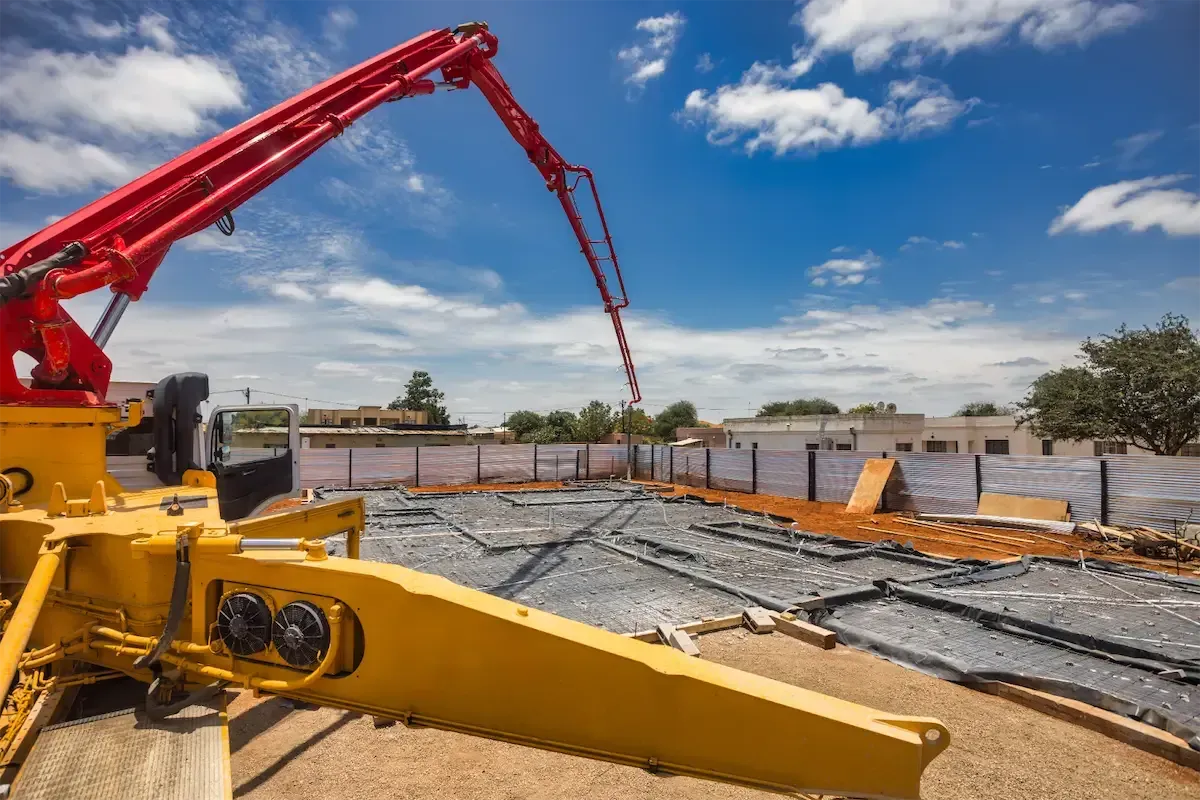
Start with the exposure that most shapes a New Jersey pumper’s general-liability cost: boom-to-power-line contact. A boom places concrete in three dimensions, and contact between the boom and an overhead line is the severe, sometimes fatal event carriers underwrite against — exactly the catastrophic loss that general liability and an umbrella exist to answer. The Hudson Gold Coast gives genuine tower placement, where a boom operates at height near surrounding structures, while Newark, the older Hudson and Essex suburbs, and the dense inner-ring towns carry extensive legacy overhead distribution line along tight, built-out residential and commercial lots — precisely where a boom swinging into an energized conductor becomes the exclusive risk. Because the severity is high, a carrier weighs your clearance discipline, spotter protocol, placement record, and OSHA clearance practice heavily. This is a severity priced on how you manage it, not a fixed charge.
The boom pump truck — one high-value asset in dense traffic
For a pumper the truck is the operation, and it is a high-value, specialized asset. A boom pump truck concentrates a large amount of value in a single unit, which is why the commercial auto line covering its physical damage and its liability is a leading driver of your cost — the opposite of a general install crew, whose vehicles are ordinary work trucks. New Jersey adds pressure the truck feels directly: some of the heaviest freight and commuter congestion in the country on the turnpike, the port-and-warehouse corridor, and the inner-ring arterials, all of which weigh on the road exposure. The value, reach, and upkeep of the boom, and how carefully it is operated, are inputs a carrier watches closely, because a loss involving the truck is expensive and central to whether you keep working. Scheduling the truck — and any owned property — to real value is where this driver is won.
Real-World Scenario: One crew sets a boom for a high-rise pour on the Jersey City waterfront, working at height between the tower and the surrounding Gold Coast structures, while another threads a boom past the legacy overhead line strung along a tight, built-out lot in an older Essex County town. Different density, same defining exposure — the boom near energized lines — and the same two lead drivers, the truck and the power-line risk. The pumper who documents clearance and spotter discipline on those tight lots gives a carrier a reason to price the severity down.
Line and pipe failure on the pour
Beyond the boom and the lines, the delivery system itself is an exposure. A line or pipe that fails under pressure during a pour can cause injury and property damage on the site, so it is a real part of the general liability picture a carrier prices. Disciplined inspection and maintenance are levers — a documented maintenance record reads well, because it lowers the frequency of exactly the on-site losses an underwriter weighs.
The crew, the record, and the coverage you buy
A pumping operation typically runs a smaller crew — an operator and a spotter — so the payroll-driven workers compensation line, placed with a private carrier in New Jersey’s competitive market, is generally a smaller share of a pumper’s cost than a general concrete crew’s. Your loss record is a driver you have been writing for years: a clean history opens more markets and prices better. And what you buy is a driver too — because the power-line exposure is catastrophic, the limits your general contractors require push a pumper toward an umbrella more firmly than most trades. The New Jersey Department of Banking and Insurance regulates the carriers writing those lines.
Getting an accurate New Jersey quote
The path to a real number is to describe your real operation. Tell a broker the boom truck you run and its value, the pours you place and how close they sit to overhead lines, whether you work the Gold Coast corridor or spread southern suburbs, your clearance and spotter discipline, your crew, your loss history, and the limits your contracts require. From there a carrier with genuine pumping appetite can price it. When you are ready, start a quote and tell us about your equipment and your placements, browse the full coverage overview, or see how pumping cost compares across states in the national concrete insurance cost guide. For a concrete pumping operation, the number at the end will reflect your business, which is the only number worth having.