

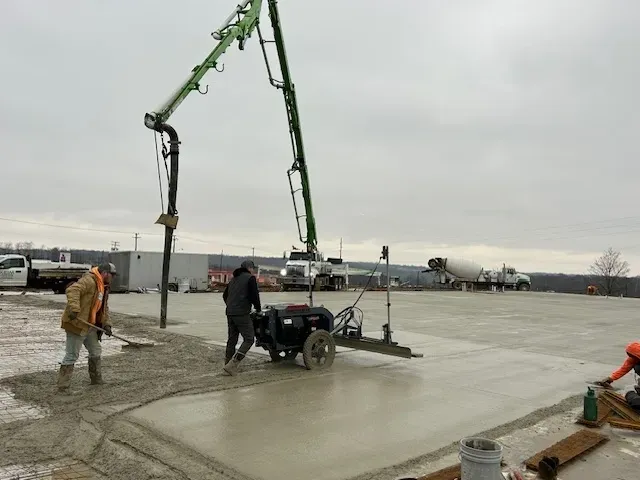
A New Hampshire concrete pumping contractor will not find a published price, and any figure quoted before an underwriter has studied the operation is guesswork. A carrier builds the cost from your specific business, and for a pumper it gathers around two things a general concrete crew does not carry: a high-value boom pump truck and the overhead power-line exposure of placing concrete in three dimensions. New Hampshire shapes both in a distinctive way, because this is a low- and mid-rise state where the boom earns its keep on difficult ground rather than in tall vertical cores. This guide walks the drivers behind a New Hampshire pumper’s number.
The state splits cleanly by geography. The north is the White Mountains and hilly interior, where sloped, uneven terrain makes boom setup and leveling genuinely harder and the rural grid runs as long-overhead distribution line. The real construction density sits in the southern tier around Manchester, Nashua, and the Salem-to-border suburbs, where mixed suburban overhead threads residential and light-commercial lots feeding off metro Boston growth. Placement statewide stays low- and mid-rise — Manchester’s downtown is modest in height — so a pumper’s line-contact risk comes from hilly northern setups and reach across overhead-crossed southern sites, not dense towers. A pumper’s cost reads from that reality, not from any statewide average.
The ground reinforces the terrain story: deep frost penetration and frost heave over glacial till and near-surface granite bedrock define footing and slab work statewide, so a boom on a northern lot may reach over a foundation set deep against frost and anchored into rock. In the southern tier around Derry and Dover, the same frost discipline applies to the faster-moving residential and light-commercial pours feeding off metro Boston growth, where reach and clearance rather than leveling dominate the setup.
Setup on hilly northern ground — the boom truck’s terrain
For a pumper the truck is the operation, and it is a high-value, specialized asset that concentrates a large amount of value in a single unit. That makes commercial auto — the line covering its physical damage and its liability, on the road and while set up — a leading driver, the opposite of a general install crew whose vehicles are ordinary work trucks. New Hampshire presses on this driver through terrain: the White Mountains and hilly interior force setup on sloped, uneven ground where outrigger footing and leveling are harder and reach has to work over grade. The value, type, and reach of the boom, how many trucks you run, and how they hold up on that terrain and how they are maintained are inputs a carrier weighs closely, because a loss involving the truck is both expensive and central to whether you can keep working.
Southern suburban overhead corridors
The second signature driver is the one that makes pumping underwrite unlike any other concrete work: the overhead power line. A boom places concrete in three dimensions, and contact between it and an energized line is the severe event carriers price against — capable of fatal injury, and exactly the loss general liability and an umbrella exist to answer. In New Hampshire the exposure does not come from stacked downtown lines, because the state has little true vertical work. It comes instead from two directions: the long rural overhead runs a boom works near on sloped northern sites, and the mixed suburban overhead threading the residential and light-commercial lots of the busy southern tier around Manchester, Nashua, and Salem. Rural or suburban, the catastrophic exposure is the same, and a carrier prices it on how you manage clearance rather than on a fixed charge.
No statewide license — the local gate
One thing New Hampshire does not add to the cost picture is a statewide trade license — the state issues none for general or concrete contracting, credentialing only specialty trades such as electrical and plumbing and leaving general contractors to local rules. The gate here is municipal permitting and the contract you sign, not a state license. That is not the same as no obligations, though: a carrier still looks at your permitting standing and at the certificate-of-insurance and additional-insured terms a general contractor attaches to the job. We say plainly that the gate is local rather than pointing to a credential that does not exist.
A smaller crew and a competitive comp market
New Hampshire runs a competitive workers compensation market, so comp is placed with a private carrier and structured to the real crews and payroll classifications. But a pumping operation runs a smaller crew than a labor-heavy finishing crew — an operator and a spotter rather than a full team — so the payroll-driven comp line is generally a lighter share of a pumper’s cost than a general concrete contractor’s. That is what makes pumping a different cost conversation than the New Hampshire concrete contractor cost picture, where payroll leads. For a pumper the truck and the overhead line lead, and comp coordinates with the general liability, commercial auto, and property beside it.
Line and pipe failure on the pour
Between the truck and the overhead line sits a third exposure: the pipeline the concrete travels through. Under pumping pressure a burst line or a failed coupling can strike the crew or damage the site, which puts it squarely inside the general liability a carrier is weighing. A pump operator who keeps inspection logs and swaps worn line on schedule is thinning out the everyday frequency losses that sit beneath the catastrophic ones, and an underwriter can read that discipline straight off the record.
Claims and the clearance record
Few things speak louder to a carrier than the loss runs you have already accumulated. A record clear of power-line, auto, and liability claims widens the set of markets willing to quote and earns a better price within them; a serious recent loss does the reverse. Underwriters weigh the narrative too — corrective clearance and spotter procedures after a single event read far better than a recurring one. The most reliable way to shape that record is field practice: boom-to-line clearance, a dedicated spotter, and operator training aligned with OSHA guidance, all of which follow a concrete pumping operation into every renewal. The New Hampshire Insurance Department oversees the admitted market these programs are placed in.
Coverage limits and umbrella
The limits and lines you elect are themselves a cost input. The catastrophic nature of a line-contact loss is exactly why general contractors ask a pumper for higher liability limits and an umbrella — and why buying thin here is false economy, since the one severe event the tower of coverage exists to absorb is the event that defines the trade. Carrying general liability sized to the boom exposure, scheduling the truck and any property at real replacement value, and setting limits to the contracts you sign all move the number a carrier lands on.
Real-World Scenario: A crew hauls a boom truck up a winding road to a sloped White Mountain lot, spending real time leveling outriggers on grade before reaching the boom uphill toward a foundation with a long rural overhead run crossing the approach. The same operation, days later, works a flat southern-tier subdivision near Nashua, reaching across an overhead-crossed suburban lot. Different ground, one defining exposure — the boom near an energized line — and one pair of lead drivers, the truck and the power line. The pumper who documents clearance and spotter protocol on hilly and suburban sites alike gives a carrier a reason to price the severity down.
How to get a real New Hampshire quote
An accurate premium starts with an accurate description of the work. Walk a broker through the boom truck and its value, the sites you set on — sloped northern lots or overhead-crossed southern subdivisions — your clearance and spotter routine, the crew, the loss history, the limits your jobs demand, and your local permitting standing. A carrier with real pumping appetite prices from that picture. When you are ready, open a quote and describe your equipment and placements, or read the coverage overview to see how the lines interlock. The market context sits on the New Hampshire concrete pumping insurance page, and the cross-trade comparison on the concrete insurance cost overview. The figure you end with will describe your business — the only figure worth having.