

A Minnesota concrete pumping contractor will not find a published price, and any figure quoted before an underwriter has studied the operation is guesswork. A carrier builds the cost from your specific business, and for a pumper it gathers around two things a general concrete crew does not carry: a high-value boom pump truck and the overhead power-line exposure of placing concrete in three dimensions. Minnesota adds a rhythm few states share — a severe winter that compresses the calendar for elevated and outdoor pours, concentrating the work into the frost-free months and pushing the boom truck hard while the season is open. This guide walks the drivers behind a Minnesota pumper’s number.
The state also splits sharply in geography. The Twin Cities give Minnesota its real vertical and high-value core, where downtown Minneapolis and St. Paul mix older overhead-lined neighborhoods with newer buried-service subdivisions, and the Mississippi and Minnesota river corridors cut bluffs and grade changes that complicate boom setup. Beyond the metro, the ground opens into flat glaciated farmland toward St. Cloud, Rochester, and Duluth’s Lake Superior industrial edge, where spread agricultural overhead runs and low-rise small-town work dominate. A pumper’s cost reads from that mix, not from any statewide average.
The cold is not only a calendar constraint; it is a ground condition. Deep frost drives frost-depth footings well below grade, especially in the north around Duluth, and cold-weather curing governs when an elevated pour can even be attempted. A boom placing a foundation in Bloomington or Plymouth in the shoulder season is working against frost as much as against the overhead line, which is one more reason the season concentrates the work and the truck’s utilization into a tight window.
A compressed season and the boom pump truck
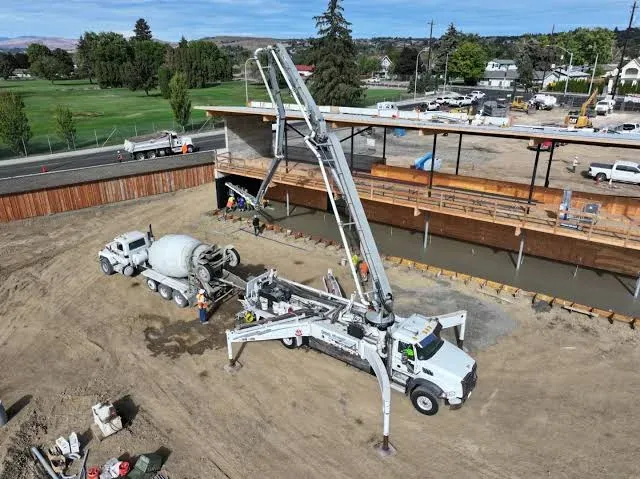
For a pumper the truck is the operation, and it is a high-value, specialized asset that concentrates a large amount of value in a single unit. That makes commercial auto — the line covering its physical damage and its liability, on the road and while set up — a leading driver, the opposite of a general install crew whose vehicles are ordinary work trucks. Minnesota presses on this driver through the calendar: a compressed pour season concentrates utilization, so the truck works hard across the frost-free months and then endures hard winters between. The value, type, and reach of the boom, how many trucks you run, and how they are maintained across that demanding rhythm are inputs a carrier weighs closely, because a loss involving the truck is both expensive and central to whether you can keep working.
Overhead lines: Twin Cities infill against a flat spread
The second signature driver is the one that makes pumping underwrite unlike any other concrete work: the overhead power line. A boom places concrete in three dimensions, and contact between it and an energized line is the severe event carriers price against — capable of fatal injury, and exactly the loss general liability and an umbrella exist to answer. In Minnesota the exposure concentrates on tight Twin Cities infill and rebuild, where downtown Minneapolis and St. Paul mix older overhead-lined blocks with newer buried service and the river-bluff grade makes setup harder. Across greater Minnesota the picture flips to spread agricultural overhead runs threading low-rise small-town work. Metro infill or open farmland, the catastrophic exposure is the same, and a carrier prices it on how you manage clearance rather than on a fixed charge.
Minnesota’s split licensing picture
Minnesota’s licensing is worth getting right because it splits by the kind of work. The state issues a Residential Building Contractor license through the Department of Labor and Industry, while commercial general contracting is not licensed at the state level. Whichever side of that line your concrete work falls on, the classification that applies is part of the cost picture a carrier reads, alongside the certificate-of-insurance and additional-insured requirements a general contractor or project owner layers on top. We confirm the credential that actually fits your work rather than assume one, because standing and contract obligations are part of the operation being priced.
The crew and a competitive comp market
Minnesota runs a competitive workers compensation market, so comp is placed with a private carrier and structured to the real crews and payroll classifications. But a pumping operation runs a smaller crew than a labor-heavy finishing crew — an operator and a spotter rather than a full team — so the payroll-driven comp line is generally a lighter share of a pumper’s cost than a general concrete contractor’s. That is what makes pumping a different cost conversation than the Minnesota concrete contractor cost picture, where payroll leads. For a pumper the truck and the overhead line lead, and comp coordinates with the general liability, commercial auto, and property beside it.
Line and pipe failure on the pour
Beyond the boom and the lines, the delivery system is its own exposure. A line or pipe that fails under pressure during a pour can injure the crew and damage the site, so it is a real part of the general liability picture a carrier prices. Disciplined line and pipe inspection and maintenance are levers here — a documented record reads well because it lowers the frequency of exactly the on-site losses an underwriter is weighing, and cold-weather work makes maintenance discipline count for more.
Claims and the record a carrier reads
Your loss history is a driver you have already been writing. A clean record opens more markets and prices better, while a serious power-line, auto, or general-liability loss in recent years narrows the field. Carriers read the story behind a loss — one incident followed by corrected clearance and spotter procedure reads differently than a pattern. The durable lever is operational discipline: documented boom-to-line clearance, spotter protocol, and operator training under OSHA standards all show up in the record a carrier prices for a concrete pumping operation. The Minnesota Department of Commerce oversees the admitted market these programs are placed in.
Coverage limits and umbrella
What you buy is a driver. Because the power-line exposure is catastrophic, the limits general contractors require push a Minnesota pumper toward an umbrella more firmly than most trades, and higher limits cost more than lower ones. Whether you carry general liability at the limits the boom exposure calls for, whether you schedule the truck and any property to real value, and how your limits are set all feed the number. The larger Twin Cities commercial, medical, and institutional projects often set the steepest limit requirements a Minnesota pumper sees. For a pumper these are not places to under-buy, because the single catastrophic loss the coverage exists to answer is the whole reason the class underwrites as it does.
Real-World Scenario: Deep into a short summer season, a crew threads a boom past the older overhead lines of a downtown Minneapolis infill lot, working a bluff-cut site above the river with tight setup room. The same operation, days later, reaches a boom flat across an open jobsite near St. Cloud where a farm-country distribution run crosses the property. Different ground, one defining exposure — the boom near an energized line — and one pair of lead drivers, the truck and the power line, both worked hard in a compressed calendar. The pumper who documents clearance and spotter protocol on urban and rural sites alike gives a carrier a reason to price the severity down.
How to get an accurate Minnesota quote
A real number comes from describing a real operation. Tell a broker the boom truck you run and its value, the pours you place and how close they sit to overhead lines, whether you work tight urban infill or open rural sites, how your season concentrates the work, your clearance and spotter discipline, your crew, your claims history, the limits your contracts require, and your licensing standing. From there a carrier with genuine pumping appetite can price it. When you are ready, start a quote and tell us about your equipment and placements, or browse the coverage overview to see how each line fits. For the market picture behind these drivers, see the Minnesota concrete pumping insurance page, and for how pumping compares with the other concrete trades, the concrete insurance cost overview. The number at the end will reflect your business — the only number worth having.