

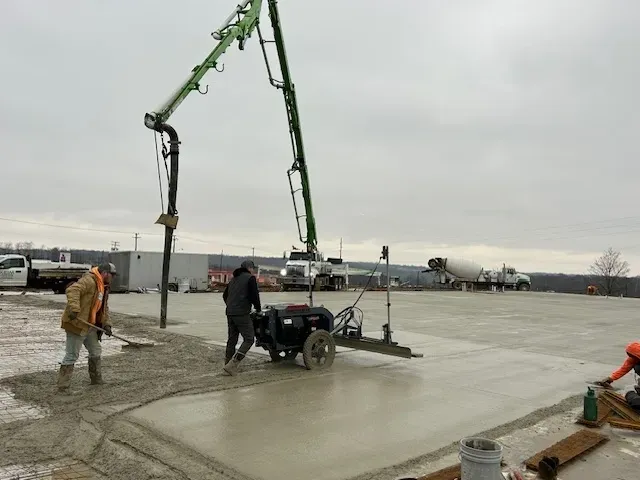
Set a boom truck in an eastern Kentucky hollow and you fight grade before you ever place a yard of concrete — the ridge above, the creek below, and a long rural distribution line following the narrow road past your setup. Set one on the Louisville riverfront and you are threading a boom into vertical downtown work beside an older distribution grid on the bank of the Ohio. Those two pictures bracket the Commonwealth’s pumping market, and neither one has a published insurance price. A carrier builds the cost from your specific operation, and for a pumper that cost is led by two things a general concrete crew does not carry: a high-value boom pump truck, and the overhead power-line exposure of placing concrete in three dimensions.
That answer frustrates owners who just want a number, but it is the honest one, and for a concrete pumper the drivers are distinct enough that understanding them beats any fake average. This guide walks what actually moves the number for a pumping operation in Kentucky, in roughly the order it matters — and why the same two lead drivers hold whether you are pouring in Pikeville country or downtown Louisville.
The two drivers that lead every pumping quote
A premium is the output of an underwriting model, not a sticker. The carrier takes your real exposures — the boom truck you run, the pours you place and how close they sit to overhead lines, your crew, your loss history, and the limits your contracts require — and prices each line against them. For a pumper the cost concentrates in two places most trades do not share: a very expensive single vehicle, and a catastrophic power-line exposure. Everything else in this guide feeds those two.
Kentucky makes a statewide “average” especially misleading, because the state splits so cleanly between mountain and metro. The eastern Appalachian coalfields are steep, hollow-and-ridge country where boom setups battle grade and long rural overhead lines follow the creek bottoms — technically demanding low-rise work. Move west and the central Bluegrass around Lexington rolls into horse-country and suburban development; Louisville on the Ohio River is the real urban and vertical market, where downtown and riverfront pours put a boom near an older distribution grid. Farther west the land flattens toward the Jackson Purchase, giving spread, level placement under roadside utility runs. A pumper working an eastern hollow and one working the Louisville riverfront are the same class only in name.
For the full market picture behind these drivers, see our Kentucky concrete pumping insurance page. That page is the market overview; this one is the cost explainer.
The boom pump truck carries the weight
For a pumper the truck is the operation, and it is a high-value, specialized asset. A boom pump truck concentrates a large amount of value in a single unit, which is why the commercial auto line that covers its physical damage and its liability — on the road and while set up on site — leads your cost. This is the reverse of a general install crew, whose vehicles are ordinary work trucks riding behind the crew and the finished work. In Kentucky the truck also does harder driving than the term “commercial auto” suggests: the same unit that threads a downtown Louisville street may spend the next week climbing switchbacks to reach a hollow setup in the eastern coalfields. The value, type, and reach of the boom, how many trucks you run, and how they are maintained and operated are inputs a carrier weighs closely, because a loss involving the truck is both expensive and central to whether you keep working. Scheduling the truck to its real value is where this driver is won.
Overhead lines — the exposure that defines the class
The second signature driver is the reason pumping underwrites differently from any other concrete work, and Kentucky sharpens it at both ends of the state. A boom places concrete in three dimensions, and contact between the boom and an overhead power line is the severe event carriers price against. It can cause serious bodily injury, and it is exactly the kind of catastrophic loss that general liability and an umbrella are built to answer. In the eastern hollows, long rural distribution lines run right along the narrow roads and creek bottoms where the boom has to set up, leaving little room to maneuver. In Louisville, a riverfront or downtown pour often puts the boom near an older distribution grid threaded through built-up blocks. Either setting raises the same question a carrier is really asking, so it weighs your clearance discipline, spotter protocol, and placement record heavily. This is not a fixed surcharge; it is a real exposure priced on how you manage it.
Real-World Scenario: A crew sets a boom truck at the bottom of an eastern Kentucky hollow, working a low-rise pour where a rural line follows the road just above the setup and the grade leaves almost no room to swing. The same week, another crew stages on the Louisville riverfront for a vertical downtown pour, threading the boom past an older distribution grid near the Ohio. Different country, same defining exposure — the boom working near energized lines — and the same two lead drivers, the truck and the power-line risk. The pumper who can describe clearance protocol and placement discipline clearly gives a carrier a reason to price the severity down.
Line and pipe failure on the pour
Beyond the boom and the lines, the delivery system itself is an exposure. A line or pipe that fails under pressure during a pour can cause injury and property damage on the site, so it is a real part of the general liability picture a carrier prices. Disciplined line and pipe inspection and maintenance are levers here — a documented maintenance record reads well, because it lowers the frequency of exactly the on-site losses an underwriter is trying to weigh. On the steep eastern setups, where a failure can send material and pressure loose on a slope, that discipline reads even more clearly.
Why the crew keeps workers comp lighter
Unlike a labor-heavy install crew, a pumping operation typically runs a smaller crew — an operator and a spotter rather than a full finishing crew. Workers compensation is still a real line, and Kentucky runs a competitive market, so comp is placed with a private carrier rather than a state fund. But because the crew is smaller, the payroll-driven comp line is generally a smaller share of a pumper’s cost than it is for a general concrete crew — which is precisely why pumping is a different cost conversation than the Kentucky concrete contractor cost picture, where payroll leads. The spotter is where a smaller crew earns its keep on the exposure side, because that person is central to the power-line and placement discipline a carrier is pricing.
Licensing in Kentucky — read the contract, not a state card
It is worth being plain about credentials, because pumpers hear a lot of noise here. Kentucky does not require a statewide license to work as a general or concrete contractor — there is no state concrete-contractor license, and only the electrical, plumbing, and HVAC trades are licensed at the state level. General-contractor requirements are handled by city and county, so the real gates are local permitting and the contract you sign. Those contracts, not a statewide credential, are what routinely dictate the insurance limits you must carry — which is why for a Kentucky pumper the coverage conversation tends to lead the compliance conversation. When you want to confirm a carrier or a filing, the Kentucky Department of Insurance is the authority; the license question, for pumping, is answered locally.
Karst, seismic ground, and the claims record
Two Kentucky ground realities sit quietly behind the exposure picture. Roughly half the state rests on limestone karst prone to sinkholes and cover-collapse, and the western counties carry real New Madrid seismic hazard. Neither changes the boom or the line, but both affect the ground a truck sets on and the structures a crew pours, and a thoughtful operator accounts for setup stability the same way a carrier accounts for it in your record. Your loss history is the driver you have already been writing for years: a clean record opens more markets and prices better, while a serious power-line, auto, or general-liability loss narrows the field. Carriers read the story behind the losses too — a single incident followed by corrected clearance and spotter procedures reads differently than repeated, similar events. Operator training under OSHA standards shows up in the record a carrier prices for a concrete pumping operation.
The coverage choices that move your number
Finally, what you buy is a driver. Because the power-line exposure is catastrophic, the limits your general contractors require push a pumper toward an umbrella more firmly than most trades, and higher limits cost more than lower ones. Whether you carry general liability at the limits the boom exposure calls for, whether you schedule the truck and any property to real value, and how your limits are set all feed the number. For a pumper these are not places to under-buy blindly — the single catastrophic loss the coverage exists to answer is the whole reason the class underwrites the way it does. Reviewing the full coverage overview shows how each line fits the others.
Getting an accurate Kentucky quote
The path to a real number is to describe your real operation. Tell a broker the boom truck you run and its value, the pours you place and how close they sit to overhead lines, whether you fight grade on eastern hollow setups or work vertical near the Louisville riverfront, your clearance and spotter discipline, your crew, your claims history, and the limits your contracts require. From there a carrier with genuine pumping appetite can price it, and you can compare apples to apples instead of chasing a headline. When you are ready, start a quote and tell us about your equipment and your placements, or read the Kentucky concrete pumping insurance market page for the picture behind these drivers. The number at the end will reflect your business, which is the only number worth having.