

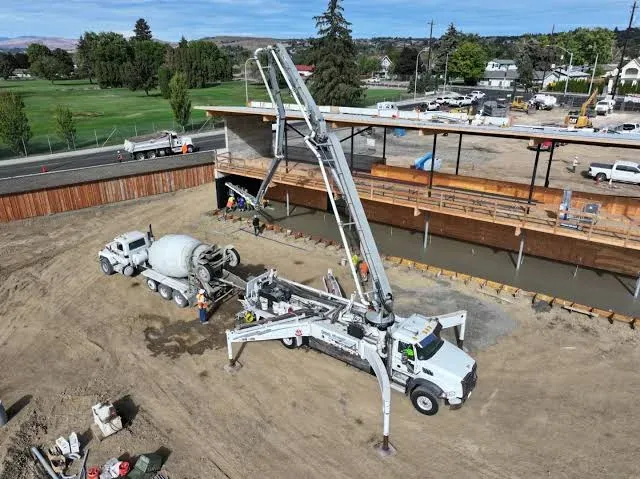
No one can publish a real price for concrete pumping insurance in Iowa, and any figure you see before an underwriter has looked at your operation is a guess. What a carrier actually does is build the cost from your specific business — and in a spread, low-rise state like Iowa the cost for a pumper is led by two things a general concrete crew never carries: a high-value boom pump truck, and the long rural overhead power lines that run alongside so much of the work. Start there and the rest of the picture falls into place.
Iowa sets that picture apart from the tall-skyline states. Here the boom is rarely threading a downtown corridor; far more often it is reaching over a farm slab, a subdivision pour, or a small-city commercial lot out in the open, where energized primary line is strung for long spans along section roads and the edges of town. That is where the defining exposure lives — not vertical reach, but horizontal proximity to overhead lines across flat cropland — and it is the first thing that separates an Iowa pumper’s cost from a general concrete crew’s.
Spread, low-rise placement and the overhead lines that come with it
Iowa is overwhelmingly flat glaciated cropland, and its concrete pumping demand is spread rather than stacked. Work concentrates in Des Moines and the Cedar Rapids and Iowa City corridor, with secondary demand in Davenport, Sioux City, and Waterloo, but there is no dense high-rise skyline pulling booms into tight urban airspace. Instead, a boom is placing agricultural, commercial, and subdivision slabs in open settings — and open settings in Iowa mean long overhead line runs along the roads and lot edges. That is the signature of the class here, and it is why the general-liability conversation for an Iowa pumper starts with power lines rather than square footage.
The one terrain exception matters for setup: the steep Loess Hills along the Missouri River on the western edge break the flat pattern with grade and collapse-prone windblown silt, so footing and stabilization complicate placement where the rest of the state offers level ground. For the full market picture behind these drivers — the placement geography, the licensing reality, and the competitive workers-comp market — see our Iowa concrete pumping insurance page. This guide is its cost companion: that page is the market overview, this one explains what moves the number.
The overhead power-line exposure — the catastrophic general-liability driver
In a state built on spread rural placement, the power-line exposure is the reason pumping underwrites differently from any other concrete work. A boom places concrete in three dimensions, and contact between the boom and an energized overhead line is the severe event a carrier prices against. It can cause serious bodily injury, and it is exactly the kind of catastrophic loss that general liability and an umbrella are built to answer. Iowa sharpens this driver because so much of the work sits in the open — long spans of primary line strung along section roads and edge-of-town lots, rather than the contained airspace of a downtown block. A carrier weighs your clearance discipline, your spotter protocol, and your placement record heavily here, because it is pricing the severity of that exposure, not applying a fixed surcharge.
Real-World Scenario: A crew sets a boom truck at a farm equipment shed on the edge of a rural county, reaching over a slab beneath a long run of primary line that follows the section road, while another crew works a subdivision pour on the outskirts of Cedar Rapids where distribution line crosses the lot frontage. Different jobs, same defining exposure — the boom working near energized lines in the open — and the same two lead cost drivers, the truck and the power-line risk. The pumper who can walk a carrier through clearance protocol and spotter placement gives it a reason to price the severity down.
The boom pump truck — the leading asset on commercial auto
For a pumper the truck is the operation, and it is a high-value, specialized asset. A boom pump truck concentrates a large amount of value in a single unit, which is why the commercial auto line covering its physical damage and its liability — on Iowa’s roads and while set up on site — is a leading driver of your cost. That is the reverse of a general install crew, whose vehicles are ordinary work trucks trailing the crew and the completed work. Across Iowa’s spread the truck also runs real road miles between scattered placements, which keeps the commercial-auto line front and center. The value, type, and reach of the boom, how many trucks you run, and how they are maintained and operated are inputs a carrier weighs closely, because a loss involving the truck is both likely to be expensive and central to whether you can keep working. Scheduling the truck to its real value is where this driver is won.
Line and pipe failure on the pour
Beyond the boom and the lines overhead, the delivery system itself is an exposure. A line or pipe that fails under pressure during a pour can cause injury and property damage on the site, so it is a genuine part of the general liability picture a carrier prices. Iowa’s hard-freeze winters put extra strain on equipment worked through cold seasons, which makes disciplined inspection and maintenance a real lever — a documented maintenance record reads well, because it lowers the frequency of exactly the on-site losses an underwriter is trying to weigh.
A smaller crew and a competitive workers-comp market
Unlike a labor-heavy install crew, a pumping operation typically runs a small crew — an operator and a spotter rather than a full finishing crew. Workers compensation is still a real line, but because the crew is smaller, the payroll-driven comp cost is generally a lighter share of a pumper’s total than it is for a general concrete crew. Iowa is a competitive workers-comp state, so comp is placed with a private carrier in the open market rather than through a state fund — one more input priced to your actual payroll and class. That lighter comp weighting is a large part of why pumping is a different cost conversation than the Iowa concrete contractor cost picture, where payroll leads.
Licensing, registration, and the certificates your GCs require
Iowa does not issue a competency-exam license for concrete contractors, and there is no separate concrete-contractor license. What the state requires instead is contractor registration through the Iowa Division of Labor for construction contractors above a low annual earnings threshold — a registration obligation, not a trade exam. The credential picture is completed by the general contractors and owners you work for, who layer their own certificate-of-insurance and additional-insured requirements on top of whatever the state asks. Confirm the credential that actually applies to your work rather than assuming one that does not. Because those contract requirements often set the limits you must carry, they feed directly into your coverage cost. For the state’s own consumer and market resources, the Iowa Insurance Division is the regulator to know.
Claims history and how carriers read it
Your loss record is a driver you have been writing for years. A clean history opens more markets and prices better; a serious power-line, auto, or general-liability loss in the last several years narrows the field and pushes the number up. Carriers read the story behind the losses too — a single incident followed by corrected clearance and spotter procedures reads differently than repeated, similar events. The durable lever is operational discipline: documented boom-to-line clearance, spotter protocol, and operator training under OSHA standards all show up in the record a carrier prices for a concrete pumping operation.
The coverage choices that move your premium
What you buy is a driver in its own right. Because the power-line exposure is catastrophic, the limits your general contractors require push an Iowa pumper toward an umbrella more firmly than most trades, and higher limits cost more than lower ones. Whether you carry general liability at the limits the boom exposure calls for, whether you schedule the truck and any property to real value, and how your limits are set all feed the number. For a pumper these are not places to under-buy blindly — the single catastrophic loss the coverage exists to answer is the whole reason the class underwrites the way it does.
Getting an accurate Iowa quote
The path to a real number is to describe your real operation. Tell a broker the boom truck you run and its value, the pours you place and how close they sit to overhead lines, whether you work the Des Moines core or the spread rural and small-city lots, your clearance and spotter discipline, your crew, your claims history, and the limits your contracts require. From there a carrier with genuine pumping appetite can price it, and you can compare apples to apples instead of chasing a headline figure. When you are ready, start a quote and tell us about your equipment and your placements, or browse the full coverage overview to see how each line fits together. For the market picture behind these drivers, see the Iowa concrete pumping insurance page, and for how pumping compares to the rest of the trade the concrete insurance cost overview lays out the classes side by side. The number at the end will reflect your business, which is the only number worth having.