

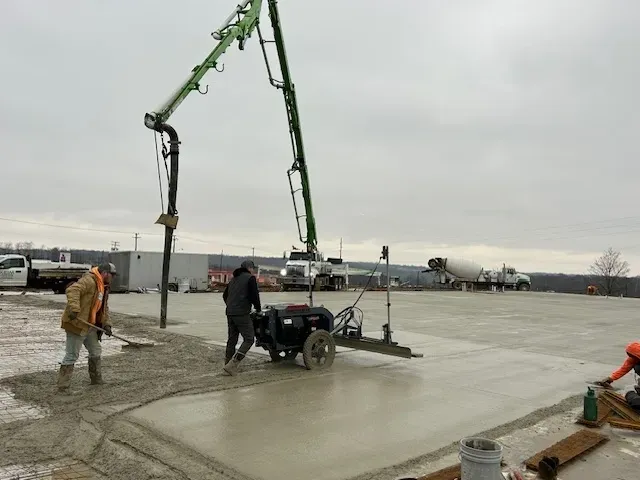
A Delaware concrete pumping contractor will not find a published price, and any figure quoted before an underwriter has studied the operation is guesswork. A carrier builds the cost from your specific business, and for a pumper it gathers around two things a general concrete crew does not carry: a high-value boom pump truck and the overhead power-line exposure of placing concrete in three dimensions. Delaware gives that second driver a particular shape, because the state is small and almost entirely coastal plain — flat, spread, and low-rise — so the line-contact risk comes from reaching a boom over roadside utility runs rather than from any mountain setup. This guide walks the drivers behind a Delaware pumper’s number.
The geography is worth stating plainly. The one concentration of taller construction sits in Wilmington and the New Castle County corridor at the top of the state, where a boom’s reach earns its keep on the few downtown and corporate-campus pours near older overhead. South of the canal, Kent and Sussex counties are agricultural flatland giving way to fast-growing beach-resort development around Rehoboth and Lewes, so most placement is subdivision, slab, and light-commercial work under suburban and rural overhead lines strung along open roadsides. Flat coastal-plain ground removes the setup-terrain problem entirely but leaves the overhead exposure intact — and a pumper’s cost reads from that reality, not from a statewide average.
The coastal-plain ground shapes the pour more than the setup: a high water table and shifting sandy soils near the coast, and around Newark, Middletown, and Smyrna inland, mean a boom often places concrete for foundations and slabs engineered for soft, wet ground rather than for grade. That keeps the placement problem centered on reach, the roadside line, and consistent delivery rather than on leveling a machine on a slope.
Overhead reach on flat, spread ground
The exposure that makes pumping underwrite unlike any other concrete work is the overhead power line, and in Delaware it is defined by reach rather than height. A boom places concrete in three dimensions, and contact between it and an energized line is the severe event carriers price against — capable of fatal injury, and exactly the loss general liability and an umbrella exist to answer. On flat subdivision, slab, and light-commercial sites across Kent and Sussex, the boom often reaches over roadside distribution runs strung along open frontage, and at the Wilmington corporate-campus pours it works near older overhead. The ground is easy; the line is not. A carrier prices this on how you manage clearance and spotter protocol rather than on a fixed surcharge.
The boom pump truck across a compact state
For a pumper the truck is the operation, and it is a high-value, specialized asset that concentrates a large amount of value in a single unit. That makes commercial auto — the line covering its physical damage and its liability, on the road and while set up — a leading driver, the opposite of a general install crew whose vehicles are ordinary work trucks. Delaware’s small footprint means one truck can cover much of the state, from Wilmington to the beach corridor, so the road exposure is concentrated in that unit rather than spread across a large fleet. The value, type, and reach of the boom, how many trucks you run, and how they are maintained are inputs a carrier weighs closely, because a loss involving the truck is both expensive and central to whether you can keep working. A single unit covering the whole run — a Wilmington campus pour one day, a Sussex subdivision the next — concentrates that exposure rather than diluting it across a large fleet, which sharpens how closely an underwriter watches the truck.
No statewide license — registration and the local gate
Delaware asks for registration rather than a trade license. There is no statewide general- or concrete-contractor license to hold; instead contractors register with the Department of Labor and carry a state business license, with only specific trades such as electrical and plumbing licensed at the state level. The effective gate is that registration plus local permitting. Registration is not the same as being off the hook, though — a carrier still checks your standing and the certificate-of-insurance and additional-insured terms a general contractor or project owner writes into the job, and prices the program to the operation those obligations describe.
A smaller crew and a competitive comp market
Delaware runs a competitive workers compensation market, so comp is placed with a private carrier and structured to the real crews and payroll classifications. But a pumping operation runs a smaller crew than a labor-heavy finishing crew — an operator and a spotter rather than a full team — so the payroll-driven comp line is generally a lighter share of a pumper’s cost than a general concrete contractor’s. That is what makes pumping a different cost conversation than the Delaware concrete contractor cost picture, where payroll leads. For a pumper the truck and the overhead line lead, and comp coordinates with the general liability, commercial auto, and property beside it.
Line and pipe failure on the pour
The delivery line the concrete runs through is the quieter of the pumping exposures, but it is real. A coupling or section that lets go under pressure mid-pour can hurt the crew and wreck what is around it, so it belongs to the general liability an underwriter is sizing. Keeping inspection records and retiring worn line before it fails is one of the plainest levers a pump operator holds, because a clean maintenance history lowers the frequency of the on-site losses a carrier is trying to anticipate.
Claims and the clearance record
Your claims record is the driver you have spent years authoring without thinking of it that way. Loss runs free of power-line, auto, and liability claims open doors to more markets and better pricing; a serious recent loss shuts several of them. And carriers read for pattern, not just for the headline — a lone event met with tightened clearance and spotter procedures lands very differently from repetition. Field discipline is what moves that record: boom-to-line clearance, a spotter on every set, and operator training keyed to OSHA practice all travel with a concrete pumping operation from one renewal to the next. The Delaware Department of Insurance oversees the admitted market these programs are placed in.
Coverage limits and umbrella
The coverage you choose is a driver in its own right. Because a line-contact loss is catastrophic, the general contractors a Delaware pumper works for tend to require higher liability limits and an umbrella than they would of a lower-risk trade, and higher limits carry more cost. Whether your general liability is sized to the boom exposure, whether the truck and any property are scheduled at real value, and where your limits are set all feed the final figure — and for this class thin limits are the wrong saving, since the rare severe event is the reason the coverage exists at all.
Real-World Scenario: A crew sets a boom on a flat Sussex County subdivision lot near the beach corridor, with easy leveling but a roadside distribution run crossing the frontage the boom has to clear on the way to the pour. The same operation, days later, works one of the few Wilmington corporate-campus pours near older overhead at the top of the state. Different jobs, one defining exposure — the boom near an energized line — and one pair of lead drivers, the truck and the power line. The pumper who documents clearance and spotter protocol on open roadside sites gives a carrier a reason to price the severity down.
How to get a real Delaware quote
A real figure follows a real description of the work. Give a broker the boom truck and its value, the pours you place and their distance from overhead lines, whether the job is a beach-corridor subdivision or a Wilmington campus, the clearance and spotter routine you keep, the crew, the loss history, the limits your contracts set, and your registration and permitting standing. From there a carrier with genuine pumping appetite can quote it. When you are ready, open a quote and lay out your equipment and placements, or scan the coverage overview to see how the lines fit together. The market context lives on the Delaware concrete pumping insurance page, and the comparison with the other concrete trades on the concrete insurance cost overview. What you end with will describe your business — the only number worth carrying.