

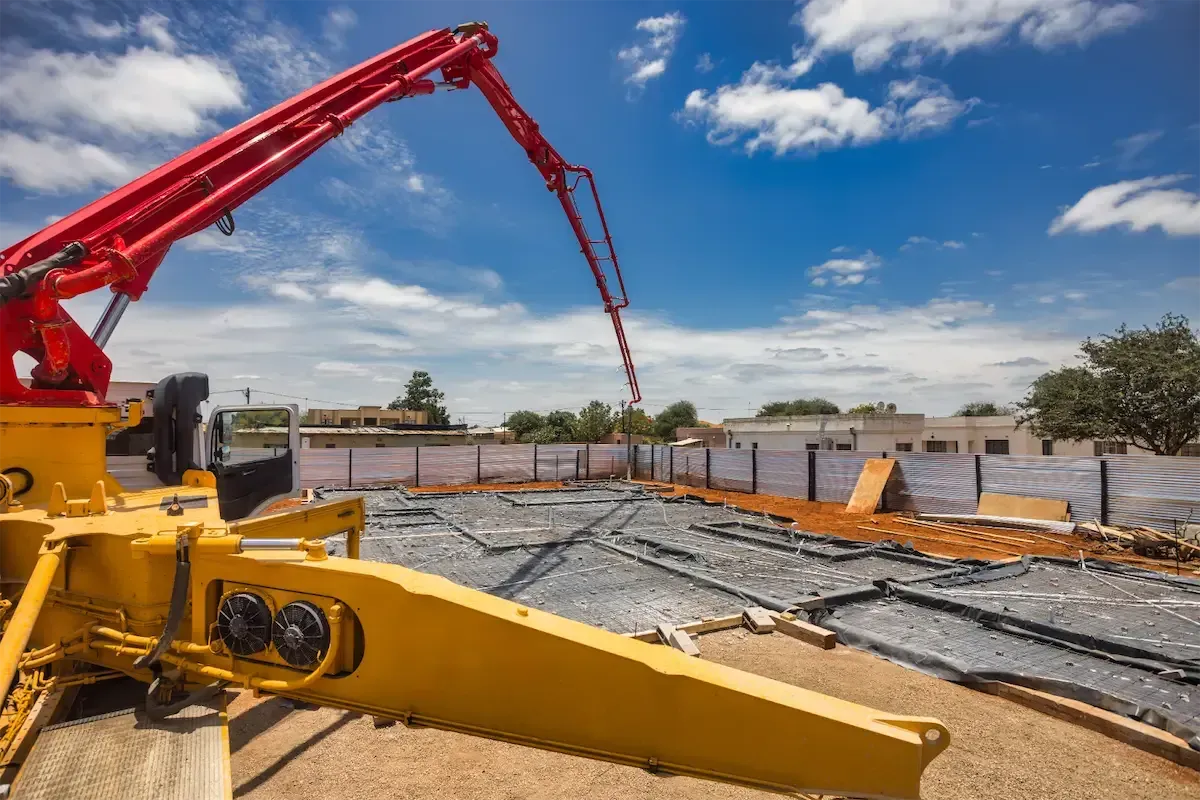
There is no published price for concrete pumping insurance in California, and any number you see quoted before an underwriter has looked at your operation is a guess. A carrier builds the cost from your specific business — and for a pumper it is led by two things a general concrete crew does not carry: a high-value boom pump truck, and the overhead power-line exposure of placing concrete in three dimensions.
California pushes both of those drivers to their extremes. It holds the deepest high-rise boom market in the West and, in wildfire country, some of the most heavily lined rural and foothill corridors in the nation. Concrete work also falls under the C-8 license, which a carrier confirms but does not rate. Below are the drivers that actually move the number, in roughly the order they matter.
Why California concrete pumping has no published price
A premium is the output of an underwriting model, not a sticker. A carrier takes your specific exposures — the boom truck you run, the pours you place and how close they sit to overhead lines, your loss history, and the limits your contracts require — and prices each line against them. Change any input and the number moves. For a pumper the cost concentrates in two places most trades never share: one very expensive vehicle, and a catastrophic power-line exposure.
California makes a statewide “average” almost meaningless, because the same class spans dense high-rise cores in Los Angeles, San Francisco, San Diego, San Jose, and Sacramento, hillside placement across the coastal ranges and the LA basin foothills, and the vast horizontal spread of Central Valley slab and tilt-up work. A pumper threading a long boom among downtown conductors and one placing concrete on a wildland-edge foothill lot price from different pictures, so a blended figure tells you little about your own.
For the full market picture — the seismic-driven high-rise volume, the wildfire-utility overlay, and the C-8 licensing reality — see our California concrete pumping insurance page. That page is the market overview; this one is the cost explainer.
The boom pump truck — your leading cost driver
For a pumper the truck is the operation, and it is a high-value, specialized asset. A boom pump truck concentrates a large amount of value in a single unit, which is why the commercial auto line covering its physical damage and its liability — on the road and set up on site — is a leading driver of your cost. This is the opposite of a general install crew, whose vehicles are ordinary work trucks. California adds pressure the truck feels directly: some of the country’s worst metro congestion in the Los Angeles and Bay Area corridors, and steep hillside access in the coastal ranges, both of which weigh on the road exposure. The value, reach, and upkeep of the boom, how many trucks you run, and how carefully they are operated are inputs a carrier watches closely, because a loss involving the truck is both likely to be expensive and central to whether you keep working. Scheduling the truck to its real value is where this driver is won.
Two faces of the power-line exposure — high-rise grids and wildfire corridors
The second signature driver is why pumping underwrites differently from any other concrete work, and California shows it at both extremes. A boom places concrete in three dimensions, and contact with an overhead line is the severe event carriers price against — capable of serious bodily injury, and exactly the catastrophic loss that general liability and an umbrella are built to answer. In the dense older neighborhoods of Los Angeles and San Francisco, a long boom threads among stacked urban conductors close overhead. Across wildfire country, where major utilities run public-safety power shutoffs and grid-hardening programs, overhead lines line the rural and foothill corridors a crew works. Either way, a carrier weighs your clearance discipline, spotter protocol, placement record, and OSHA clearance practice heavily — this is a severity priced on how you manage it, not a fixed surcharge.
Real-World Scenario: A crew sets a boom for a high-rise pour in downtown San Francisco, threading between the structure and the overhead grid of a dense older corridor, while another reaches over a wildland-edge foothill lot east of the LA basin where the utility runs public-safety shutoffs across the surrounding terrain. Different geography, same defining exposure — the boom near energized lines — and the same two lead drivers, the truck and the power-line risk. The pumper who documents clearance and placement discipline gives a carrier a reason to price the severity down.
The C-8 license a carrier confirms but does not rate
Concrete work in California falls under the C-8 Concrete classification, issued through the Contractors State License Board, and a contractor license is required above a low combined labor-and-materials threshold. A carrier confirms the classification is held and in good standing, but the license itself is not a rating input the way the equipment and exposures are. It matters because it signals a legitimate, contract-ready operation: general contractors and project owners require it and then layer their own insurance, certificate-of-insurance, and additional-insured demands on top. What actually moves the pumping premium is the boom truck, the power-line exposure, your loss record, and your limits — the license is the gate, not the price.
Line and pipe failure on the pour
Beyond the boom and the lines, the delivery system itself is an exposure. A line or pipe that fails under pressure during a pour can cause injury and property damage on the site, so it is a real part of the general liability picture a carrier prices. Disciplined inspection and maintenance are levers — a documented maintenance record reads well, because it lowers the frequency of exactly the on-site losses an underwriter is trying to weigh.
The operator-and-spotter crew — a lighter workers-comp line
Unlike a labor-heavy install crew, a pumping operation typically runs a smaller crew — an operator and a spotter rather than a full finishing crew. Workers compensation is still a real line in California’s competitive market, placed with a private carrier, but because the crew is smaller the payroll-driven comp line is generally a smaller share of a pumper’s cost than it is for a general concrete crew. That is precisely what makes pumping a different cost conversation: the money concentrates on the boom truck and the power-line exposure rather than on payroll.
Claims history and the coverage you buy
Your loss record is a driver you have been writing for years. A clean history opens more markets and prices better; a serious power-line, auto, or general-liability loss in the last several years narrows the field and raises the number, and carriers read the story behind the losses. What you buy is a driver too. Because the power-line exposure is catastrophic, the limits your general contractors require push a pumper toward an umbrella more firmly than most trades, and scheduling the truck and any property to real value all feed the number. The California Department of Insurance regulates the carriers writing those lines.
Getting an accurate California quote
The path to a real number is to describe your real operation. Tell a broker the boom truck you run and its value, the pours you place and how close they sit to overhead lines, your clearance and spotter discipline, your crew, your loss history, your C-8 classification, and the limits your contracts require. From there a carrier with genuine pumping appetite can price it, and you can compare like for like. When you are ready, start a quote and tell us about your equipment and your placements, browse the full coverage overview, or see how pumping cost compares across states in the national concrete insurance cost guide. For a concrete pumping operation, the number at the end will reflect your business, which is the only number worth having.