

Arkansas hands a pump-truck operator two very different jobs depending on where the pour sits, but the cost of insuring either comes down to the same two things — and neither is payroll. A concrete pumper is priced first on the boom pump truck as a single high-value asset, and second on the overhead power-line exposure that comes with placing concrete in three dimensions. There is no published Arkansas number for any of it, because a carrier builds the premium from your specific operation, not from a chart.
That distinction matters more for a pumper than for a general concrete crew. A one-truck operation working slabs around Jonesboro and a fleet feeding commercial towers in the Fayetteville–Springdale–Rogers corridor share a class name and almost nothing else, so a carrier reads them from separate pictures. What follows is what actually moves the number for a pumping contractor in Arkansas, roughly in the order it carries weight.
Why an Arkansas “average” tells you nothing
A premium is the output of an underwriting model, not a sticker price. The carrier takes your real exposures — the boom truck you run, how close your pours sit to overhead lines, your crew, your loss history, and the limits your contracts demand — and prices each line against them. Change one input and the number moves.
Arkansas makes a blended figure especially misleading, because the state splits sharply between the rugged Ozark and Ouachita uplands of the north and west and the flat Delta lowlands of the east. A pumper working graded, sloped lots in the booming Northwest Arkansas corridor and one reaching a boom across open, overhead-lined Delta ground price from different realities. The rest of this guide is those drivers.
The boom pump truck: where a pumper’s money concentrates
Strip everything else away and a pumping contractor is essentially one very expensive, very specialized vehicle. A boom pump truck packs a large amount of value into a single unit, which is why the commercial auto line — covering its physical damage and its liability both on the highway and while set up over a pour — leads the cost. A flatwork crew’s trucks are ordinary; they follow the crew and the finished work. A pumper’s truck is the work. Its value, the reach of the boom, how many units you run, and the maintenance and operating discipline behind them are all weighed carefully, because a truck loss is both costly and the thing that stops you from earning. Scheduling that unit to its true value is where this driver is won or lost.
Ozark grade, Delta overhead: the general-liability driver
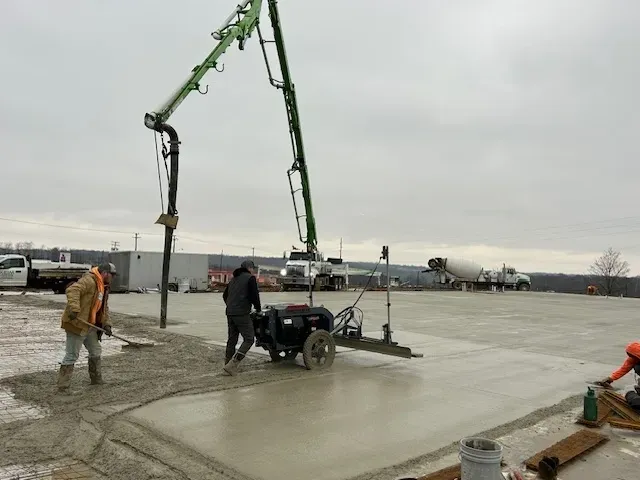
The second signature cost is the reason pumping underwrites unlike any other concrete trade. A boom moves concrete through the air, and contact between that boom and an energized overhead line is the catastrophic event a carrier prices against — it can cause serious bodily injury, and it is exactly what general liability and an umbrella exist to answer. In the flat eastern Delta, distribution lines follow the road frontage of nearly every spread residential and light-commercial site. In the hilly Northwest Arkansas corridor, booms set up on graded, sloped lots near built-up commercial service. Either way the severity is high, so a carrier weighs your clearance protocol, your spotter discipline, and your placement record closely — not as a fixed surcharge, but as an exposure priced on how you manage it.
Real-World Scenario: One crew sets a boom on a sloped Ozark lot in Rogers, threading reach between a rising grade and the overhead service feeding a new commercial pad, while another reaches a boom across an open Delta site outside Jonesboro to place a slab under a distribution line running the road frontage. Different terrain, same defining exposure — the boom working near energized conductors — and the same two lead drivers, the truck and the power-line risk. The operator who can describe clearance and spotter procedure clearly gives a carrier a reason to price the severity down.
The delivery line and pipe under pressure
The delivery system is a third exposure riding beneath the two big ones. When a line or pipe lets go under pressure mid-pour, the blowout can hurt a worker or wreck finished work nearby, which puts it squarely inside the general liability a carrier rates. A logged inspection routine on your lines, clamps, and reducers is a quiet but real lever, because it thins out the on-site losses an underwriter would otherwise have to assume.
A smaller crew, a lighter comp line
A pumping operation does not carry a labor-heavy finishing crew — it runs lean, typically an operator and a spotter. Workers compensation is still a real line, and Arkansas runs a competitive private market for it, overseen alongside the admitted market by the Arkansas Insurance Department. Contractors licensed through the state — Arkansas does license contractors via the Arkansas Contractors Licensing Board, with a commercial license required above one threshold and residential above a lower one — often face comp requirements written into their contracts regardless. But because the crew is small, the payroll-driven comp line is generally a smaller share of a pumper’s cost than the truck and the power-line exposure, which is exactly why pumping is a different cost conversation than a flatwork operation.
What your loss record tells a carrier
Your loss runs are a record you have been building for years, and a carrier reads them closely. A clean sheet widens your market and sharpens the price; a serious power-line, auto, or liability claim in recent years thins the field and pushes the number up. Underwriters weigh the narrative too — one event with corrected clearance and spotter steps afterward reads far better than a repeating pattern. The lasting lever is discipline you can document: boom-to-line clearance, spotter routine, and operator training to OSHA standards all sit in the file a carrier prices for a concrete pumping operation.
Limits, umbrella, and the catastrophic-loss logic
The coverage you actually buy is its own driver. Because a power-line contact is a catastrophic loss, the limits your general contractors demand tend to push an Arkansas pumper onto an umbrella sooner than most trades, and higher limits carry more cost than lower ones. Whether your general liability sits at the level the boom exposure warrants, whether the truck and any property are scheduled to real value, and how the limits are set all move the figure. Under-buying here is a poor gamble, because the one catastrophic loss the coverage answers is the reason the class prices as it does.
Getting a real Arkansas number
The path to an accurate figure is to describe the real operation. Tell a broker the boom truck you run and its value, the pours you place and how close they sit to overhead lines, your clearance and spotter discipline, your crew, your loss history, the limits your contracts require, and where in Arkansas you work — Ozark grade, Delta flat, or both. From there a carrier with real pumping appetite can price it, and you can compare like for like instead of chasing a headline. When you are ready, start a quote and tell us about your equipment and your placements, browse the full coverage overview, or see the market picture on the Arkansas concrete pumping insurance page. For how the drivers compare across the trade, the concrete insurance cost overview lays them side by side.