

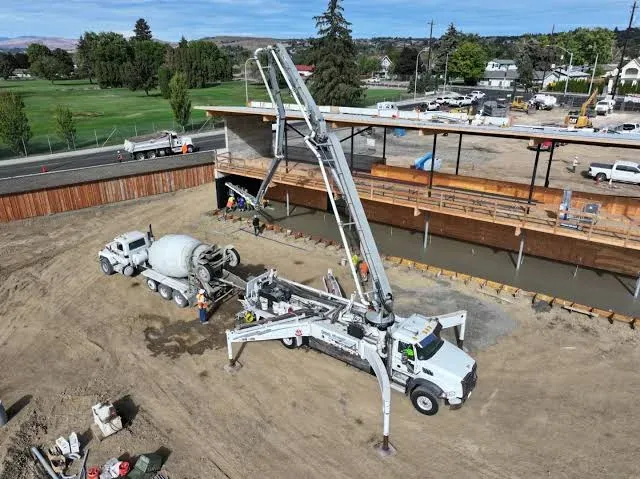
An Alabama concrete pumping contractor will not find a posted price, and any number quoted before an underwriter has looked at the operation is a guess. Carriers build the cost from your specific business, and for a pumper that cost gathers around two things a general concrete crew does not carry: a high-value boom pump truck and the overhead power-line exposure of placing concrete in three dimensions. What makes Alabama its own case is the range of ground a boom sets on — from the sloped ridge-and-valley lots of the north to the flat coastal plain of the Gulf — and the state contractor license that sits over the work. This guide walks the drivers behind an Alabama pumper’s number.
That answer disappoints owners who want a figure, but it is the honest one, and for a pumper the drivers are distinct enough that understanding them beats any blended average. A single-truck pumper on flat Mobile-area slabs and a fleet running booms onto graded Birmingham hillsides are the same class in name only, and a carrier prices them from different pictures. Below is what moves the number, roughly in order.
Alabama’s ground gives the work a further wrinkle: expansive Black Belt and Yazoo-belt clays across the central and western counties drive foundation heave and slab movement, so a boom in Tuscaloosa or the Montgomery area often places concrete for footings and slabs engineered against shrink-swell, while the hot, humid Gulf climate pushes crews to place and finish before the set gets away from them. Auburn and the smaller markets add scattered residential and light-commercial pours to the mix, each with its own reach and clearance to solve.
The boom pump truck — the leading Alabama cost driver
For a pumper the truck is the operation, and it is a high-value, specialized asset. A boom pump truck concentrates a large amount of value in a single unit, which is why the commercial auto line that covers its physical damage and its liability — on the road and while set up on site — leads the cost. This is the opposite of a general install crew, whose vehicles are ordinary work trucks that ride behind the crew and the finished work. In Alabama the truck also crosses genuinely different terrain in a single week, from tight urban Birmingham setups to open coastal sites near Mobile, so its road exposure is real. The value, type, and reach of the boom, how many trucks you run, and how they are maintained and operated are inputs a carrier weighs closely, because a loss involving the truck is both likely to be expensive and central to whether you can keep working.
Overhead lines from north ridges to the flat coast
The second signature driver is the one that makes pumping underwrite unlike any other concrete work: the overhead power line. A boom places concrete in three dimensions, and contact between it and an energized line is the severe event carriers price against — capable of fatal injury and exactly the loss general liability and an umbrella exist to answer. Alabama gives this exposure two faces. In the Appalachian foothills of the north, where Birmingham sits among ridges and valleys and Huntsville’s fast tech-and-aerospace growth drives commercial and multifamily work, a boom often sets on sloped, graded lots near built-up overhead. Toward Montgomery and the flat coast around Mobile, the ground opens and the risk rides the roadside distribution lines that thread spread jobsites. Grade in the north, spread in the south — the same catastrophic exposure priced on how you manage it.
The contractor license behind the work
Alabama licenses contractors, which not every state does, and that credential is part of the cost picture. A state general contractor license is required for commercial and industrial projects above a threshold, and concrete is among the listed classifications, issued through the Alabama Licensing Board for General Contractors. The classification depends on the work, and a general contractor or project owner layers its own insurance, certificate-of-insurance, and additional-insured requirements on top. We confirm the license that actually applies to your concrete work rather than assume one, because a carrier reads standing and contract obligations as part of the operation it is pricing.
A competitive comp market and a smaller crew
Alabama runs a competitive workers compensation market, so comp is placed with a private carrier and structured to the real crews and payroll classifications. But a pumping operation runs a smaller crew than a labor-heavy finishing crew — an operator and a spotter rather than a full team — so the payroll-driven comp line is generally a lighter share of a pumper’s cost than it is for a general concrete contractor. That is precisely what makes pumping a different cost conversation than the Alabama concrete contractor cost picture, where payroll leads. For a pumper the truck and the overhead line lead, and comp coordinates with the general liability, commercial auto, and property beside it.
Line and pipe failure on the pour
Beyond the boom and the lines, the delivery system is its own exposure. A line or pipe that fails under pressure during a pour can injure the crew and damage the site, so it is a real part of the general liability picture a carrier prices. Disciplined line and pipe inspection and maintenance are levers here — a documented record reads well because it lowers the frequency of exactly the on-site losses an underwriter is weighing.
Claims, clearance, and how carriers read the record
Your loss history is a driver you have already been writing. A clean record opens more markets and prices better, while a serious power-line, auto, or general-liability loss in recent years narrows the field and raises the number. Carriers read the story behind a loss — a single incident followed by corrected clearance and spotter procedure reads differently than a repeating pattern. The durable lever is operational discipline: documented boom-to-line clearance, spotter protocol, and operator training under OSHA standards all show up in the record a carrier prices for a concrete pumping operation. The Alabama Department of Insurance oversees the admitted market these programs are placed in.
Coverage limits and the umbrella
What you buy is a driver. Because the power-line exposure is catastrophic, the limits general contractors require push an Alabama pumper toward an umbrella more firmly than most trades, and higher limits cost more than lower ones. Whether you carry general liability at the limits the boom exposure calls for, whether you schedule the truck and any property to real value, and how your limits are set all feed the number. For a pumper these are not places to under-buy blindly, because the single catastrophic loss the coverage exists to answer is the whole reason the class underwrites as it does.
Real-World Scenario: A crew sets a boom on a terraced Birmingham hillside lot, leveling the outriggers on grade while threading the boom past the overhead lines of an older ridge neighborhood. The same operation, a week later, reaches a boom flat across an open jobsite near Mobile where the risk is a roadside distribution run rather than a slope. Different ground, same defining exposure — the boom near an energized line — and the same two lead drivers, the truck and the power line. The pumper who can describe clearance and spotter protocol on both kinds of site gives a carrier a reason to price the severity down.
How to get a real Alabama number
The path to an accurate number is to describe an accurate operation. Tell a broker the boom truck you run and its value, the pours you place and how close they sit to overhead lines, whether you work graded northern lots or flat coastal sites, your clearance and spotter discipline, your crew, your claims history, the limits your contracts require, and your standing under the state license. From there a carrier with genuine pumping appetite can price it. When you are ready, start a quote and tell us about your equipment and placements, or browse the coverage overview to see how each line fits. For the market picture behind these drivers, see the Alabama concrete pumping insurance page, and for how pumping compares with the other concrete trades, the concrete insurance cost overview. The number at the end will reflect your business — the only number worth having.