

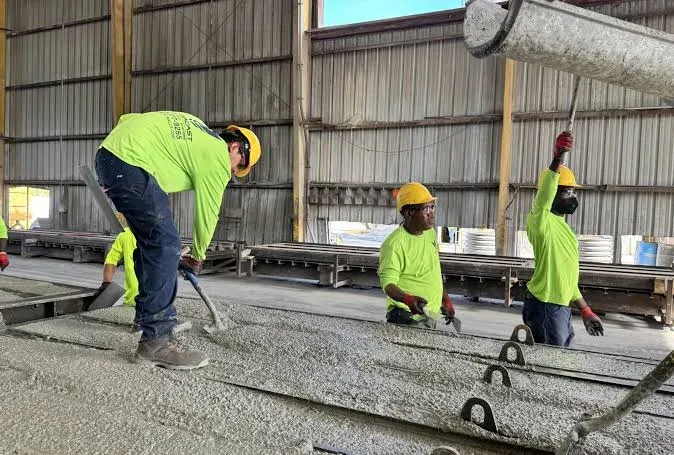
There is no fixed price for concrete contractor insurance in New Mexico — a carrier derives it from your particular crews, your revenue, and your track record, never from a published rate. The two inputs that carry the most weight are the payroll behind your install crews and the exposure your finished concrete keeps generating after you leave. Below is how a carrier reads each one.
New Mexico concrete follows energy, federal and defense work, and commercial building, concentrated along the Rio Grande through Albuquerque and Santa Fe, down into the growing Las Cruces and Mesilla Valley, and scattered across long empty stretches of high desert. A tight metro crew and a contractor chasing remote energy or federal pads are not the same risk, so a single statewide number washes out the detail that would set your price.
Three ways the ground works against a slab
Start with what New Mexico demands of the concrete itself, because that demand becomes the risk a carrier prices. The state is rare in stacking three separate soil threats: expansive clays that swell and shrink, collapsible soils that drop suddenly the first time they are wetted under load, and sulfate in the ground that chemically attacks concrete not mixed to resist it. Get the site or the mix wrong and a foundation can fail by heave, by collapse, or by deterioration of the material — which puts ground conditions at the center of the trade here and lengthens the exposure a carrier has to weigh.
The Construction Industries Division license and your jobs
New Mexico licenses its contractors, and the way it classifies them frames your contracts. A license through the Construction Industries Division is required to contract, issued by trade classification, so which credential governs you follows the concrete work you actually perform. The license is not a line on your premium, but it sits under the whole contract stack — the general contractor or owner on a project fixes its certificate-of-insurance and additional-insured demands to it, and those limits are a real input a carrier reads. We confirm the classification your New Mexico work truly requires. For the market and regulatory backdrop, see our New Mexico concrete contractor insurance page; this is the cost counterpart.
Payroll usually tops the list
For most install operations payroll is the biggest single item a carrier prices, because it drives both your workers compensation and a broad portion of your general liability. The dollar figure is only part of the story; the rest is what the crew is doing for those hours. Placing, screeding, and finishing concrete, or setting and stripping forms, carries a much sharper injury exposure than supervisory or clerical time, and a carrier rates every class to its own reality. Comp trades in a competitive private market here, so sorting your payroll into the right classes is where this driver is won or lost.
Completed operations: the tail three soils lengthen
Revenue drives your general-liability rating, but completed operations is the exposure that truly names the install class — the concrete still standing once the crew is gone. A slab, a walk, a footing, a foundation keeps carrying load for years, and work that fails downstream can return as a third-party claim long after the pour. On New Mexico ground that failure has three doors: heave on expansive clay, sudden settlement on collapsible soil, or sulfate attack eating the concrete itself. The completed-operations reach of your general liability is the line written to respond, so a carrier examines your revenue and your finishing quality closely. This is the driver that separates concrete from trades that leave nothing behind them.
Real-World Scenario: An Albuquerque crew pours residential foundations along the Rio Grande corridor, while another sets structural pads for a remote energy project on collapsible, sulfate-bearing desert ground. Both leave concrete that must perform for years, but the underwriter treats them differently — the Albuquerque tail rides on steady residential volume, the energy tail on fewer, higher-stakes pours where the wrong mix invites chemical attack or a sudden drop. One state, one class, two prices — and the owner who can describe the ground and the mix earns the sharper one.
Gear, forms, and the storage yard across the miles
Your property coverage answers for what you own and store — the storage yard, the forms, and the trowels, floats, screeds, and small mixers that ride long New Mexico distances to each site. On an install book it usually ranks under the crew and the completed-work exposure, but across those miles it is real, and the outcome is yours to control by insuring the gear at genuine replacement cost rather than a rough figure. Cutting corners on the equipment that gets a crew to a finished pour saves little and risks much; scheduling it honestly is the whole matter.
Work trucks — the light auto line
The vehicles a New Mexico install crew runs are ordinary trucks and trailers carrying people, forms, and tools to the site. That leaves commercial auto a real but secondary line — it rises with the fleet without leading as it would for a mixer operation or a boom-pump truck. Single trade, but the method of placing concrete divides it into separate cost conversations.
The story a carrier reads in your losses
Your record is a driver you have been writing job after job. A clean history opens more carriers and prices tighter; a serious liability, completed-operations, or comp loss in the last few years narrows the field and raises the number, and a pattern of small claims can weigh as much as one large one. Underwriters read the trajectory too — a single incident followed by tighter safety and finishing habits reads unlike the same loss twice over. The lever in your hands is ground discipline: crew training, fall and lifting protection, and finishing held to OSHA standards all appear in the file a carrier prices from.
Limits chosen on purpose
Last, the coverage you buy is itself a driver. Limits your general contractors and owners require above your primary layer send you to an umbrella, and higher limits cost more than lower — which matters because one completed-operations failure on a foundation can climb well past a primary policy. Whether your general liability carries the products-completed-operations aggregate your revenue justifies, whether your equipment is scheduled to value, and where your limits land all cycle back into the price. These are choices to make deliberately, not to shave, and they mark the gap between a cheap concrete construction policy and the right one.
Getting to a real New Mexico number
An accurate figure follows an accurate account. Take a broker through your crew payroll and its classes, your revenue and the concrete you leave behind, your storage yard and equipment values, your loss history, the limits your jobs demand, and where in New Mexico you pour — Rio Grande corridor, southern valleys, or the energy and federal country. A carrier that genuinely wants the concrete class prices from there, and you measure like against like rather than a headline. When you are ready, open a quote and describe how your crews run, or read the coverage overview to see the lines together. Check the regulator yourself at the New Mexico Office of Superintendent of Insurance, and for how these drivers behave nationally, see the concrete insurance cost pillar. The figure you reach will describe your business — the only one worth having.