

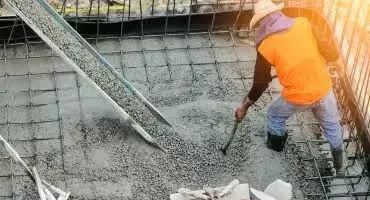
There is no published price for concrete contractor insurance in Montana, and any figure quoted before an underwriter has seen your crew is a guess. What shapes the exposure a carrier prices here is a hard climate over a vast state: a severe freeze-thaw regime runs statewide, and genuine seismic hazard sits in the western valleys. This guide walks the drivers that decide what an install contractor pays.
That answer frustrates owners who just want a number, but the honest one is worth understanding here. A flatwork crew around Billings and a foundation contractor pouring in a Bozeman mountain valley are the same class only in name, and a carrier reads them from different pictures. Below is what moves the number for an install operation, led by the thing that defines Montana concrete work.
Severe freeze-thaw and the completed-operations tail
For an install contractor the exposure that defines the class is completed operations — the work you leave behind — and in Montana the climate is what makes it bite. The concrete you pour keeps existing after your crew is gone, and installed work that fails downstream can become a serious third-party claim months or years later. Montana pairs a severe cold-climate freeze-thaw regime statewide with genuine seismic hazard in the western Intermountain Seismic Belt, so a slab that heaves with frost, a footing that lifts, or a foundation that moves is exactly how that tail shows up — often after a hard winter or two. The completed-operations side of general liability is the signature line built to answer for it, and because installed concrete against that climate carries such a long tail, your revenue and your frost-detailing and finishing record are inputs a carrier weighs closely. This is the install contractor’s defining cost driver. The state’s insurance market is overseen by the Montana Commissioner of Securities and Insurance.
Real-World Scenario: A Bozeman contractor sets foundations on seismic ground in a fast-growing mountain valley, detailing for both frost depth and earthquake movement, while a Great Falls crew pours flatwork across a commercial site facing the same brutal winters. Both leave finished concrete that must survive years of freeze-thaw, but an underwriter reads them differently — the valley foundation work carries a heavier completed-operations tail on seismic ground, the flatwork a broader one across many pours. Same Montana, same install class — but the ground and the revenue mix price differently. The owner who can describe how the crew builds for frost and seismic movement gets a sharper quote.
Crew payroll and your workers-comp rating basis
Payroll is the other line that leads for an install contractor, because it scales both your workers compensation and a large part of your general liability. Montana runs a competitive comp market, so coverage is placed with a private carrier and rated largely off payroll and its class codes. It is not just the dollar figure — it is which work the payroll covers. Pouring, finishing, lifting, and setting and stripping forms carry a different injury profile than supervisory or office work, and cold-weather work adds its own hazards, so a carrier rates each by what the crew actually does. Because Montana ties contractor registration to comp compliance, carrying and documenting comp correctly matters twice over.
The registration that runs through workers comp
Montana handles the licensing question in a way owners should understand for what it is. The state issues no statewide trade license to work as a general or concrete contractor, and there is no competency exam. What does apply is that contractors with employees register through the Department of Labor and Industry — and that registration exists as a workers-comp compliance step rather than a trade credential. The gate to work is local permitting and the contract. That means the general contractors and project owners you serve, and their certificate-of-insurance and additional-insured requirements, are what push your general liability and umbrella limits. For the full market and registration picture, see our Montana concrete contractor insurance page; this guide is the cost companion.
Property across long distances, work trucks, and claims
The property line covers what you own and store — the yard, the forms, and the finishing equipment — and in a state this large, where gear travels long distances between widely separated jobs, scheduling it to real value rather than guessing is where this smaller driver is won. Your work trucks are ordinary vehicles hauling crews, forms, and tools, so commercial auto is a genuine but minor line for the concrete construction model — real over Montana’s long hauls, but not the center of the risk the way a mixer fleet is. Your loss record is a driver you have already been writing: a clean history opens more markets and prices better, and documented crew training and finishing quality under OSHA standards show up in the record a carrier prices.
The coverage limits your contracts require
Finally, what you buy is a driver. The limits Montana’s general contractors and energy, resource, and infrastructure project owners require push you toward an umbrella, and higher limits cost more than lower ones — which matters for a concrete contractor because a single completed-operations failure on a foundation can run well above a primary limit. Whether you carry general liability with the products-completed-operations aggregate your revenue actually calls for, whether you schedule your equipment to value, and how your limits are set all feed the number. These are places to buy deliberately, not to under-buy blindly.
What Montana’s construction economy means for your cost
Montana’s construction demand runs on residential growth, energy and resource work, and infrastructure spread across enormous distances, from the fast-growing western valleys around Bozeman, Missoula, and Kalispell to Billings, Great Falls, and Helena. For an install contractor that geography shapes both your contracts and your exposure. Energy and resource owners, public-infrastructure agencies, and the general contractors building fast-growing valley commercial and multi-family projects set demanding certificate-of-insurance and additional-insured requirements and require higher limits than an ordinary private job. The more your revenue leans on that work, the more your general-liability and umbrella limits — and the number a carrier builds — reflect it.
That base collides with a brutal climate. Every slab and foundation you leave behind, whether for an energy site in the east or a Bozeman valley subdivision, has to survive a severe statewide freeze-thaw regime, and the western valleys add seismic movement on top. A carrier reading your revenue wants to know how much of your book is high-value energy and commercial work versus residential building, and across what distances your crews operate, because the completed-operations tail and the logistics behind it both feed the number.
Neither the energy base nor the distances change the underlying cost drivers; they change the emphasis among them. A contractor chasing energy and valley-commercial work leans hardest on the completed-operations and limits drivers, while a residential crew leans on payroll, and the sheer distances make the property and work-truck lines matter more here than in a compact state. That is why two Montana install contractors of similar size can price differently, and why an honest quote begins with the work you do, the ground it sits on, and the miles your crews cover, not a state name pulled off a map.
Montana’s climate adds a hard seasonal layer as well: the pour calendar is short, the warm-weather push is intense, and the cold-weather curing discipline that protects finished concrete through the first brutal winter is exactly the kind of operational detail that keeps completed-operations claims down. Combined with the distances crews cover between jobs, that discipline is one of the strongest levers a Montana owner actually controls over the price.
How to get an accurate Montana quote
The path to a real number is to describe your real operation. Tell a broker your crew payroll and the work it covers, your revenue and the kind of concrete you leave behind, the ground and climate your crews build for, your equipment values, your claims history, and the limits your contracts require. From there a carrier with genuine concrete appetite can price it. When you are ready, start a quote and tell us how your crews work, browse the full coverage overview to see how each line fits together, or read the national concrete insurance cost pillar for the cross-state view. The number at the end will reflect your business, which is the only number worth having.