

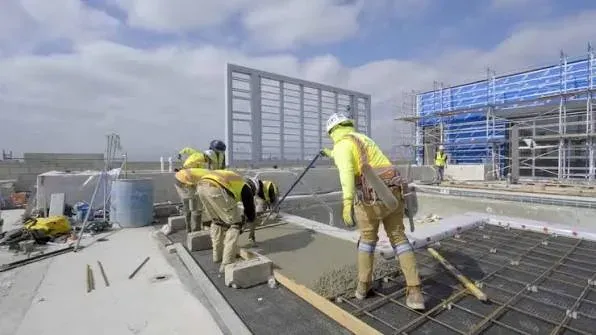
There is no list price for concrete contractor insurance in Massachusetts, and any number floated before an underwriter studies your crew is a guess. A carrier assembles the cost from the shape of your install work — your payroll and its tasks, the revenue behind your finished concrete, your record, and the limits you hold. This walks through what actually drives the figure for a Bay State install contractor.
Massachusetts concrete leans institutional to a degree few states match. Greater Boston concentrates commercial, university, life-science, and residential building into one of the tightest markets in the country, and Worcester and Springfield add a commercial base of their own. A crew pouring small residential foundations and a contractor placing structural concrete on a downtown Boston job read as different risks, so a statewide average tells you next to nothing about your own price.
Where the number comes from — and why it is not a chart
A premium is a model’s output, not a posted rate. The carrier takes your headcount and their tasks, the revenue behind your completed work, your losses, and the limits your contracts impose, and prices every line against that. Shift an input and the figure shifts. For an install contractor the weight sits on two things above all: the crew, and the concrete it leaves standing.
The Construction Supervisor License and its municipal layer
Massachusetts licenses its builders, and the structure shapes how your contracts read. The state grants a Construction Supervisor License through the Board of Building Regulations and Standards, and a great many cities and towns stack their own contractor licensing on top — so what governs you depends on both the work and the municipality. The license is not a premium item, yet it underpins the contract stack: a general contractor or institutional owner attaches its certificate-of-insurance and additional-insured requirements to it, and those limits are a genuine input to your price. We confirm the credential your Massachusetts work truly needs rather than assume one. The market-and-regulatory picture sits on our Massachusetts concrete contractor insurance page; this is the cost side.
Payroll — the lever under both comp and liability
Payroll tends to be the largest single lever on an install book, because a carrier reads it into workers compensation and a broad share of general liability together. What counts is not only the sum but the work the hours cover: the crew placing and finishing structural concrete or wrestling forms carries a heavier injury profile than supervisory or office time, and a carrier rates each class to its real exposure. Massachusetts keeps comp in a competitive private market, and getting the payroll classes right is where you win or lose the driver.
Completed operations on Boston Blue Clay
Revenue feeds general liability, but the exposure that defines the install class is completed operations — the concrete left in place. A slab, a foundation, a structural pour keeps performing for years, and installed work that fails later can become a serious third-party claim long after the crew has gone. Massachusetts sharpens this in a particular way: Greater Boston’s glaciomarine Boston Blue Clay, under a hard freeze-thaw winter of repeated freeze-thaw cycles, makes bearing, drainage, and durable air-entrained mixes the core of the craft — and a weak mix or a rushed finish can resurface as settlement, heave, or spalling. The completed-operations arm of general liability answers for it, so a carrier weighs your revenue and finish record closely. This is the install contractor’s signature driver.
Real-World Scenario: A crew places structural foundations for a Cambridge research building on soft Boston Blue Clay, while a Worcester contractor turns out residential foundations and flatwork through a hard freeze-thaw winter. Both leave concrete that must hold for years, but the underwriter reads them apart — the Cambridge tail concentrates in a few high-stakes structural pours where bearing on soft clay is everything, the Worcester tail spreads across many smaller foundations facing repeated freeze cycles. Same state, same class, different prices — and the owner who can describe it earns the tighter quote.
Forms, finishing gear, and the storage yard
Property coverage stands behind what you own and keep — the storage yard, the forms, the trowels, screeds, floats, and small mixers, plus any shop. On an install book it usually ranks below the crew and completed-work exposure, but it is real, and you control it by insuring the gear at true replacement value instead of a guess. Underinsuring the equipment that carries a crew to a finished pour is false economy; honest scheduling settles the driver.
Work trucks — the minor line
An install crew’s vehicles are plain work trucks and trailers moving people, forms, and tools around a compact metro. That keeps commercial auto a genuine but secondary line, scaling with the fleet rather than leading as it would for a mixer operation or a boom-pump truck. The trade is single; the way concrete is placed splits the cost story three ways.
What your record tells a carrier
Your loss history is a driver already written over years of work. A clean sheet widens the market and prices better; a serious liability, completed-operations, or comp claim in recent years narrows it and lifts the figure, and a run of small claims can matter as much as one large loss. Carriers read the pattern — one incident followed by tighter safety and finishing practice reads unlike the same loss repeated. The lever is operational: crew training, fall and lifting protection, and finishing to OSHA standards all show in the file that sets your price.
Setting limits with intent
The coverage you carry is a driver in its own right. Limits demanded by general contractors and institutional owners push you toward an umbrella, and more limit costs more than less — which counts because one completed-operations failure on a structural foundation can run well past a primary policy. Whether your general liability holds the products-completed-operations aggregate your revenue warrants, whether your equipment is scheduled to value, and where your limits sit all feed the number. Buy these on purpose rather than short, and you separate a cheap concrete construction policy from the correct one.
Getting an accurate Massachusetts quote
The road to a real number is an honest account of your operation. Give a broker your crew payroll and its class split, your revenue and the concrete you leave behind, your storage yard and equipment values, your claims history, the limits your jobs demand, and where in Massachusetts you work — Greater Boston, Worcester, or Springfield. A carrier with real concrete appetite prices from there, and you compare true like-for-like instead of a headline. When ready, open a quote and describe how your crews run, or read the coverage overview to see the lines together. Verify the regulator yourself at the Massachusetts Division of Insurance, and for the national view of these drivers, see the concrete insurance cost pillar. The figure you reach will describe your business — the only one worth holding.