

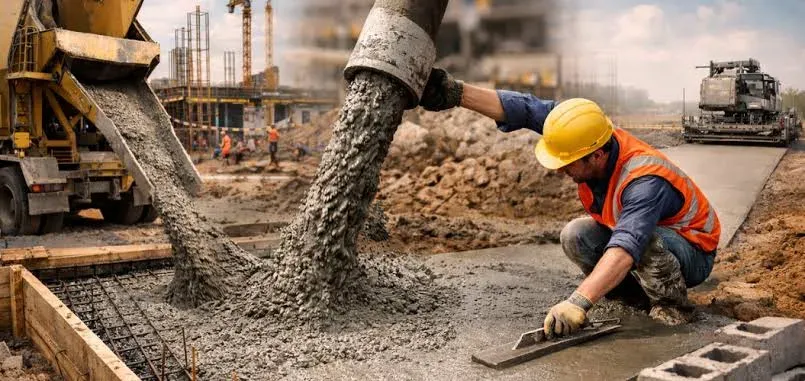
There is no published price for concrete contractor insurance in Kansas, and the reason starts in the ground. Eastern Kansas and the Kansas City metro sit on very-high-shrink-swell clays that swell wet and shrink dry, so the concrete you leave behind has to hold as the soil moves for years — which is exactly the exposure a carrier prices, alongside your crew and your record.
That answer frustrates owners who just want a number, but it is the honest one, and for an install contractor the drivers are specific enough that understanding them beats any fake statewide average. A two-crew flatwork operation and a foundation contractor pouring on expansive clay in the KC metro are the same class only in name, and a carrier prices them from different pictures. Below are the drivers that move the number for a Kansas install operation, and what you can do about each.
Expansive clay and the completed-operations tail that leads Kansas cost
For an install contractor the exposure that defines the class is completed operations — the work you leave behind — and in Kansas the soil puts that exposure front and center. Eastern Kansas and the Kansas City metro sit on very-high-shrink-swell clays that swell when wet and shrink when dry, making expansive-soil movement the state’s defining concrete and foundation risk. A slab, a driveway, or a foundation keeps existing after your crew is gone, and on ground that moves seasonally, installed concrete that cracks, heaves, or settles downstream can become a serious third-party injury or property-damage claim months or years later. The completed-operations side of general liability is the signature line built to answer for it, and because installed concrete on expansive clay carries such a long tail, your revenue and your subgrade-and-finishing record are inputs a carrier weighs closely. This is the install contractor’s defining cost driver — the thing that separates concrete from trades that leave nothing behind.
Real-World Scenario: An Overland Park foundation crew sets footings and basement walls on high-shrink-swell clay across a new subdivision, while a Wichita flatwork crew pours commercial slabs and walks on more stable ground to the west. Both leave finished concrete that has to perform for years, but the underwriter reads them differently — the foundation contractor’s completed-operations tail rides on fewer, higher-stakes pours where soil movement can drive a severe settlement claim, the flatwork crew’s on many smaller placements. Same Kansas, same install class, but the revenue mix and the completed-work picture price differently, and the owner who can describe that clearly gets the sharper quote.
Why there is no published price for Kansas concrete contractor insurance
A premium is the output of an underwriting model, not a sticker. The carrier takes your specific exposures — how many people you employ and what they do, the revenue behind your completed work, your loss history, and the limits your contracts require — and prices each line against them. Change any input and the number moves. Kansas makes a statewide “average” misleading, because the spread between a flatwork crew on stable ground and a foundation contractor on expansive KC-metro clay is wide, and the state’s mix of agricultural and aerospace-industry districts, residential growth, and infrastructure bundles operations a carrier would never price the same way. The rest of this guide is the drivers that actually build your number. You can review the market picture on our Kansas concrete contractor insurance page; the state regulator is the Kansas Insurance Department.
Crew payroll and Kansas’s competitive comp market
Payroll is usually the single biggest driver for an install contractor, because it scales both workers compensation and a large part of general liability. Kansas runs a competitive comp market, so that line is placed with a private carrier and structured to your real crews and payroll classifications rather than assigned by a state fund. And it is not just the dollar figure — it is which work the payroll covers. Pouring, finishing, lifting, and setting and stripping forms carry a different injury profile than supervisory or office work, so a carrier rates each by what it actually does, and coordinates comp with general liability, commercial auto, and property. Because many general contractors and project contracts require comp regardless, reading that decision against how your work is done is part of getting this driver right.
The local licensing patchwork — city, county, and the contract
Kansas does not require a statewide license to work as a general or concrete contractor. Licensing is entirely local, handled by city and county, and only roofing carries a statewide registration — which means a concrete crew’s credential requirements can change from one jurisdiction to the next as you move between Wichita, Topeka, Lawrence, Olathe, and the Kansas City-area municipalities. The practical gate is local permitting and the contract you sign, not a statewide credential. This shapes eligibility and paperwork more than it drives premium directly, but it is a genuine per-jurisdiction input, because the general contractor or project owner layers its own certificate-of-insurance and additional-insured requirements on top of whatever the local jurisdiction requires, and those requirements often set the limits you carry across concrete construction work. For a crew that pours across several counties in a season, that patchwork means carrying the paperwork and certificates each jurisdiction and each general contractor asks for, and keeping the coverage lined up behind them. It adds administrative work rather than a line item to the premium, but a carrier still wants to see that your program can satisfy the contracts you actually sign, wherever in the state the pour lands.
Equipment, forms, and the storage yard
The property line answers for what you own — the forms and formwork, the power trowels, screeds, floats, vibrators, and mixers, plus any shop and the storage yard where it all lives between jobs. On expansive Kansas clay, the compaction and subgrade-prep gear that helps a slab hold is worth scheduling accurately, because it is part of how you keep completed-operations claims down in the first place. This line trails the crew and the completed-work tail in weight, but it is one you fully control: put real replacement values on the schedule instead of a round guess, and you neither over-pay for phantom coverage nor come up short after a loss.
Commercial auto stays a supporting line here
A Kansas install fleet is work trucks and trailers moving crews, forms, and hand tools between jurisdictions — genuine exposure that scales with the size of your rolling stock, but not the engine of the program. Commercial auto earns its place, yet it never dominates an install contractor the way a boom truck drives a pumping operation or a mixer fleet drives ready-mix. That contrast is the whole point of reading these by operating model; our concrete insurance cost pillar lays the three side by side.
Your record, your limits, and the levers you actually hold
Loss history is the driver you have been building for years without a policy in front of you. A clean run widens the field of carriers and sharpens the number; a serious completed-operations or comp loss in recent years does the opposite, and a steady drip of small claims can read worse than one isolated event. Underwriters also weigh the narrative — corrective subgrade and finishing procedures after a claim tell a different story than a repeat pattern — and training documented to OSHA standards lands in that record. Then there is what you elect to carry: contracts that demand higher limits pull you toward an umbrella, and because a foundation that fails on shifting clay can breach a primary limit on its own, those limits are a decision to make on purpose, not a corner to cut.
How to get an accurate Kansas quote
The path to a real number is to describe your real operation. Tell a broker your crew payroll and the work it covers, your revenue and the concrete you leave behind, your storage yard and equipment values, your claims history, the local jurisdictions and contracts you work under, and where in Kansas you build — Wichita, Overland Park, Topeka, Olathe, Lawrence, or the Kansas City metro. From there a carrier with genuine concrete appetite can price it, and you can compare apples to apples instead of chasing a headline rate. When you’re ready, start a quote and tell us how your crews work, or browse the full coverage overview to see how each line fits together. The number at the end will reflect your business, which is the only number worth having.