

There is no published price for concrete contractor insurance in Illinois, and any figure quoted before an underwriter has looked at your crew is a guess. A carrier builds the cost from your specific operation — your payroll and the work it covers, the revenue behind the concrete you leave behind, your record, and the coverage you carry. This guide walks the drivers that decide what an install contractor pays.
That answer frustrates owners who just want a number, but a statewide average is especially misleading in Illinois, where the work runs from a dense high-rise metro to a broad, flat downstate. A Chicago contractor pouring structural concrete on tall projects and a downstate flatwork crew are the same class only in name. Below is what moves the number for an install operation, starting with a question Illinois answers differently than many states.
No statewide license — the local gate
Owners often expect the state to set the credential that governs their work. In Illinois it does not. The state issues no statewide license to work as a general or concrete contractor, and there is no state concrete-contractor license to hold. General-contractor licensing is handled locally, city by city and county by county, while only certain trades are state-regulated. The gate in Illinois is local permitting and the contract, not a statewide license. That matters for your cost because it puts the general contractors and project owners you serve — and their certificate-of-insurance and additional-insured requirements — at the center of what pushes your limits. The state’s insurance market is overseen by the Illinois Department of Insurance. For the full market and permitting picture, see our Illinois concrete contractor insurance page; this guide is the cost companion.
Crew payroll and your workers-comp rating basis
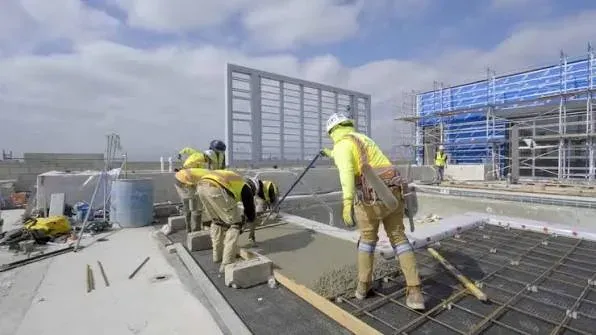
Payroll is usually the single biggest driver for an install contractor, because it scales both your workers compensation and a large part of your general liability. Illinois runs a competitive comp market, so coverage is placed with a private carrier and rated largely off payroll and its class codes. It is not just the dollar figure — it is which work the payroll covers. Pouring, finishing, lifting, and setting and stripping forms carry a different injury profile than supervisory or office work, so a carrier rates each by what the crew actually does. On an Illinois high-rise crew placing structural concrete many stories up, or a downstate crew finishing flatwork in a compressed cold season, that exposure is real — and it is exactly what comp is pricing.
Revenue and the completed-operations tail, from high-rise to prairie
Your revenue is a rating basis for general liability, but for an install contractor the exposure that defines the class is completed operations — the work you leave behind. A slab, a foundation, or a structural pour keeps existing after your crew is gone, and installed concrete that fails downstream can become a serious third-party claim long after the work. Illinois spreads that exposure across an unusually wide range: a Chicago high-rise structural pour carries a completed-operations tail with high stakes and public exposure, while a downstate slab faces hard Midwest freeze-thaw, and the far southern counties carry a real New Madrid and Wabash Valley seismic tail most of the state’s north never considers. The completed-operations side of general liability is the signature line built to answer for all of it, so your revenue and your finishing record are inputs a carrier weighs closely. This is the install contractor’s defining cost driver.
Real-World Scenario: A Chicago contractor places structural concrete on a mid-rise infill project in a dense neighborhood, while a Springfield crew pours flatwork and footings across a downstate commercial site facing hard winter freeze-thaw. Both leave finished concrete that must perform for years, but an underwriter reads them differently — the high-rise work carries a heavier, higher-stakes completed-operations tail, the downstate flatwork a broader one shaped by frost. Same Illinois, same install class — but the work and the revenue mix price differently. The owner who can describe that picture gets a sharper quote.
Property, work trucks, and your claims record
The property line covers what you own and store — the yard, the forms, and the finishing equipment — and scheduling it to real value rather than guessing is where this smaller driver is won. Your work trucks are ordinary vehicles hauling crews, forms, and tools, so commercial auto is a genuine but minor line for the concrete construction model, growing with your rolling stock but never leading it the way a mixer fleet does. Your loss record is a driver you have already been writing: a clean history opens more markets and prices better, a serious general-liability or comp loss in the last several years narrows the field, and documented crew training and finishing quality under OSHA standards show up in the record a carrier prices.
The coverage limits your contracts require
Finally, what you buy is a driver. The limits Chicago-metro general contractors, developers, and public-infrastructure contracts require push you toward an umbrella, and higher limits cost more than lower ones — which matters for a concrete contractor because a single completed-operations failure on a high-rise or foundation can run well above a primary limit. Whether you carry general liability with the products-completed-operations aggregate your revenue actually calls for, whether you schedule your equipment to value, and how your limits are set all feed the number. These are places to buy deliberately, not to under-buy blindly.
What Illinois’s construction economy means for your cost
Illinois hands an install contractor two very different economies. Chicago and its collar counties — Aurora, Joliet, Naperville — drive commercial high-rise, dense industrial and logistics, and heavy public-infrastructure work, while downstate around Rockford and Springfield the picture flattens into commercial, residential, and agricultural-adjacent building. That divide shapes both your contracts and your exposure more than any statewide figure could.
In the Chicago market, developers, public-works owners, and general contractors on tight urban sites set demanding certificate-of-insurance and additional-insured requirements and require higher limits than a downstate private job does, because a high-rise structural pour carries public stakes and a long completed-operations tail. The more your revenue rides on that metro work, the more your general-liability and umbrella limits — and the number a carrier builds — reflect it. Downstate contracts tend to run at more modest limits, though the freeze-thaw exposure on the concrete you leave behind is just as real.
That geography also feeds the completed-operations tail directly. A high-rise pour in Chicago answers to a different failure profile than a downstate slab heaving under hard Midwest freeze-thaw, and the far southern counties add a genuine New Madrid and Wabash Valley seismic tail that most of the state never weighs. A carrier reading your revenue wants to know which of those exposures dominates your book, because each behaves differently over the years the concrete stays in place.
This two-economy divide does not reshape the cost drivers; it reshuffles how much each one counts. A Chicago high-rise specialist leans hardest on the completed-operations and limits drivers, while a downstate flatwork contractor leans on payroll and the frost-driven tail. That is why two Illinois install contractors of similar size can price very differently, and why an honest quote begins with the work you actually run, not a statewide figure.
Winter also compresses the Illinois calendar into a hard push through the warm months, with thaw-season road postings narrowing the working window further. Operations that keep their placing and finishing crews sharp under that time pressure are the ones that hold down injuries and installed-work failures alike — and that discipline, more than the market you pour in, is what ultimately reaches the price.
How to get an accurate Illinois quote
The path to a real number is to describe your real operation. Tell a broker your crew payroll and the work it covers, your revenue and the kind of concrete you leave behind, your equipment values, your claims history, the limits your contracts require, and where in Illinois you work. From there a carrier with genuine concrete appetite can price it. When you are ready, start a quote and tell us how your crews work, browse the full coverage overview to see how each line fits together, or read the national concrete insurance cost pillar for the cross-state view. The number at the end will reflect your business, which is the only number worth having.