

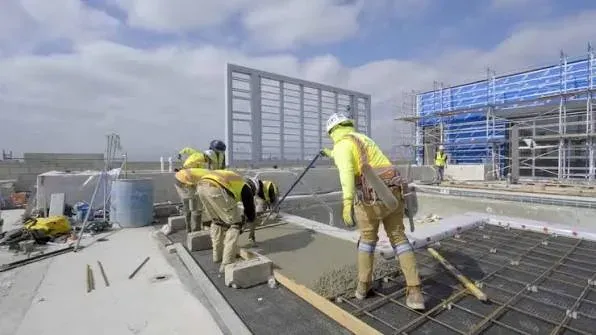
Ask what concrete contractor insurance costs in Arkansas and the honest answer is that no fixed figure exists — a carrier assembles it from your own crews, your revenue, and the record you have built, not from a chart. The pieces that move it most are the payroll on your install crews and the tail of exposure your finished pours leave behind. Here is how each one works.
Arkansas concrete runs unevenly across the map. The corporate-fueled expansion of the northwest — Bentonville, Fayetteville, Springdale, and Rogers — pulls a heavy stream of foundation and commercial pours, while Little Rock, Fort Smith, and Jonesboro carry a steadier residential and light-commercial base. Because those operations look nothing alike to an underwriter, a single statewide figure blends away everything that would actually shape your quote.
Why a posted Arkansas price would mislead you
A premium is the output of an underwriting model, not a shelf price. The carrier feeds in how many people you employ and what they do on the pour, the revenue behind your completed work, your losses, and the limits your contracts force — then prices each line to that picture. Move any input and the number moves with it. For an install contractor two inputs dominate: the crew, and the concrete it leaves in the ground.
The Contractors Licensing Board sits beneath your contracts
Arkansas licenses its contractors, and the tier you hold shapes the jobs you can sign for. The Arkansas Contractors Licensing Board issues a commercial license for larger projects and a separate residential license above a lower dollar threshold, so the credential that applies to you tracks the scale and type of your concrete work. The license is not a charge on your policy, but it feeds the policy indirectly: the general contractor or owner on a job attaches its own certificate-of-insurance and additional-insured demands to that credential, and those required limits are exactly what a carrier reads when it builds your program. We start by confirming which credential your work actually needs. The market and regulatory backdrop lives on our Arkansas concrete contractor insurance page; treat this as the cost half of that pair.
Payroll: one number, two of your largest lines
For most install contractors payroll is the heaviest single input, because a carrier reads it into both your workers compensation and a large slice of your general liability. And it is not the raw total that matters so much as what the hours are spent doing — the crew placing, screeding, and finishing a slab, or setting and stripping forms, carries a heavier injury profile than anyone in the office or running the job from a truck, and each classification is rated on its own terms. Arkansas keeps a competitive comp market, so that coverage goes to a private carrier, and getting the class split right on your payroll is where you either earn or lose this driver.
Completed operations: the exposure Arkansas ground stretches out
Revenue feeds your general-liability rating, but the piece that truly marks the install class is completed operations — everything your crew leaves in place. A finished driveway approach, a sidewalk, a slab, or a foundation goes on carrying load for years after the trucks pull off, and concrete that later moves, cracks, or fails can surface as a third-party claim long past the pour date. Two features of Arkansas ground lengthen that tail: shrink-swell Porters Creek clays that lift and drop with moisture, and the New Madrid Seismic Zone across the northeast, where movement and liquefaction become real design questions. The completed-operations reach of your general liability is the line built to respond, and because that reach runs long, your revenue and your finishing quality are things a carrier studies before it prices. Of every driver here, this is the one that sets concrete apart from trades that walk away leaving nothing behind.
Real-World Scenario: A Rogers outfit runs foundation and slab pours through a busy northwest-corridor season, while a smaller crew near Jonesboro places flatwork on ground that sits inside the New Madrid zone. Both leave concrete that has to hold for years, yet an underwriter weighs them apart — the Rogers work concentrates a larger completed-operations tail in fewer, higher-value pours; the Jonesboro work sits on ground where a seismic event is a genuine design factor. One state, one class code, two different pricing conversations — and the owner who can lay that picture out earns the sharper quote.
Forms, tools, and the storage yard
Your property coverage answers for the things you own and park — the storage yard, the forms, and the trowels, screeds, floats, and small mixers that ride to every job. For an install contractor it usually trails the crew and the completed-work exposure in weight, but it is not nothing, and it is the driver you steer most directly by insuring your gear at what it would actually cost to replace rather than a rough guess. Shorting the equipment that moves your crews to a finished pour saves little and risks a lot; scheduling it honestly is the whole game here.
Work trucks — the light line in this model
The trucks and trailers an install crew runs are ordinary — they haul people, forms, and tools to the site and home again. That makes commercial auto a real but secondary line, scaling with the size of your fleet without ever leading the way it would for a mixer operation or a boom-pump rig. The trade is one thing; how the concrete reaches the forms splits it into very different cost stories.
What a carrier hears in your loss history
Your record is a driver you have already been writing, pour after pour. A clean run widens the field of carriers and sharpens the price; a serious general-liability, completed-operations, or comp loss inside the last few years shrinks that field and lifts the number, and a string of small claims can weigh as heavily as one big one. Underwriters also read the arc — a single incident followed by tightened safety and finishing practices tells a different story than the same loss happening twice. The lever you actually hold is discipline on the ground: crew training, fall and lifting protection, and finishing standards kept to OSHA rules all end up in the file a carrier prices from.
The limits you choose on purpose
The last driver is the coverage itself. When a general contractor or owner demands limits above your primary layer, an umbrella fills the gap, and higher limits cost more than lower ones — which matters because one completed-operations failure on a foundation can climb well past a primary policy. Whether your general liability carries the products-completed-operations aggregate your revenue really calls for, whether your equipment is scheduled to value, and where your limits are set all feed back into the price. None of that is a place to quietly buy short; it is a place to buy on purpose, which is the whole difference between a cheap concrete construction policy and the right one.
Getting to a real Arkansas number
An accurate figure starts with an accurate picture of your operation. Walk a broker through your crew payroll and its class split, your revenue and the kind of concrete you leave behind, the value of your storage yard and gear, your loss history, the limits your jobs demand, and the parts of Arkansas you work — northwest corridor, central metros, or the seismic northeast. A carrier with real concrete appetite prices from there, and you compare true like-for-like instead of a headline. When you are set, open a quote and describe how your crews run, or read the full coverage overview to see the lines together. You can check the regulator yourself at the Arkansas Insurance Department, and for how these drivers play nationally, see the concrete insurance cost pillar. The figure you end with will describe your business — the only figure worth signing.